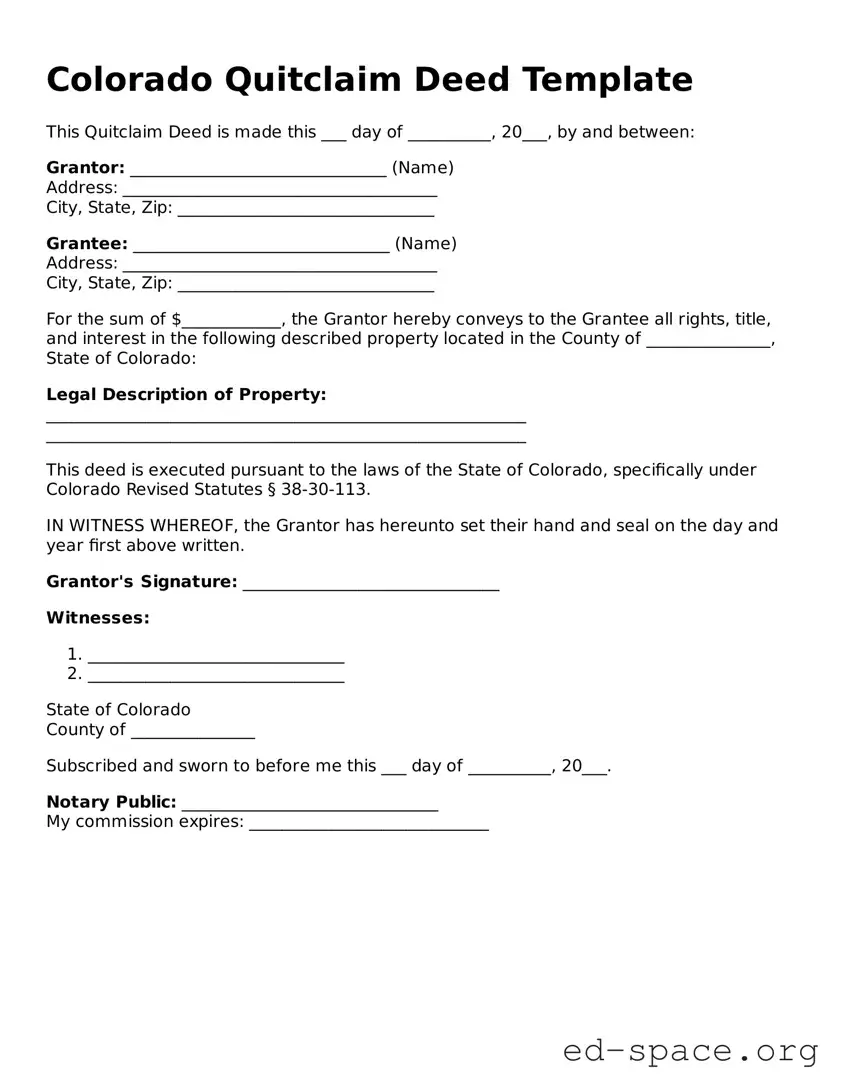
The Colorado Quitclaim Deed form serves as a vital tool in real estate transactions, allowing property owners to transfer their interest in a property to another party without making any guarantees about the title's validity. This form is particularly useful when the transfer occurs between family members or in situations where the seller cannot provide a warranty deed. By using a quitclaim deed, the granter relinquishes any claim to the property, effectively passing on whatever rights they may have, whether those rights are clear or clouded. The document must include specific details, such as the names of the granter and grantee, a description of the property, and the date of the transfer. Additionally, it requires the granter’s signature and may need to be notarized to ensure its legal standing. Understanding how to properly complete and file this form can simplify property transfers and help avoid potential disputes in the future.
Colorado Quitclaim Deed Template
This Quitclaim Deed is made this ___ day of __________, 20___, by and between:
Grantor: _______________________________ (Name)
Address: ______________________________________
City, State, Zip: _______________________________
Grantee: _______________________________ (Name)
Address: ______________________________________
City, State, Zip: _______________________________
For the sum of $____________, the Grantor hereby conveys to the Grantee all rights, title, and interest in the following described property located in the County of _______________, State of Colorado:
Legal Description of Property:
__________________________________________________________
__________________________________________________________
This deed is executed pursuant to the laws of the State of Colorado, specifically under Colorado Revised Statutes § 38-30-113.
IN WITNESS WHEREOF, the Grantor has hereunto set their hand and seal on the day and year first above written.
Grantor's Signature: _______________________________
Witnesses:
State of Colorado
County of _______________
Subscribed and sworn to before me this ___ day of __________, 20___.
Notary Public: _______________________________
My commission expires: _____________________________
| Fact Name | Description |
|---|---|
| Definition | A Colorado Quitclaim Deed is a legal document that transfers ownership of real property from one party to another without any warranties. |
| Governing Law | The Colorado Quitclaim Deed is governed by Colorado Revised Statutes, Title 38, Article 30. |
| Use Case | This form is commonly used in situations where the grantor wishes to transfer property to a family member or in divorce settlements. |
| No Guarantees | Unlike warranty deeds, a quitclaim deed does not guarantee that the grantor has clear title to the property. |
| Execution Requirements | The deed must be signed by the grantor in the presence of a notary public for it to be valid. |
| Recording | To provide public notice of the property transfer, the quitclaim deed should be recorded with the county clerk and recorder. |
| Consideration | While consideration is typically stated in the deed, it can be as simple as "for love and affection" in family transfers. |
| Revocation | A quitclaim deed is irrevocable once executed and recorded, meaning the transfer cannot be undone without mutual consent. |
| Impact on Taxes | Transferring property via a quitclaim deed may have tax implications, including potential reassessment of property taxes. |
Once you have the Colorado Quitclaim Deed form in hand, you can begin filling it out. This form is essential for transferring property ownership, and taking your time to complete it accurately will help ensure a smooth process.
Once you have filled out the form and submitted it, the transfer of property ownership will be officially recorded. This is an important step in ensuring that all legal documentation is in order for future reference.
What is a Quitclaim Deed in Colorado?
A Quitclaim Deed is a legal document used to transfer ownership of real estate in Colorado. Unlike other types of deeds, a Quitclaim Deed does not guarantee that the grantor (the person transferring the property) holds clear title to the property. Instead, it simply conveys whatever interest the grantor may have in the property, if any. This type of deed is often used among family members or in situations where the parties know each other well.
How do I complete a Quitclaim Deed form in Colorado?
To complete a Quitclaim Deed form, you will need to include specific information such as the names of the grantor and grantee, the legal description of the property, and the date of the transfer. It's essential to ensure that the form is signed in front of a notary public to make it legally binding. After completing the form, it must be filed with the appropriate county clerk and recorder's office to be effective.
Are there any fees associated with filing a Quitclaim Deed in Colorado?
Yes, there are fees for filing a Quitclaim Deed in Colorado. The amount varies by county, so it's advisable to check with your local county clerk and recorder's office for the specific fee schedule. Additionally, there may be costs associated with obtaining a notary signature or any necessary copies of the deed.
Can a Quitclaim Deed be revoked in Colorado?
Once a Quitclaim Deed is executed and recorded, it cannot be revoked unilaterally. The transfer of ownership is considered final. However, if both parties agree, they can execute another deed to reverse the transaction. This would typically involve creating a new Quitclaim Deed to transfer the property back to the original grantor.
What are the potential risks of using a Quitclaim Deed?
Using a Quitclaim Deed carries certain risks. Since it does not provide any guarantees about the title, the grantee may inherit unresolved issues, such as liens or claims against the property. It’s crucial for the grantee to conduct thorough due diligence, including a title search, to understand any potential problems before accepting the property.
Is a Quitclaim Deed suitable for all property transfers?
A Quitclaim Deed is not always the best choice for every property transfer. It is often used in informal transactions, such as transferring property between family members or in divorce settlements. For more complex transactions, such as sales involving third parties or financing, a Warranty Deed may be more appropriate, as it provides greater protection for the buyer.
Incorrect Grantee Information: People often forget to provide the full legal name of the grantee. This can lead to confusion and potential legal issues in the future.
Missing Signatures: One of the most common mistakes is failing to sign the deed. Without the necessary signatures, the document is not legally binding.
Improper Notarization: Many individuals overlook the requirement for notarization. A quitclaim deed must be notarized to be valid, so this step should never be skipped.
Incorrect Property Description: A precise description of the property is crucial. Vague or inaccurate descriptions can lead to disputes or invalidation of the deed.
Failure to Include a Legal Address: Omitting the legal address of the property can cause issues. It’s essential to provide complete and accurate information.
Not Checking for Liens: Some people neglect to check for existing liens on the property before transferring ownership. This oversight can result in unexpected financial burdens.
Ignoring Local Laws: Each state has specific requirements for quitclaim deeds. Ignoring Colorado's particular rules can lead to complications.
Not Filing the Deed: After completing the deed, some forget to file it with the appropriate county clerk’s office. This step is crucial for the deed to be recognized legally.
Using the Wrong Form: Utilizing an outdated or incorrect version of the quitclaim deed form can lead to issues. Always ensure you have the latest version.
Not Understanding the Implications: Many individuals do not fully grasp the implications of a quitclaim deed. It’s important to understand that this type of deed does not guarantee clear title.
When transferring property ownership in Colorado, the Quitclaim Deed is a popular choice. However, several other forms and documents often accompany it to ensure a smooth and legally sound transaction. Understanding these documents can help you navigate the process more effectively.
Each of these documents plays a crucial role in the property transfer process in Colorado. Being aware of them can help ensure that all legal requirements are met and that the transaction proceeds smoothly. Always consider consulting with a legal professional to assist you in navigating these forms effectively.
A Quitclaim Deed is a unique legal document, but it shares similarities with several other documents used in property transactions. Here are five documents that are similar to a Quitclaim Deed:
When filling out the Colorado Quitclaim Deed form, it is essential to approach the process with care. This document transfers ownership of property from one party to another, and any mistakes can lead to complications. Here is a list of things you should and shouldn't do to ensure the process goes smoothly.
Taking these steps seriously can help prevent potential issues and ensure a smooth transfer of property ownership. Always consider consulting with a legal professional if you have any doubts or questions about the process.
Understanding the Colorado Quitclaim Deed form is essential for anyone involved in property transfers. However, several misconceptions can lead to confusion. Below is a list of ten common misconceptions along with explanations to clarify them.
By addressing these misconceptions, individuals can navigate property transfers more confidently and effectively.
When filling out and using the Colorado Quitclaim Deed form, keep the following key takeaways in mind: