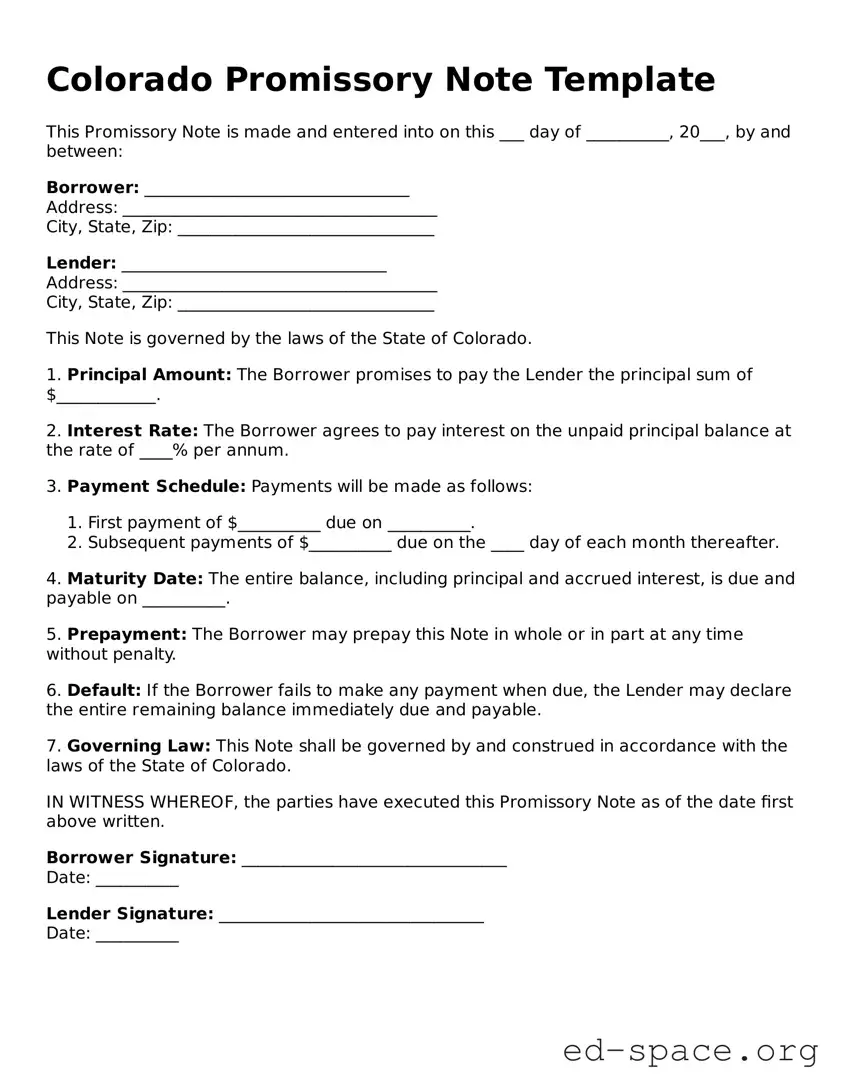
The Colorado Promissory Note form serves as a crucial financial instrument that outlines the terms of a loan agreement between a borrower and a lender. This document specifies the amount borrowed, the interest rate, and the repayment schedule, providing clarity and protection for both parties involved. Key elements such as due dates, late fees, and any collateral securing the loan are also detailed within the form. In Colorado, this note is recognized as a legally binding contract, ensuring that the lender has recourse in the event of default. Additionally, the form may include provisions for prepayment and acceleration clauses, which can further define the obligations of the borrower. Understanding these aspects is essential for anyone looking to engage in a lending arrangement in Colorado, as they help to establish trust and accountability in financial transactions.
Colorado Promissory Note Template
This Promissory Note is made and entered into on this ___ day of __________, 20___, by and between:
Borrower: ________________________________
Address: ______________________________________
City, State, Zip: _______________________________
Lender: ________________________________
Address: ______________________________________
City, State, Zip: _______________________________
This Note is governed by the laws of the State of Colorado.
1. Principal Amount: The Borrower promises to pay the Lender the principal sum of $____________.
2. Interest Rate: The Borrower agrees to pay interest on the unpaid principal balance at the rate of ____% per annum.
3. Payment Schedule: Payments will be made as follows:
4. Maturity Date: The entire balance, including principal and accrued interest, is due and payable on __________.
5. Prepayment: The Borrower may prepay this Note in whole or in part at any time without penalty.
6. Default: If the Borrower fails to make any payment when due, the Lender may declare the entire remaining balance immediately due and payable.
7. Governing Law: This Note shall be governed by and construed in accordance with the laws of the State of Colorado.
IN WITNESS WHEREOF, the parties have executed this Promissory Note as of the date first above written.
Borrower Signature: ________________________________
Date: __________
Lender Signature: ________________________________
Date: __________
| Fact Name | Details |
|---|---|
| Definition | A Colorado Promissory Note is a written promise to pay a specified amount to a designated party at a defined time. |
| Governing Law | The Colorado Promissory Note is governed by Colorado Revised Statutes, Title 4, Article 3. |
| Parties Involved | The note involves a borrower (maker) and a lender (payee). |
| Interest Rate | Interest rates can be fixed or variable, as agreed upon by the parties. |
| Payment Terms | Terms of payment can include a lump sum or installments, depending on the agreement. |
| Default Conditions | The note should outline what constitutes a default and the remedies available to the lender. |
| Signatures Required | Both parties must sign the note for it to be legally binding. |
| Notarization | Notarization is not required but can enhance the document's validity. |
| Transferability | The note can be transferred to another party unless otherwise stated in the agreement. |
| State-Specific Considerations | Colorado law may impose specific requirements for enforceability, such as clear terms and proper execution. |
Once you have the Colorado Promissory Note form in hand, you can begin filling it out. This document will require specific information about the borrower, lender, and the terms of the loan. Make sure to have all necessary details ready to ensure a smooth process.
After completing the form, review it carefully for any errors. It’s important that all information is accurate and complete before moving forward with the next steps.
What is a Colorado Promissory Note?
A Colorado Promissory Note is a legal document in which one party (the borrower) promises to pay a specific amount of money to another party (the lender) under agreed-upon terms. This document outlines the loan amount, interest rate, repayment schedule, and any penalties for late payments. It serves as a written record of the debt and the obligations of both parties involved.
What are the essential elements of a Colorado Promissory Note?
Essential elements include the names and addresses of both the borrower and lender, the principal amount of the loan, the interest rate, the repayment schedule, and any collateral securing the loan. Additionally, the document should specify the consequences of default and any other terms that both parties have agreed upon. Clear and concise language helps ensure that both parties understand their rights and obligations.
Is a Colorado Promissory Note legally binding?
Yes, a properly executed Colorado Promissory Note is legally binding. Once signed by both parties, it creates an enforceable agreement. If the borrower fails to make payments as outlined in the note, the lender can take legal action to recover the owed amount. It is advisable for both parties to retain a copy of the signed document for their records.
Do I need to have the Promissory Note notarized?
While notarization is not required for a Colorado Promissory Note to be valid, it is highly recommended. Notarizing the document adds an extra layer of protection and can help prevent disputes about the authenticity of the signatures. A notary public verifies the identities of the signers, which can be beneficial if legal issues arise in the future.
Can I modify a Colorado Promissory Note after it has been signed?
Yes, modifications to a Colorado Promissory Note can be made, but they must be documented in writing and signed by both parties. This ensures that any changes to the terms, such as the interest rate or repayment schedule, are clear and agreed upon. Verbal modifications are generally not enforceable, so it is crucial to keep all changes documented.
What happens if the borrower defaults on the Promissory Note?
If the borrower defaults, the lender has several options. These may include demanding immediate payment of the remaining balance, charging late fees, or initiating legal proceedings to recover the owed amount. The specific actions the lender can take depend on the terms outlined in the Promissory Note. It is important for both parties to understand the consequences of default before entering into the agreement.
Failing to include the date on the form. Without a date, the note may lack clarity regarding when the agreement was made.
Not specifying the borrower and lender names correctly. Full legal names should be used to avoid any confusion in the future.
Leaving out the loan amount. Clearly stating the amount borrowed is crucial to ensure both parties understand the financial obligation.
Omitting the interest rate. This detail is vital as it determines how much the borrower will repay over time.
Not including the payment schedule. A detailed repayment plan helps to prevent misunderstandings about when payments are due.
Failing to outline consequences for default. It’s important to specify what happens if the borrower does not make payments as agreed.
Not signing the document. Both parties must sign the promissory note for it to be legally binding.
Neglecting to have the document witnessed or notarized, if required. This step can add an extra layer of validity to the agreement.
Using vague or unclear language. It’s essential to be precise to avoid any potential disputes in the future.
When entering into a loan agreement in Colorado, the Promissory Note is a key document. However, several other forms and documents often accompany it to ensure clarity and legal compliance. Below is a list of common documents that may be used alongside the Colorado Promissory Note.
Each of these documents plays a crucial role in the lending process. They help protect the rights of both parties and ensure that all aspects of the loan are clearly defined and understood. Proper documentation can prevent disputes and facilitate smoother transactions.
When filling out the Colorado Promissory Note form, it is essential to approach the task with care and attention to detail. This ensures that the document is legally binding and accurately reflects the agreement between the parties involved. Here are some important dos and don’ts to consider:
Understanding the Colorado Promissory Note form is essential for both lenders and borrowers. However, several misconceptions can lead to confusion. Below is a list of common misconceptions along with clarifications.
This is incorrect. A promissory note is a legally binding document that outlines the terms of a loan. It serves as evidence of the borrower's obligation to repay the loan under specified conditions.
Not all promissory notes require notarization. While notarization can add an extra layer of authenticity, it is not a legal requirement for the note to be enforceable in Colorado.
This is misleading. A valid promissory note must clearly state the repayment terms, including the amount, interest rate, and payment schedule. Ambiguity can lead to disputes.
This is false. Individuals can also issue promissory notes. Anyone who lends money can create a promissory note to document the loan agreement.
While both documents relate to loans, they serve different purposes. A promissory note is a promise to pay, whereas a loan agreement outlines the terms and conditions of the loan in greater detail.
This is incorrect. Any changes to the terms of a promissory note require the agreement of both the borrower and the lender. Unilateral changes are not permitted.
When filling out and using the Colorado Promissory Note form, consider the following key takeaways: