In the picturesque state of Colorado, couples preparing for marriage often consider the benefits of a prenuptial agreement, a proactive measure designed to address financial matters before tying the knot. This legal document serves as a framework for understanding each partner's rights and responsibilities regarding assets, debts, and potential spousal support in the event of a divorce or separation. By outlining these critical aspects, a prenuptial agreement can foster transparency and communication between partners, helping to prevent misunderstandings down the road. The Colorado Prenuptial Agreement form typically includes essential elements such as the identification of separate and marital property, provisions for the division of assets, and any stipulations regarding alimony. Additionally, it is important for both parties to fully disclose their financial situations to ensure that the agreement is fair and enforceable. As couples navigate the complexities of love and partnership, understanding the intricacies of this form can provide peace of mind and set a solid foundation for their future together.
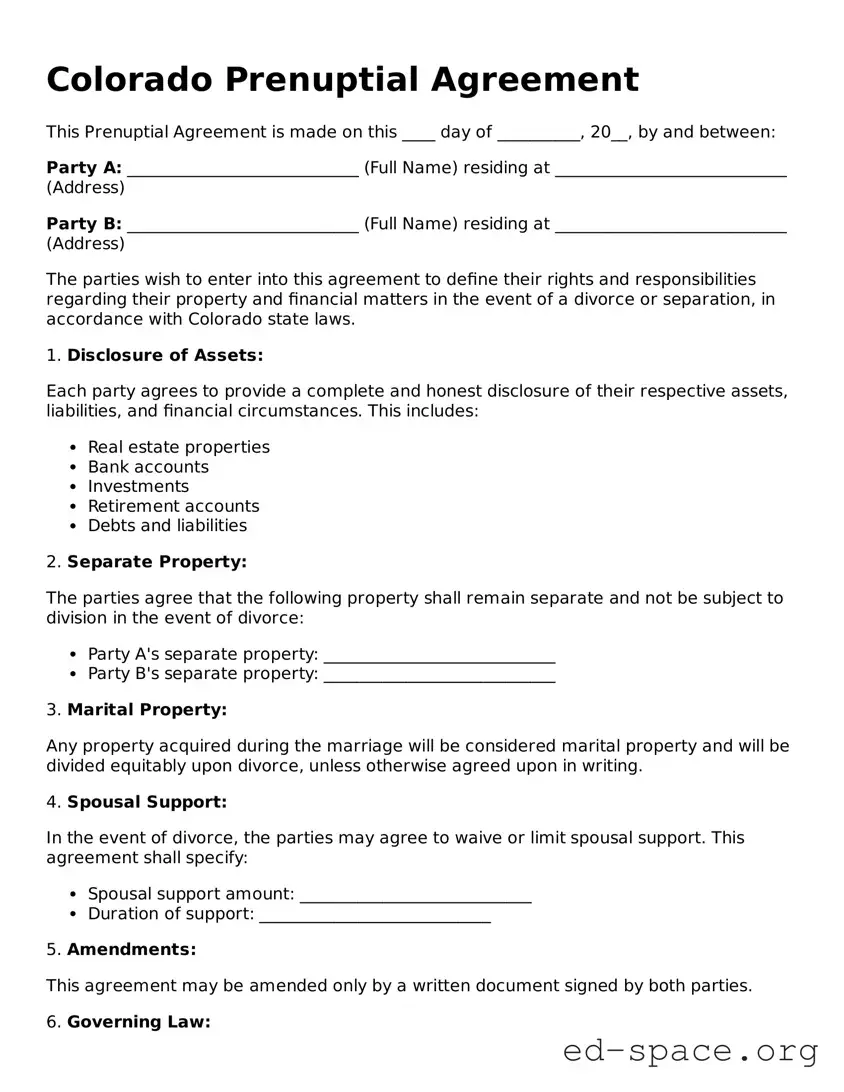
Colorado Prenuptial Agreement
This Prenuptial Agreement is made on this ____ day of __________, 20__, by and between:
Party A: ____________________________ (Full Name) residing at ____________________________ (Address)
Party B: ____________________________ (Full Name) residing at ____________________________ (Address)
The parties wish to enter into this agreement to define their rights and responsibilities regarding their property and financial matters in the event of a divorce or separation, in accordance with Colorado state laws.
1. Disclosure of Assets:
Each party agrees to provide a complete and honest disclosure of their respective assets, liabilities, and financial circumstances. This includes:
2. Separate Property:
The parties agree that the following property shall remain separate and not be subject to division in the event of divorce:
3. Marital Property:
Any property acquired during the marriage will be considered marital property and will be divided equitably upon divorce, unless otherwise agreed upon in writing.
4. Spousal Support:
In the event of divorce, the parties may agree to waive or limit spousal support. This agreement shall specify:
5. Amendments:
This agreement may be amended only by a written document signed by both parties.
6. Governing Law:
This agreement shall be governed by the laws of the State of Colorado.
IN WITNESS WHEREOF, the parties have executed this Prenuptial Agreement as of the date first above written.
______________________________
Party A Signature
______________________________
Party B Signature
______________________________
Witness Signature
______________________________
Date
| Fact Name | Details |
|---|---|
| Definition | A prenuptial agreement in Colorado is a legal contract between two individuals before marriage that outlines the division of assets and responsibilities in the event of divorce or separation. |
| Governing Laws | Colorado's prenuptial agreements are governed by the Uniform Premarital Agreement Act (UPAA), specifically under Colorado Revised Statutes § 14-2-301 to § 14-2-308. |
| Enforceability | For a prenuptial agreement to be enforceable in Colorado, it must be in writing and signed by both parties. Full disclosure of assets is also important. |
| Modification | Both parties can modify a prenuptial agreement after marriage, but any changes must be made in writing and signed by both parties to be valid. |
| Legal Representation | While not required, it is highly recommended that both parties seek independent legal counsel before signing a prenuptial agreement to ensure fairness and understanding. |
| Common Misconceptions | Many people believe prenuptial agreements are only for the wealthy. However, they can benefit anyone looking to clarify financial rights and responsibilities. |
Filling out the Colorado Prenuptial Agreement form is an important step for couples looking to clarify their financial arrangements before marriage. Once completed, this document can provide peace of mind and set clear expectations for both parties involved.
What is a prenuptial agreement in Colorado?
A prenuptial agreement, often referred to as a "prenup," is a legal document that couples create before marriage. It outlines how assets and debts will be divided in the event of divorce or separation. In Colorado, these agreements can also address other matters, such as spousal support and financial responsibilities during the marriage.
Why should I consider a prenuptial agreement?
Many couples choose to create a prenup to protect their individual assets, clarify financial responsibilities, and reduce conflict in the event of a divorce. A prenup can provide peace of mind, especially for those with significant assets, business interests, or children from previous relationships.
What are the requirements for a valid prenuptial agreement in Colorado?
For a prenuptial agreement to be valid in Colorado, it must be in writing and signed by both parties. Additionally, both individuals should fully disclose their assets and debts. It’s also crucial that both parties enter into the agreement voluntarily and without coercion.
Can I modify or revoke a prenuptial agreement after marriage?
Yes, a prenuptial agreement can be modified or revoked after marriage. Both parties must agree to any changes, and it’s advisable to document these modifications in writing. This ensures clarity and protects both parties' interests.
What happens if one spouse does not adhere to the prenup?
If one spouse fails to adhere to the terms of the prenuptial agreement, the other spouse can seek enforcement through the court. Courts generally uphold prenups as long as they are deemed fair and were entered into voluntarily. However, if the agreement is found to be unconscionable or if one party did not fully disclose their financial situation, it may be challenged.
Are there any issues that cannot be included in a prenuptial agreement?
Yes, certain issues cannot be included in a prenuptial agreement. For example, agreements regarding child custody and child support are typically not enforceable in a prenup. These matters are decided based on the best interests of the child at the time of divorce.
How can I ensure my prenuptial agreement is enforceable?
To ensure your prenuptial agreement is enforceable, consider working with an experienced attorney. They can help draft the agreement in compliance with Colorado laws and ensure that both parties fully understand its implications. Additionally, both parties should have independent legal representation to avoid claims of coercion or unfairness.
When should we start discussing a prenuptial agreement?
It’s best to start discussing a prenuptial agreement well before the wedding. Having these conversations early allows both partners to express their concerns and desires openly, leading to a more amicable agreement. Waiting until the last minute can create tension and may even lead to rushed decisions.
Can a prenuptial agreement protect my business?
Yes, a prenuptial agreement can protect your business. By clearly outlining ownership and management rights in the event of a divorce, you can safeguard your business interests. It’s essential to detail how any increase in value or income generated during the marriage will be handled.
What is the cost of creating a prenuptial agreement in Colorado?
The cost of creating a prenuptial agreement can vary widely based on factors such as the complexity of your financial situation and the attorney's fees. Generally, couples can expect to pay anywhere from a few hundred to a few thousand dollars. Investing in a well-drafted prenup can save you significant legal costs and emotional stress in the future.
Insufficient Disclosure of Assets: One common mistake is failing to fully disclose all assets and liabilities. Each party should provide a complete list of their financial situation. Omitting information can lead to disputes later.
Not Seeking Legal Advice: Many individuals attempt to fill out the form without consulting a lawyer. This can result in misunderstandings about rights and obligations. Legal guidance is crucial for ensuring that the agreement is valid and enforceable.
Using Ambiguous Language: Clarity is essential in a prenuptial agreement. Vague terms can lead to different interpretations. It is important to use precise language to avoid confusion in the future.
Failing to Update the Agreement: Life circumstances can change, such as the birth of children or significant changes in income. Not revisiting and updating the agreement can leave parties unprotected.
Not Considering Future Changes: Some individuals may overlook potential future financial situations, such as career changes or inheritance. Anticipating these changes can help in crafting a more comprehensive agreement.
When preparing for a marriage, many couples consider a prenuptial agreement to outline their financial rights and responsibilities. Alongside this important document, several other forms and documents may be necessary to ensure a comprehensive understanding of both parties' intentions and obligations. Here’s a list of some commonly used documents that often accompany a Colorado Prenuptial Agreement.
By considering these documents in conjunction with a prenuptial agreement, couples can create a solid foundation for their marriage. Open communication and legal clarity can help both parties navigate their financial future together.
A Prenuptial Agreement, often referred to as a prenup, is a legal document that outlines the division of assets and responsibilities in the event of a divorce. It has similarities to several other legal documents. Here are four documents that share characteristics with a Prenuptial Agreement:
When considering a prenuptial agreement in Colorado, it's essential to approach the process thoughtfully. Below are six key actions to take and avoid when filling out the necessary form.
By adhering to these guidelines, you can create a prenuptial agreement that meets both partners' needs and establishes a solid foundation for your future together.
When considering a prenuptial agreement in Colorado, many people hold misconceptions that can lead to confusion or even conflict. Understanding these misconceptions can help individuals make informed decisions. Below is a list of common misunderstandings regarding the Colorado Prenuptial Agreement form.
By addressing these misconceptions, individuals can approach the topic of prenuptial agreements with a clearer perspective and greater confidence in their decisions.
When considering a prenuptial agreement in Colorado, it's essential to understand the following key points: