When parents or guardians find themselves in situations where they cannot be present to care for their child, the Colorado Power of Attorney for a Child form becomes an invaluable tool. This legal document allows a parent or guardian to designate another individual—often a relative or trusted friend—to make decisions on behalf of the child during their absence. The form covers essential areas such as medical care, education, and general welfare, ensuring that the designated agent has the authority to act in the child's best interests. It is important for parents to understand the specific powers granted, the duration of the authority, and the process for revocation. By utilizing this form, parents can maintain peace of mind, knowing that their child's needs will be met even when they are not physically available to provide care. Furthermore, understanding the nuances of this document can help prevent potential misunderstandings or conflicts regarding parental rights and responsibilities.
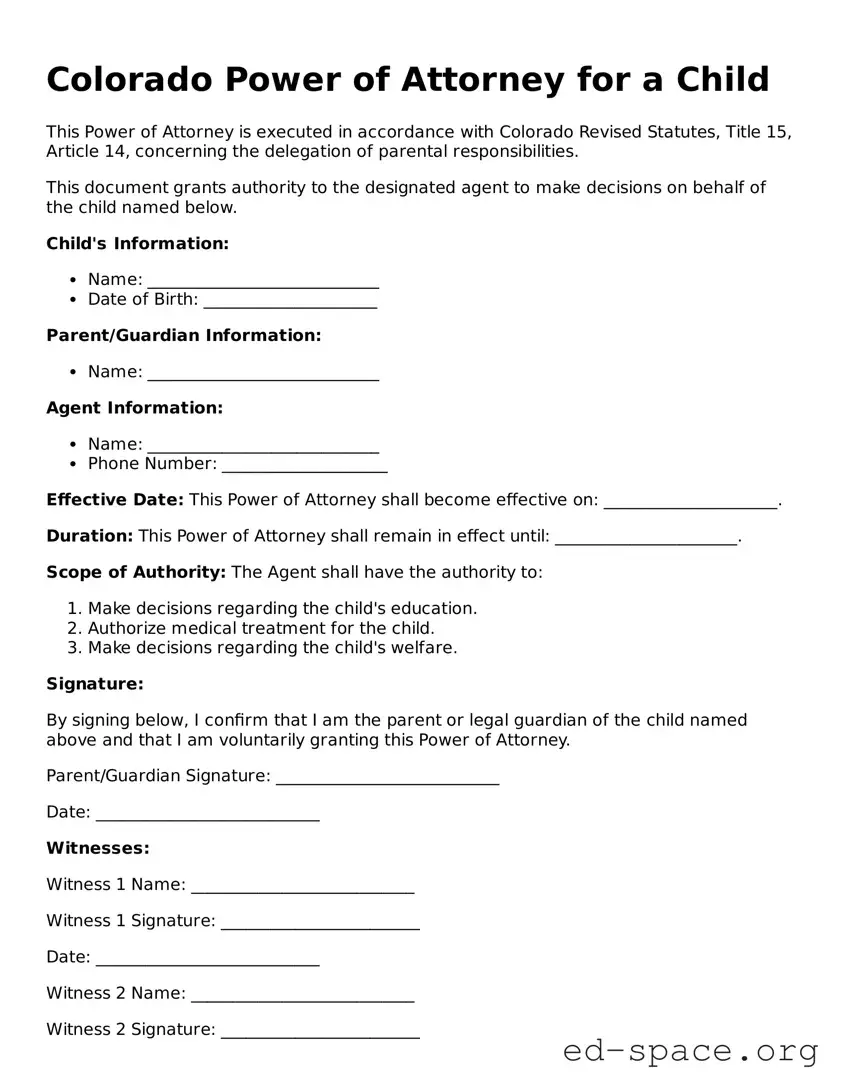
Colorado Power of Attorney for a Child
This Power of Attorney is executed in accordance with Colorado Revised Statutes, Title 15, Article 14, concerning the delegation of parental responsibilities.
This document grants authority to the designated agent to make decisions on behalf of the child named below.
Child's Information:
Parent/Guardian Information:
Agent Information:
Effective Date: This Power of Attorney shall become effective on: _____________________.
Duration: This Power of Attorney shall remain in effect until: ______________________.
Scope of Authority: The Agent shall have the authority to:
Signature:
By signing below, I confirm that I am the parent or legal guardian of the child named above and that I am voluntarily granting this Power of Attorney.
Parent/Guardian Signature: ___________________________
Date: ___________________________
Witnesses:
Witness 1 Name: ___________________________
Witness 1 Signature: ________________________
Date: ___________________________
Witness 2 Name: ___________________________
Witness 2 Signature: ________________________
Date: ___________________________
| Fact Name | Description |
|---|---|
| Definition | A Colorado Power of Attorney for a Child form allows a parent or guardian to designate another adult to make decisions on behalf of their child. |
| Governing Law | This form is governed by Colorado Revised Statutes, Title 15, Article 14. |
| Purpose | It is primarily used for temporary guardianship, often for travel or emergencies. |
| Duration | The authority granted can be limited to a specific time frame or event. |
| Notarization | Notarization is recommended but not always required for the form to be valid. |
| Revocation | The parent or guardian can revoke the Power of Attorney at any time, as long as they provide proper notice. |
| Eligibility | Any adult can be designated as an agent, but they should be trustworthy and capable of making decisions for the child. |
| Limitations | The agent cannot make decisions regarding the child's medical care unless specifically authorized. |
| Signature Requirements | The form must be signed by the parent or guardian granting the authority. |
| Additional Forms | Other legal documents, such as a Medical Power of Attorney, may be necessary for comprehensive care decisions. |
Completing the Colorado Power of Attorney for a Child form is an important step in ensuring that a designated individual can make decisions on behalf of a child when necessary. After filling out the form, it should be signed and dated to make it legally binding. Below are the steps to guide you through the process of filling out the form.
What is a Power of Attorney for a Child in Colorado?
A Power of Attorney for a Child in Colorado is a legal document that allows a parent or legal guardian to designate another adult to make decisions on behalf of their child. This document is particularly useful for situations where the parent or guardian will be unavailable, such as during travel or medical emergencies. It grants the designated person authority to handle specific matters, including medical care and educational decisions.
Who can be designated as an agent in the Power of Attorney for a Child?
The agent can be any responsible adult, such as a family member, friend, or neighbor. However, it is important to choose someone who is trustworthy and capable of making decisions in the best interest of the child. The agent should also be willing to accept this responsibility and understand the expectations involved.
How long is the Power of Attorney for a Child valid?
The Power of Attorney for a Child remains valid until it is revoked by the parent or legal guardian or until the child reaches the age of 18. The document can also specify an expiration date or conditions under which it will terminate. It is advisable to review the document periodically to ensure it still meets the needs of the family.
What decisions can the agent make on behalf of the child?
The agent can make various decisions regarding the child's welfare, including but not limited to medical treatment, educational choices, and extracurricular activities. The scope of authority can be tailored in the document, allowing the parent or guardian to specify what decisions the agent can or cannot make.
Is it necessary to have the Power of Attorney for a Child notarized?
While notarization is not always required, it is highly recommended. Having the document notarized can provide additional legal protection and help ensure that it is recognized by schools, medical facilities, and other institutions. It may also be beneficial to have witnesses sign the document, depending on individual circumstances.
Can the Power of Attorney for a Child be revoked?
Yes, the Power of Attorney for a Child can be revoked at any time by the parent or legal guardian. To revoke the document, a written notice should be provided to the agent and any institutions that may have received a copy of the original Power of Attorney. It is advisable to create a new document if the revocation is due to a change in the designated agent.
Where can I obtain a Power of Attorney for a Child form in Colorado?
Power of Attorney for a Child forms can often be obtained from legal offices, online legal services, or local government websites. It is important to ensure that the form complies with Colorado state laws. Consulting with a legal professional may also be beneficial to ensure that the document meets specific needs and requirements.
Not including the child’s full legal name. It’s crucial to provide the complete name as it appears on the birth certificate.
Failing to specify the duration of the power of attorney. Clearly state how long the arrangement will last to avoid confusion.
Leaving out the names of the agents. Always list the full names of the individuals who will act on behalf of the child.
Not signing the document in front of a notary. A signature without notarization may render the document invalid.
Overlooking the need for witnesses. Depending on the situation, it may be necessary to have additional witnesses sign the form.
Using outdated forms. Ensure that you are using the most current version of the Power of Attorney for a Child form.
Failing to provide specific powers granted. Clearly outline what decisions the agent can make on behalf of the child.
Not reviewing the document for accuracy. Errors in names, dates, or other details can lead to complications later.
Neglecting to inform the child about the arrangement. It’s important for the child to understand who will be responsible for them and why.
When creating a Power of Attorney for a Child in Colorado, several other forms and documents may be beneficial to ensure comprehensive legal coverage. These documents can help clarify responsibilities and streamline processes related to the care and custody of a child. Below is a list of commonly used forms that often accompany the Power of Attorney for a Child.
Using these forms in conjunction with the Power of Attorney for a Child can help clarify roles and responsibilities, ensuring that the child's best interests are prioritized. It is always advisable to consult with a legal professional to ensure that all documents meet specific needs and legal requirements.
The Power of Attorney for a Child form allows a parent or guardian to give someone else the authority to make decisions for their child. This document is similar to several others that also grant decision-making powers or responsibilities. Here are nine documents that share similarities:
When filling out the Colorado Power of Attorney for a Child form, it's important to navigate the process carefully. Here are some guidelines to help you:
Following these tips can help ensure that the Power of Attorney for a Child form is filled out correctly and serves its intended purpose. Careful attention to detail can make a significant difference in the process.
Understanding the Colorado Power of Attorney for a Child form is crucial for parents and guardians. However, several misconceptions can lead to confusion. Here are eight common misunderstandings:
Clarifying these misconceptions can help ensure that parents and guardians use the Power of Attorney for a Child form effectively and responsibly.
Filling out and using the Colorado Power of Attorney for a Child form is an important process for parents and guardians. Here are key takeaways to consider:
By understanding these key points, you can effectively navigate the process of using the Power of Attorney for a Child form in Colorado.