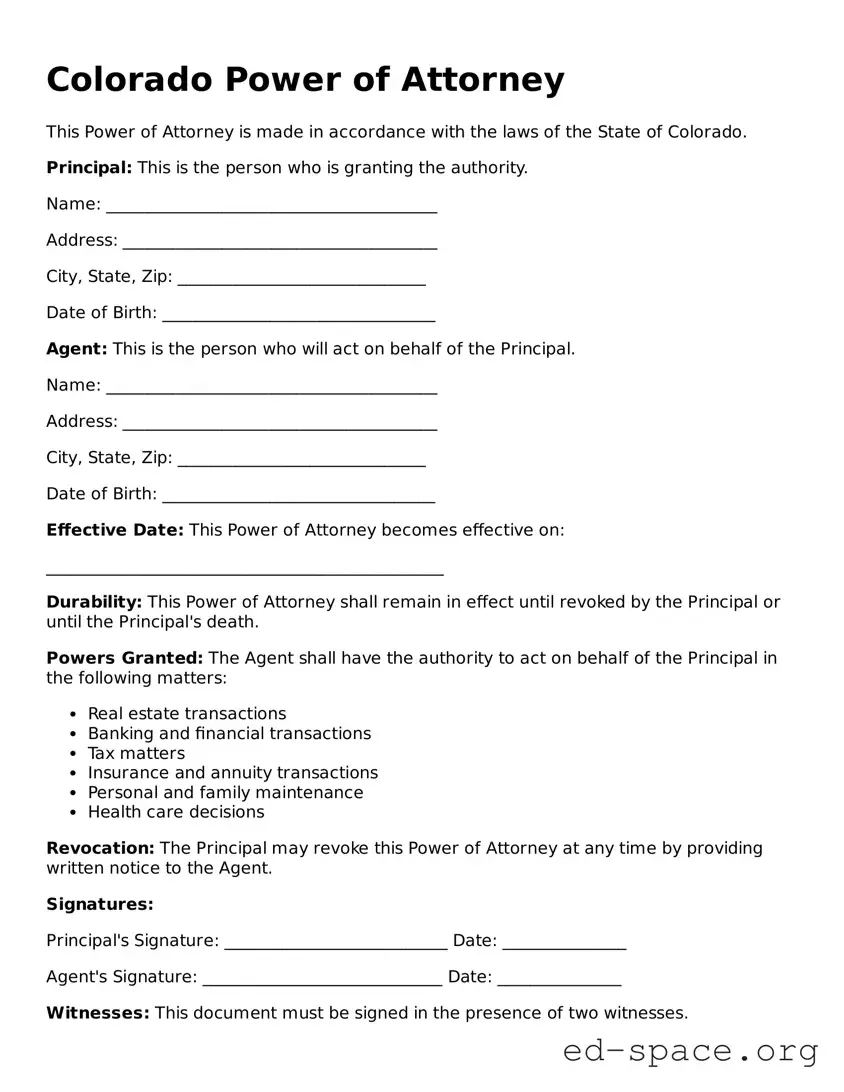
In the state of Colorado, the Power of Attorney (POA) form serves as a crucial legal document that empowers individuals to designate someone they trust to make decisions on their behalf, especially in situations where they may be unable to do so themselves. This form can cover a wide range of responsibilities, from managing financial affairs to making healthcare decisions, depending on the specific type of POA established. Colorado recognizes several variations of this document, including the General Power of Attorney, which grants broad powers, and the Medical Power of Attorney, which focuses specifically on health-related decisions. Importantly, the form must be completed with careful attention to detail, ensuring that the designated agent understands their responsibilities and the principal's wishes. Additionally, the POA can be tailored to remain effective even if the principal becomes incapacitated, providing peace of mind during uncertain times. Understanding the nuances of the Colorado Power of Attorney form is essential for anyone looking to navigate the complexities of legal decision-making and ensure that their interests are well-represented when they cannot advocate for themselves.
Colorado Power of Attorney
This Power of Attorney is made in accordance with the laws of the State of Colorado.
Principal: This is the person who is granting the authority.
Name: ________________________________________
Address: ______________________________________
City, State, Zip: ______________________________
Date of Birth: _________________________________
Agent: This is the person who will act on behalf of the Principal.
Name: ________________________________________
Address: ______________________________________
City, State, Zip: ______________________________
Date of Birth: _________________________________
Effective Date: This Power of Attorney becomes effective on:
________________________________________________
Durability: This Power of Attorney shall remain in effect until revoked by the Principal or until the Principal's death.
Powers Granted: The Agent shall have the authority to act on behalf of the Principal in the following matters:
Revocation: The Principal may revoke this Power of Attorney at any time by providing written notice to the Agent.
Signatures:
Principal's Signature: ___________________________ Date: _______________
Agent's Signature: _____________________________ Date: _______________
Witnesses: This document must be signed in the presence of two witnesses.
Notarization: This Power of Attorney must be notarized to be valid.
State of Colorado
County of ______________________
Subscribed and sworn before me this _____ day of ____________, 20__.
Notary Public: ______________________________
My Commission Expires: ______________________
| Fact Name | Details |
|---|---|
| Definition | A Power of Attorney (POA) in Colorado allows an individual to designate another person to make decisions on their behalf, particularly in financial or medical matters. |
| Governing Law | The Colorado Power of Attorney is governed by the Colorado Revised Statutes, specifically Title 15, Article 14. |
| Types of POA | Colorado recognizes several types of POAs, including durable, medical, and general powers of attorney, each serving different purposes. |
| Durability | A durable power of attorney remains effective even if the principal becomes incapacitated, ensuring that decisions can still be made. |
| Revocation | The principal can revoke a Power of Attorney at any time, as long as they are mentally competent to do so. |
Filling out the Colorado Power of Attorney form is a straightforward process that allows you to designate someone to act on your behalf in financial or medical matters. Once completed, this document will need to be signed and potentially notarized, depending on your specific needs.
What is a Power of Attorney in Colorado?
A Power of Attorney (POA) in Colorado is a legal document that allows one person, known as the principal, to appoint another person, called the agent or attorney-in-fact, to make decisions on their behalf. This can include financial matters, healthcare decisions, or other legal affairs. The principal can specify the powers granted to the agent, which can be broad or limited in scope. It’s important to understand that a POA is only effective while the principal is alive and can be revoked at any time, as long as the principal is mentally competent.
How do I create a Power of Attorney in Colorado?
Creating a Power of Attorney in Colorado involves several steps. First, you need to choose a trusted individual to serve as your agent. Next, you must complete the appropriate POA form, which can be found through legal websites or local government offices. Colorado law requires that the form be signed by the principal and, in most cases, witnessed by two individuals or notarized. After the document is completed, it is advisable to provide copies to your agent and any relevant institutions, such as banks or healthcare providers, to ensure they are aware of your designated agent.
Can I revoke a Power of Attorney in Colorado?
Yes, you can revoke a Power of Attorney in Colorado at any time, as long as you are mentally competent. To revoke the POA, you should create a written revocation document that clearly states your intention to cancel the previous POA. It is recommended to notify your agent and any institutions that were relying on the original POA. Additionally, if the original POA was notarized, it may be helpful to have the revocation notarized as well to avoid any potential disputes.
What happens if I do not have a Power of Attorney in place?
If you do not have a Power of Attorney in place and become unable to make decisions for yourself, your family may need to go through a legal process called guardianship or conservatorship to appoint someone to make decisions on your behalf. This process can be time-consuming, expensive, and may not reflect your wishes. By having a POA, you can ensure that your preferred person is in charge and that your wishes are honored in case of incapacity.
Not specifying the type of Power of Attorney: Many individuals fail to indicate whether they want a general or a limited Power of Attorney. This can lead to confusion about the authority granted.
Forgetting to date the document: Omitting the date can create issues regarding the validity of the Power of Attorney. Always ensure the document is dated to establish when it takes effect.
Neglecting to sign in front of a witness: Colorado law requires that the Power of Attorney be signed in front of a witness. Failing to do so may invalidate the document.
Not having the document notarized: While not always required, notarization adds an extra layer of protection and validity. Many people overlook this step, which can lead to complications.
Choosing the wrong agent: Selecting an agent who may not act in your best interest can be detrimental. It’s crucial to choose someone trustworthy and reliable.
Failing to communicate with the agent: Not discussing your wishes and expectations with your chosen agent can lead to misunderstandings later on. Open communication is key.
Not reviewing the document regularly: Life circumstances change, and so should your Power of Attorney. Failing to review and update the document can lead to outdated decisions.
Ignoring state-specific requirements: Each state has its own rules regarding Power of Attorney forms. Not adhering to Colorado’s specific requirements can invalidate the document.
When preparing to establish a Power of Attorney in Colorado, it's important to consider additional documents that can support your intentions and ensure clarity in legal matters. Here’s a list of commonly used forms and documents that often accompany the Power of Attorney form.
These documents work together to provide a comprehensive approach to managing personal, medical, and financial matters. Ensuring that each form is properly completed and understood can help avoid complications in the future.
The Power of Attorney (POA) form is an important legal document that allows one person to act on behalf of another in various matters. There are several other documents that share similarities with the Power of Attorney, each serving a unique purpose. Here’s a list of eight such documents:
Understanding these documents can help individuals make informed decisions about their legal and healthcare needs. Each document serves a specific function, but they all share the common goal of ensuring that a person's wishes are respected when they cannot express them themselves.
When filling out the Colorado Power of Attorney form, it is important to follow specific guidelines to ensure the document is valid and effective. Below is a list of things to do and not to do during this process.
Things You Should Do:
Things You Shouldn't Do:
Understanding the Colorado Power of Attorney form is crucial for making informed decisions about legal and financial matters. However, several misconceptions can lead to confusion. Here are six common misconceptions:
By clarifying these misconceptions, individuals can better navigate the complexities of the Colorado Power of Attorney form and make informed choices about their legal and financial affairs.
Filling out and utilizing the Colorado Power of Attorney form is an important process that requires careful consideration. Here are some key takeaways to keep in mind:
By keeping these points in mind, individuals can navigate the Power of Attorney process more effectively and with greater confidence.