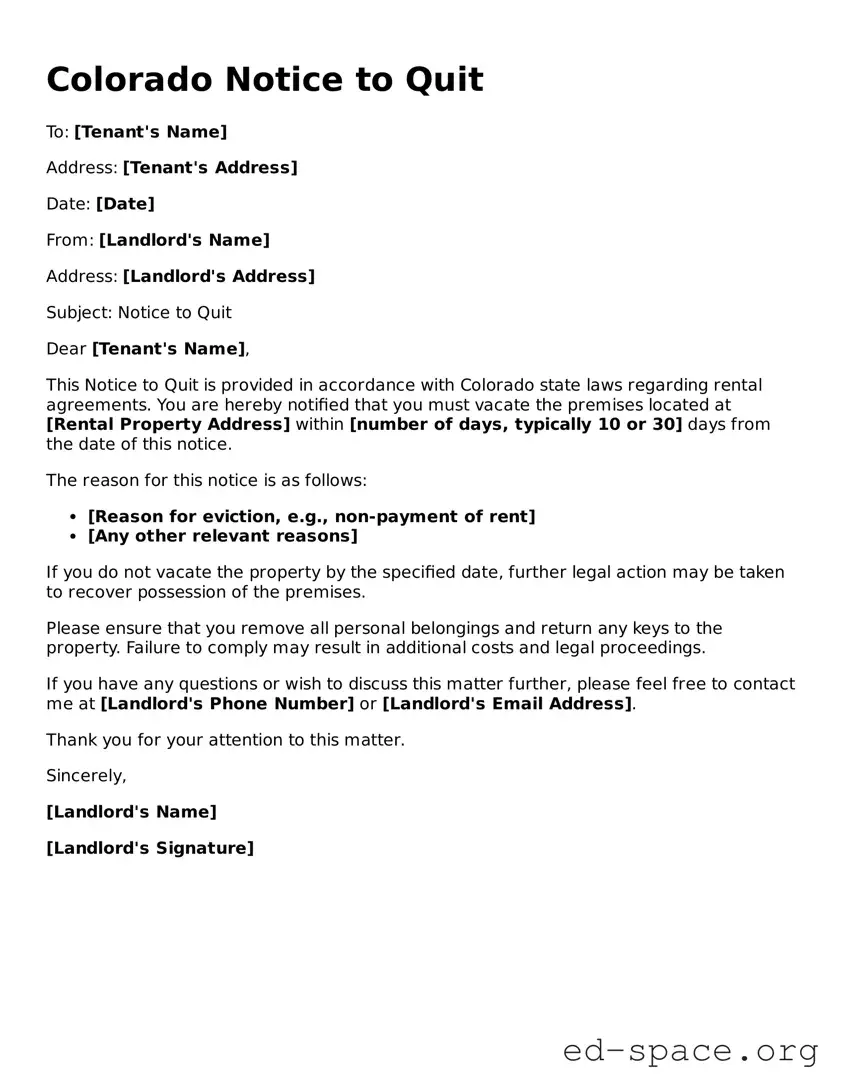
The Colorado Notice to Quit form serves as a crucial tool in the landlord-tenant relationship, particularly when disputes arise regarding lease agreements. This document is designed to formally notify tenants that they must vacate the rental property, typically due to non-payment of rent or other lease violations. By providing clear communication, the Notice to Quit helps to establish a timeline for the tenant to remedy the situation or vacate the premises. It outlines the specific reasons for the eviction, ensuring that tenants are fully aware of their obligations and the consequences of failing to comply. In Colorado, the requirements for this notice can vary based on the nature of the violation, such as whether it involves a failure to pay rent or other lease breaches. Understanding the nuances of this form is essential for both landlords seeking to enforce their rights and tenants wishing to protect their interests. Proper completion and delivery of the Notice to Quit can significantly impact the subsequent legal proceedings, making it imperative for all parties to approach this matter with clarity and diligence.
Colorado Notice to Quit
To: [Tenant's Name]
Address: [Tenant's Address]
Date: [Date]
From: [Landlord's Name]
Address: [Landlord's Address]
Subject: Notice to Quit
Dear [Tenant's Name],
This Notice to Quit is provided in accordance with Colorado state laws regarding rental agreements. You are hereby notified that you must vacate the premises located at [Rental Property Address] within [number of days, typically 10 or 30] days from the date of this notice.
The reason for this notice is as follows:
If you do not vacate the property by the specified date, further legal action may be taken to recover possession of the premises.
Please ensure that you remove all personal belongings and return any keys to the property. Failure to comply may result in additional costs and legal proceedings.
If you have any questions or wish to discuss this matter further, please feel free to contact me at [Landlord's Phone Number] or [Landlord's Email Address].
Thank you for your attention to this matter.
Sincerely,
[Landlord's Name]
[Landlord's Signature]
| Fact Name | Details |
|---|---|
| Purpose | The Colorado Notice to Quit form is used by landlords to inform tenants that they must vacate the rental property due to lease violations or non-payment of rent. |
| Governing Law | This form is governed by the Colorado Revised Statutes, specifically under Title 13, Article 40, which outlines the rights and responsibilities of landlords and tenants. |
| Notice Period | The required notice period varies depending on the reason for eviction; typically, it is 10 days for non-payment of rent and 30 days for lease violations. |
| Delivery Method | The Notice to Quit must be delivered in person, by mail, or through a process server to ensure proper notification to the tenant. |
After completing the Colorado Notice to Quit form, you will need to deliver it to the tenant. This is an important step in the eviction process, ensuring that the tenant is formally notified of the need to vacate the property. Following the delivery, you may need to take further legal steps if the tenant does not comply.
What is a Colorado Notice to Quit form?
The Colorado Notice to Quit form is a legal document used by landlords to inform tenants that they must vacate the rental property. This notice typically outlines the reasons for termination of the tenancy, such as non-payment of rent or lease violations. It serves as a formal request for the tenant to leave the premises within a specified timeframe.
When is a Notice to Quit necessary in Colorado?
A Notice to Quit is necessary when a landlord seeks to terminate a lease agreement due to specific issues. Common reasons include failure to pay rent, repeated lease violations, or the end of a lease term. Depending on the situation, the notice period may vary, so it's important for landlords to follow the appropriate legal guidelines.
How much notice must be given in a Notice to Quit?
The required notice period in Colorado can vary based on the reason for termination. For non-payment of rent, landlords typically must provide a 10-day notice. In cases of lease violations, a 7-day notice may suffice. However, if the lease has expired, no notice is needed, and the tenant must vacate immediately.
Can a tenant contest a Notice to Quit?
Yes, a tenant can contest a Notice to Quit. If a tenant believes the notice is unjustified, they may choose to respond in writing or seek legal advice. This response can include evidence of payment or compliance with lease terms. Ultimately, the matter may need to be resolved in court if the landlord proceeds with eviction.
What happens if a tenant does not comply with the Notice to Quit?
If a tenant does not comply with the Notice to Quit, the landlord may initiate eviction proceedings. This typically involves filing a complaint in the local court. The court will then schedule a hearing, where both parties can present their case. If the court rules in favor of the landlord, a judgment for eviction may be issued.
Is a Notice to Quit the same as an eviction notice?
No, a Notice to Quit is not the same as an eviction notice. The Notice to Quit is a preliminary step that informs the tenant of the need to vacate. An eviction notice, on the other hand, is issued after the Notice to Quit has been ignored and legal proceedings have begun. It is essential to understand the distinction between these two documents.
Can a landlord use a Notice to Quit for any reason?
A landlord cannot use a Notice to Quit for any reason. The reasons must comply with Colorado rental laws. Acceptable grounds include non-payment of rent, lease violations, or the expiration of a lease. Landlords should ensure that their reasons are valid and documented to avoid potential legal issues.
Where can I obtain a Colorado Notice to Quit form?
A Colorado Notice to Quit form can be obtained from various sources. Landlords may find templates online through legal websites or state resources. It is crucial to use a form that complies with Colorado laws and to ensure that all necessary information is included before issuing the notice.
Missing Tenant Information: One common mistake is failing to include all necessary details about the tenant. Ensure that the full name and address of the tenant are accurately recorded. This helps in establishing clear communication.
Incorrect Date: It's crucial to specify the correct date on the Notice to Quit. A wrong date can lead to confusion and may invalidate the notice. Always double-check the date before submission.
Improper Delivery Method: Many individuals overlook the importance of how the notice is delivered. The law requires specific methods of delivery, such as personal service or certified mail. Failing to follow these can result in complications.
Not Stating the Reason: A common oversight is neglecting to clearly state the reason for the eviction. Whether it's non-payment of rent or lease violations, providing a concise explanation is essential for legal clarity.
Ignoring Local Laws: Each area may have specific regulations regarding eviction notices. Failing to familiarize oneself with local laws can lead to mistakes that could delay the eviction process.
Not Keeping a Copy: After filling out the Notice to Quit, some forget to keep a copy for their records. Retaining a copy is important in case of future disputes or legal proceedings.
The Colorado Notice to Quit form is an essential document used in landlord-tenant relationships, particularly when a landlord seeks to terminate a lease agreement. Along with this form, there are several other documents that may be utilized in the eviction process or to clarify the terms of the rental agreement. Below is a list of commonly used forms that accompany the Notice to Quit.
Understanding these documents can help both landlords and tenants navigate the complexities of rental agreements and eviction processes more effectively. Each form plays a specific role in ensuring that the rights and responsibilities of both parties are clearly defined and upheld.
The Notice to Quit form is similar to several other documents used in the context of tenant-landlord relationships. Each of these documents serves a specific purpose in the process of managing rental agreements and tenant evictions. Below are nine documents that share similarities with the Notice to Quit form:
When filling out the Colorado Notice to Quit form, it is essential to follow certain guidelines to ensure the process is handled correctly. Here are five key actions to take and avoid:
When dealing with the Colorado Notice to Quit form, several misconceptions can arise. Understanding these misconceptions is crucial for both landlords and tenants to navigate the eviction process effectively. Here are four common misunderstandings:
Many people believe that all Notices to Quit are identical, but this is not true. Different types of Notices to Quit exist based on the reason for the eviction, such as non-payment of rent or lease violations. Each type has specific requirements and timelines that must be followed.
Some assume that issuing a Notice to Quit automatically results in eviction. However, this is not the case. The Notice is simply a formal way to inform the tenant of the landlord's intent to terminate the lease. Legal proceedings must still occur for an eviction to take place.
Another misconception is that tenants have no recourse once they receive a Notice to Quit. In reality, tenants can respond to the notice, either by addressing the issue outlined or by contesting the eviction in court if they believe it is unjust.
Some believe that landlords can serve a Notice to Quit in any way they choose. However, Colorado law requires that the notice be delivered in a specific manner, such as personal delivery or certified mail. Failure to follow these requirements can invalidate the notice.
Understanding these misconceptions can help both landlords and tenants navigate the eviction process more effectively and ensure that their rights are protected.
When dealing with the Colorado Notice to Quit form, understanding its key elements is essential for both landlords and tenants. Here are ten important takeaways:
Understanding these points can help ensure a smoother process for both parties involved.