In the state of Colorado, the Notary Acknowledgement form serves as a vital tool in the realm of legal documentation, ensuring that signatures on various documents are verified and authenticated. This form is essential for a variety of transactions, including real estate deals, contracts, and other legal agreements, as it provides a layer of protection against fraud. By utilizing the Notary Acknowledgement, individuals can confirm that the signer is who they claim to be, and that they willingly signed the document in question. The form typically includes key information such as the name of the signer, the date of the acknowledgment, and the notary’s signature and seal, which collectively affirm the legitimacy of the document. Understanding the nuances of this form is crucial for anyone involved in legal processes in Colorado, as it not only enhances the credibility of the documents but also ensures compliance with state laws. Whether you are a homeowner, business owner, or simply someone navigating legal requirements, grasping the importance of the Notary Acknowledgement can significantly impact the validity of your agreements.
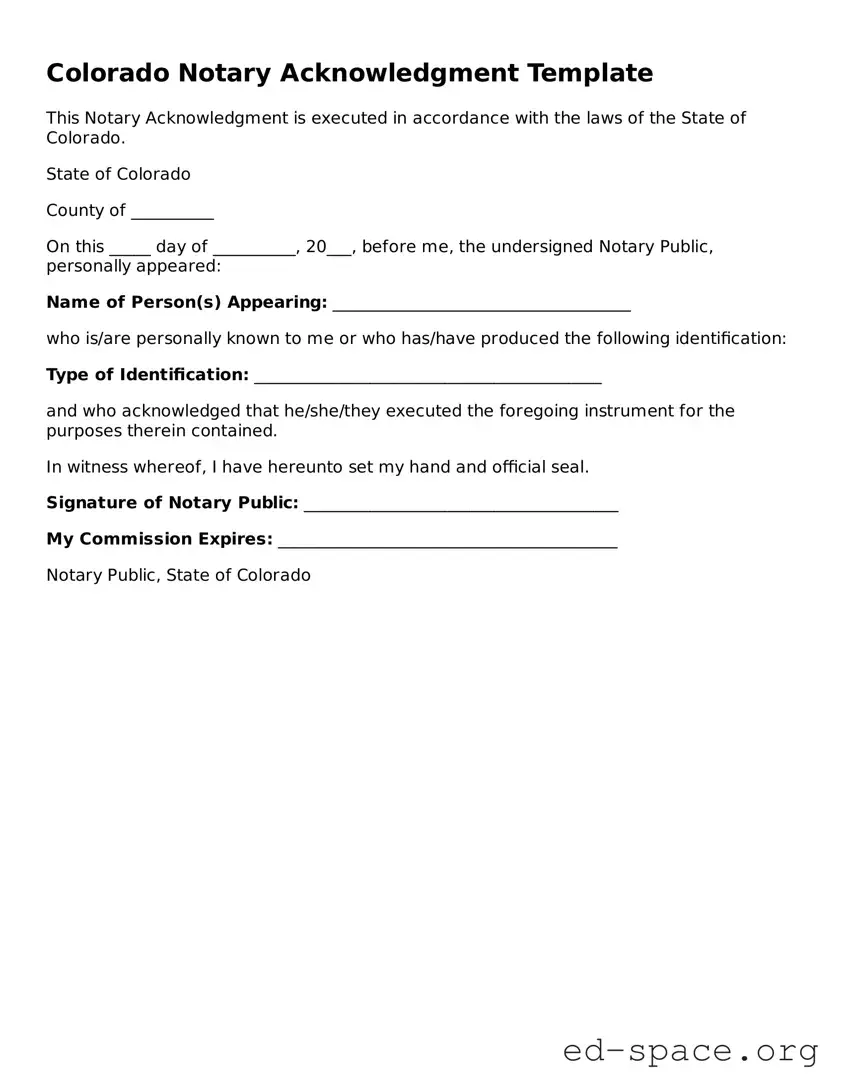
Colorado Notary Acknowledgment Template
This Notary Acknowledgment is executed in accordance with the laws of the State of Colorado.
State of Colorado
County of __________
On this _____ day of __________, 20___, before me, the undersigned Notary Public, personally appeared:
Name of Person(s) Appearing: ____________________________________
who is/are personally known to me or who has/have produced the following identification:
Type of Identification: __________________________________________
and who acknowledged that he/she/they executed the foregoing instrument for the purposes therein contained.
In witness whereof, I have hereunto set my hand and official seal.
Signature of Notary Public: ______________________________________
My Commission Expires: _________________________________________
Notary Public, State of Colorado
| Fact Name | Details |
|---|---|
| Governing Law | The Colorado Notary Acknowledgement form is governed by Colorado Revised Statutes, Title 12, Article 55. |
| Purpose | This form is used to verify the identity of individuals signing a document. |
| Signature Requirement | The signer must personally appear before the notary at the time of signing. |
| Notary's Role | The notary public certifies that the signature is genuine and the signer is competent. |
| Document Types | Commonly used for deeds, contracts, and powers of attorney. |
| Identification | The signer must provide valid identification to the notary. |
| Record Keeping | Notaries must keep a record of the acknowledgment in their journal. |
| Fees | Colorado law allows notaries to charge a maximum fee of $5 per acknowledgment. |
| Expiration | The acknowledgment does not expire, but the notary's commission does. |
| Electronic Acknowledgments | Colorado permits electronic notarization under certain conditions. |
After you have gathered the necessary information, you can proceed to fill out the Colorado Notary Acknowledgement form. This form requires specific details to ensure it is completed correctly.
What is a Colorado Notary Acknowledgement form?
The Colorado Notary Acknowledgement form is a legal document that a notary public uses to certify that a person has willingly signed a document in their presence. This form serves as proof that the signature on the document is genuine and that the signer was competent and not under duress at the time of signing. It is often required for various legal documents, such as deeds, contracts, and affidavits.
When do I need to use a Notary Acknowledgement?
You typically need a Notary Acknowledgement when you are signing important documents that require verification of your identity and intent. This can include real estate transactions, powers of attorney, and other legal agreements. If you are unsure whether your document requires notarization, it’s always a good idea to check with a legal professional or the entity requesting the document.
How do I complete a Colorado Notary Acknowledgement form?
Completing the form is straightforward. First, ensure that the signer is present and ready to sign the document. The notary will then fill out the form, which typically includes the date, the name of the signer, and the type of document being acknowledged. After the signer has signed the document in front of the notary, the notary will complete their section, which includes their signature, seal, and other identifying information. Always double-check that all fields are filled out correctly before finalizing the document.
Is there a fee for notarization in Colorado?
Yes, notaries in Colorado are allowed to charge a fee for their services. As of the latest regulations, the maximum fee for a standard notarization is set by the state. It’s important to confirm the current fee with your notary, as they may also charge additional fees for travel or other services. Always ask about the costs upfront to avoid any surprises.
Can I use a Notary Acknowledgement form from another state in Colorado?
Generally, a Notary Acknowledgement form from another state may not be accepted in Colorado. Each state has its own rules and formats for notarization. To ensure that your document is valid and accepted, it’s best to use the Colorado-specific Notary Acknowledgement form. If you have a document from another state, consult with a legal professional to determine the best course of action.
Incorrect Date: One common mistake is entering the wrong date on the form. It is essential to ensure that the date of the acknowledgment matches the date when the notary is actually performing the service.
Missing Signatures: Sometimes, individuals forget to sign the document in the presence of the notary. All parties involved must sign the document before the notary can acknowledge it.
Inaccurate Identification: Failing to provide proper identification can lead to issues. The notary needs to verify the identity of the signer, so having a valid ID is crucial.
Incomplete Information: Leaving out essential details, such as the name of the signer or the title of the document, can invalidate the acknowledgment. Double-checking all fields is advisable.
Using the Wrong Notary Acknowledgment Form: Different forms exist for different purposes. Using a form that does not match the type of document can cause delays or rejections.
The Colorado Notary Acknowledgment form is a crucial document used to verify the identity of signers and the authenticity of their signatures. However, several other forms and documents often accompany it to ensure a comprehensive and legally sound process. Here are some commonly used forms:
Understanding these documents and their purposes can enhance the effectiveness of the notary process, ensuring that all parties are protected and informed. Each document plays a vital role in various legal transactions, contributing to a smooth and reliable experience.
The Notary Acknowledgment form serves a specific purpose in the realm of legal documentation. Several other documents share similarities with it in terms of function and intent. Below are four documents that are comparable to the Notary Acknowledgment form:
When filling out the Colorado Notary Acknowledgment form, attention to detail is essential. Here’s a list of things you should and shouldn’t do to ensure the process goes smoothly.
By following these guidelines, you can help ensure that the notarization process is both effective and compliant with Colorado law.
Understanding the Colorado Notary Acknowledgement form can be tricky, especially with the many misconceptions floating around. Here’s a list of common myths and the truths behind them:
Not just anyone can be a notary. In Colorado, you must be at least 18 years old, a resident of the state, and pass a background check.
Notaries are not lawyers. They can’t offer legal advice or interpret the law. Their role is to verify identities and witness signatures.
While many people associate notarization with real estate, it’s used for a wide variety of documents, including wills, powers of attorney, and contracts.
While notaries have the right to refuse, they must have a valid reason, such as doubts about the signer’s identity or understanding of the document.
In Colorado, a notary’s seal is not just a formality; it is required for the notarization to be valid. Without it, the document may not hold up.
Notaries should avoid notarizing documents for immediate family to prevent any appearance of bias or conflict of interest.
Notarization can vary based on the type of document and the specific requirements set forth by state law. Understanding these differences is key.
Notarization does not guarantee that a document is free from legal challenges. It simply verifies that the signature was made in the presence of a notary.
Notaries do not assess the content of the documents they notarize. Their responsibility lies solely in verifying identities and witnessing signatures.
By clearing up these misconceptions, you can navigate the world of notarization with confidence. Always remember, understanding the rules and responsibilities of a notary can save you time and trouble in the long run.
When filling out and using the Colorado Notary Acknowledgement form, it’s essential to understand its purpose and requirements. Here are key takeaways to ensure proper usage:
By following these guidelines, you can effectively use the Colorado Notary Acknowledgement form while ensuring compliance with state laws.