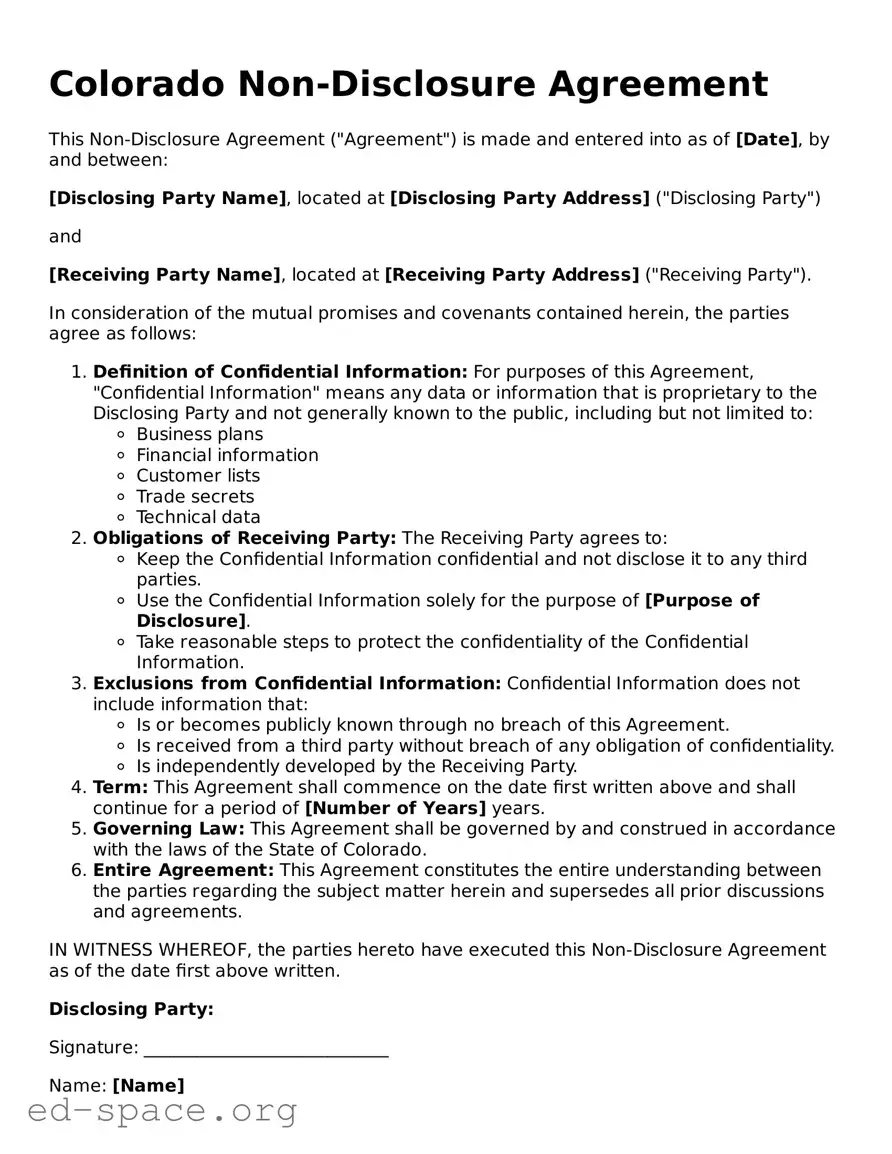
The Colorado Non-disclosure Agreement (NDA) form serves as a crucial tool for individuals and businesses seeking to protect sensitive information. This legal document establishes a confidential relationship between parties, ensuring that proprietary data, trade secrets, and other private information remain undisclosed. It outlines the obligations of the parties involved, specifying what constitutes confidential information and detailing how it should be handled. The NDA also addresses the duration of confidentiality, the permissible uses of the information, and the consequences of any breach. By clearly defining these parameters, the form helps prevent unauthorized sharing and fosters trust in business relationships. Understanding the nuances of this agreement is essential for anyone looking to safeguard their intellectual property and maintain a competitive edge in the marketplace.
Colorado Non-Disclosure Agreement
This Non-Disclosure Agreement ("Agreement") is made and entered into as of [Date], by and between:
[Disclosing Party Name], located at [Disclosing Party Address] ("Disclosing Party")
and
[Receiving Party Name], located at [Receiving Party Address] ("Receiving Party").
In consideration of the mutual promises and covenants contained herein, the parties agree as follows:
IN WITNESS WHEREOF, the parties hereto have executed this Non-Disclosure Agreement as of the date first above written.
Disclosing Party:
Signature: ____________________________
Name: [Name]
Title: [Title]
Date: [Date]
Receiving Party:
Signature: ____________________________
Name: [Name]
Title: [Title]
Date: [Date]
| Fact Name | Description |
|---|---|
| Purpose | A Colorado Non-disclosure Agreement (NDA) protects confidential information shared between parties. |
| Parties Involved | The agreement typically involves a disclosing party and a receiving party. |
| Governing Law | The NDA is governed by Colorado state law. |
| Duration | The duration of confidentiality can be specified in the agreement, often lasting several years. |
| Scope of Information | The NDA should clearly define what information is considered confidential. |
| Exclusions | Common exclusions include information that is publicly available or independently developed. |
| Enforcement | If breached, the injured party may seek legal remedies under Colorado law. |
| Signatures | Both parties must sign the NDA for it to be legally binding. |
Filling out the Colorado Non-disclosure Agreement form is a straightforward process. Once you have completed the form, you will be ready to move forward with your plans while ensuring that sensitive information remains protected.
What is a Non-disclosure Agreement (NDA) in Colorado?
A Non-disclosure Agreement (NDA) is a legal contract between parties that outlines confidential information shared between them. In Colorado, NDAs are commonly used to protect sensitive business information, trade secrets, and proprietary data. By signing an NDA, parties agree not to disclose this information to unauthorized individuals or entities. This helps maintain the confidentiality of important business matters and fosters trust between parties involved in a transaction or collaboration.
Who should use a Non-disclosure Agreement?
Any individual or business that plans to share confidential information may benefit from using an NDA. This includes entrepreneurs sharing ideas with potential investors, companies discussing mergers or acquisitions, and professionals collaborating on projects. By implementing an NDA, parties can safeguard their interests and ensure that sensitive information remains protected. It is particularly important in industries where intellectual property and proprietary information are key assets.
What are the key components of a Colorado NDA?
A typical NDA in Colorado should include several essential components. First, it should clearly define what constitutes confidential information. Next, the agreement should specify the obligations of each party regarding the handling of this information. It is also important to outline the duration of the confidentiality obligations, as well as any exclusions, such as information that becomes public knowledge. Lastly, the NDA should include provisions for dispute resolution and the governing law, which in this case would be Colorado law.
How long does the confidentiality obligation last?
The duration of the confidentiality obligation in a Colorado NDA can vary based on the specific terms agreed upon by the parties. Generally, confidentiality obligations can last for a set number of years or until the information becomes publicly available. It is essential for parties to negotiate this duration carefully, as it impacts how long they are legally bound to protect the shared information. Clear communication about expectations can help avoid misunderstandings in the future.
What happens if someone breaches the NDA?
If a party breaches the NDA, the non-breaching party may seek legal remedies. This can include monetary damages for any losses incurred due to the breach. In some cases, the non-breaching party may also seek injunctive relief, which is a court order requiring the breaching party to stop disclosing the confidential information. It is important for parties to understand the potential consequences of a breach and to include clear enforcement provisions in the NDA to protect their interests.
Can an NDA be modified or terminated?
Yes, an NDA can be modified or terminated, but this typically requires the agreement of all parties involved. Any modifications should be documented in writing to avoid confusion. Parties may choose to terminate the NDA when the purpose of the agreement has been fulfilled, or if they no longer wish to be bound by its terms. Clear communication and mutual consent are crucial when making any changes to the agreement.
Incomplete Information: Failing to fill out all required fields can lead to delays. Make sure to provide all necessary details.
Incorrect Names: Using the wrong legal names for parties involved can invalidate the agreement. Double-check spelling and accuracy.
Missing Signatures: Omitting signatures from all parties makes the document unenforceable. Ensure everyone signs where needed.
Improper Dates: Not including the correct dates can cause confusion about when the agreement takes effect. Always verify the dates.
Vague Language: Using unclear or ambiguous terms may lead to misunderstandings. Be specific about what information is protected.
Ignoring State Laws: Not considering Colorado's specific laws regarding non-disclosure agreements can result in non-compliance. Familiarize yourself with local regulations.
Failing to Define Confidential Information: Not clearly outlining what constitutes confidential information can lead to disputes. Be thorough in your definitions.
Neglecting to Review: Skipping a final review of the agreement can lead to overlooked errors. Always take the time to proofread before submission.
A Non-disclosure Agreement (NDA) is an essential document for protecting sensitive information shared between parties. In Colorado, this agreement often works alongside several other forms and documents that help clarify the terms of the relationship and ensure compliance with legal standards. Here’s a list of some commonly used documents that complement the Colorado Non-disclosure Agreement.
Each of these documents plays a crucial role in establishing clear expectations and protecting sensitive information in various business relationships. Understanding their purposes can help parties navigate their agreements more effectively and ensure that their interests are safeguarded.
When filling out the Colorado Non-disclosure Agreement form, it is essential to approach the task with care. Here are four important considerations to keep in mind:
Understanding the Colorado Non-disclosure Agreement (NDA) is crucial for anyone considering its use. However, several misconceptions can cloud judgment. Here are seven common misconceptions about the Colorado NDA:
By clarifying these misconceptions, individuals and businesses can better navigate the complexities of non-disclosure agreements in Colorado.
Filling out and utilizing the Colorado Non-disclosure Agreement (NDA) form requires careful consideration to ensure that confidential information remains protected. Here are key takeaways to keep in mind:
By adhering to these key points, individuals and businesses can effectively use the Colorado Non-disclosure Agreement to safeguard their confidential information.