In the competitive landscape of Colorado's job market, the Non-compete Agreement form plays a crucial role in shaping the relationship between employers and employees. This document is designed to protect a company's proprietary information and trade secrets while also outlining the boundaries within which employees can operate after leaving a job. Key aspects of the form include the specific duration of the non-compete period, the geographical area it covers, and the types of activities that are restricted. Employers must ensure that the terms are reasonable and not overly broad, as Colorado law places limits on the enforceability of such agreements. Additionally, employees should be aware of their rights and the implications of signing this form, as it can significantly impact their future employment opportunities. Understanding these elements is essential for both parties to navigate the complexities of employment contracts in Colorado.
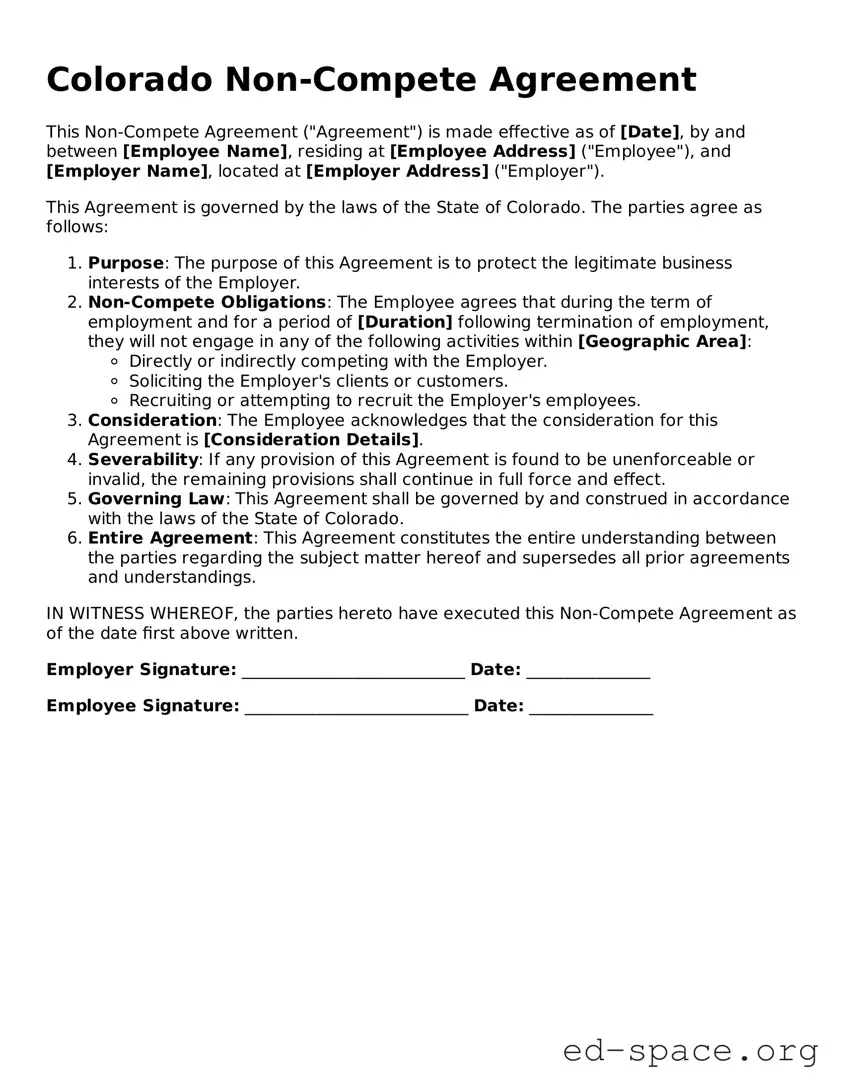
Colorado Non-Compete Agreement
This Non-Compete Agreement ("Agreement") is made effective as of [Date], by and between [Employee Name], residing at [Employee Address] ("Employee"), and [Employer Name], located at [Employer Address] ("Employer").
This Agreement is governed by the laws of the State of Colorado. The parties agree as follows:
IN WITNESS WHEREOF, the parties hereto have executed this Non-Compete Agreement as of the date first above written.
Employer Signature: ___________________________ Date: _______________
Employee Signature: ___________________________ Date: _______________
| Fact Name | Details |
|---|---|
| Governing Law | The Colorado Non-compete Agreement is governed by Colorado Revised Statutes, specifically § 8-2-113. |
| Enforceability | In Colorado, non-compete agreements are generally enforceable only if they are reasonable in scope and duration. |
| Restrictions | Colorado law prohibits non-compete agreements for certain professions, including employees in the health care industry. |
| Consideration | For a non-compete agreement to be valid, there must be adequate consideration, such as a job offer or promotion. |
Filling out the Colorado Non-compete Agreement form is an important step in establishing the terms of employment and protecting business interests. Once the form is completed, it will need to be reviewed and signed by all parties involved to ensure mutual understanding and compliance.
What is a Colorado Non-compete Agreement?
A Colorado Non-compete Agreement is a legal document that restricts an employee from engaging in certain activities that compete with their employer after leaving the job. This agreement is designed to protect the employer's business interests, including trade secrets, client relationships, and proprietary information. In Colorado, these agreements must meet specific criteria to be enforceable, and they cannot be overly restrictive in terms of time, geography, or scope of activities. Understanding these limitations is crucial for both employers and employees.
Are non-compete agreements enforceable in Colorado?
Yes, non-compete agreements can be enforceable in Colorado, but they are subject to strict regulations. For a non-compete to be valid, it must be part of a lawful contract, such as an employment agreement or a buy-sell agreement. Additionally, the agreement must protect legitimate business interests and must not impose unreasonable restrictions on the employee. Colorado law specifically states that non-compete agreements cannot last longer than one year and must be limited to specific geographic areas where the employee worked. If these conditions are not met, the agreement may not hold up in court.
What should be included in a Colorado Non-compete Agreement?
A Colorado Non-compete Agreement should clearly outline the terms and conditions that both parties agree to. Key elements include the duration of the restriction, the geographic area it covers, and the specific activities that are prohibited. It is also important to state the legitimate business interests being protected, such as confidential information or customer relationships. Both the employer and employee should sign the agreement to indicate their consent. Clear language and specific details help avoid misunderstandings and potential legal disputes.
What happens if a non-compete agreement is violated?
If a non-compete agreement is violated, the employer may take legal action against the employee. This could include seeking an injunction to prevent the employee from continuing to engage in the competing activities or pursuing damages for any losses incurred due to the violation. However, the enforceability of the agreement will be evaluated based on Colorado's legal standards. If the agreement is deemed unreasonable or overly restrictive, a court may refuse to enforce it, which could result in the employer not being able to recover damages.
Not Understanding the Scope of the Agreement: Many individuals fail to grasp the full implications of the non-compete agreement. They may overlook specific terms regarding geographical limits and duration, which can significantly impact future job opportunities.
Neglecting to Review Job Responsibilities: Some individuals do not consider how their current job duties align with the restrictions outlined in the agreement. This oversight can lead to unintended consequences if they seek employment in a similar field.
Failing to Seek Legal Advice: A common mistake is not consulting with a legal professional before signing. Understanding the nuances of the agreement can prevent future legal disputes and protect one’s career interests.
Overlooking Exceptions: Individuals often miss specific exceptions that may apply to their situation. For example, some agreements allow for certain types of employment or activities that could be beneficial to know before signing.
Not Keeping a Copy: After signing the agreement, many forget to retain a copy for their records. This can create difficulties later on if questions arise about the terms or if a dispute occurs.
When entering into a Non-compete Agreement in Colorado, several other forms and documents may be necessary to ensure clarity and compliance. Each of these documents serves a specific purpose, helping to outline expectations and protect the interests of all parties involved.
These documents work together to create a comprehensive framework for employment relationships. Understanding each one can help ensure that both employees and employers are on the same page regarding expectations and obligations.
A Non-compete Agreement is a legal document that restricts an individual from engaging in business activities that compete with their employer for a specified period after leaving the company. This type of agreement shares similarities with several other documents. Here are four of them:
When filling out the Colorado Non-compete Agreement form, there are several important considerations to keep in mind. Here is a list of things you should and shouldn't do:
Understanding these points can help you navigate the process more effectively and protect your rights.
Understanding non-compete agreements in Colorado is essential for both employers and employees. However, several misconceptions can lead to confusion and misinterpretation. Here are nine common misconceptions:
In Colorado, non-compete agreements are only enforceable under specific circumstances. They must be reasonable in scope, duration, and geographic area.
Not all employees are required to sign a non-compete agreement. Colorado law restricts these agreements primarily to key employees, executives, and those with access to sensitive information.
These agreements serve different purposes. A non-compete restricts where and how an employee can work after leaving a job, while a non-disclosure agreement protects confidential information.
This is not entirely accurate. Non-compete agreements limit competition but do not necessarily prevent all employment in the same field. They must be reasonable to be enforceable.
Employees can challenge the enforceability of a non-compete agreement in court. If it is found to be overly broad or unreasonable, it may be invalidated.
While many non-compete agreements specify a duration, some may include conditions that allow for flexibility in their enforcement.
Employers must provide consideration, such as a job offer or promotion, in exchange for an employee signing a non-compete agreement. This means it cannot be imposed arbitrarily.
Each state has its own laws regarding non-compete agreements. Colorado has specific requirements that differ from those in other states.
Employees have the right to negotiate the terms before signing. It is advisable to seek clarification on any terms that seem unreasonable or unclear.
Being informed about these misconceptions can help individuals navigate the complexities of non-compete agreements in Colorado more effectively.
When dealing with the Colorado Non-compete Agreement form, there are several important points to consider. Understanding these can help ensure compliance and effectiveness.
Understanding these key takeaways can make navigating the Colorado Non-compete Agreement form more manageable for both employers and employees.