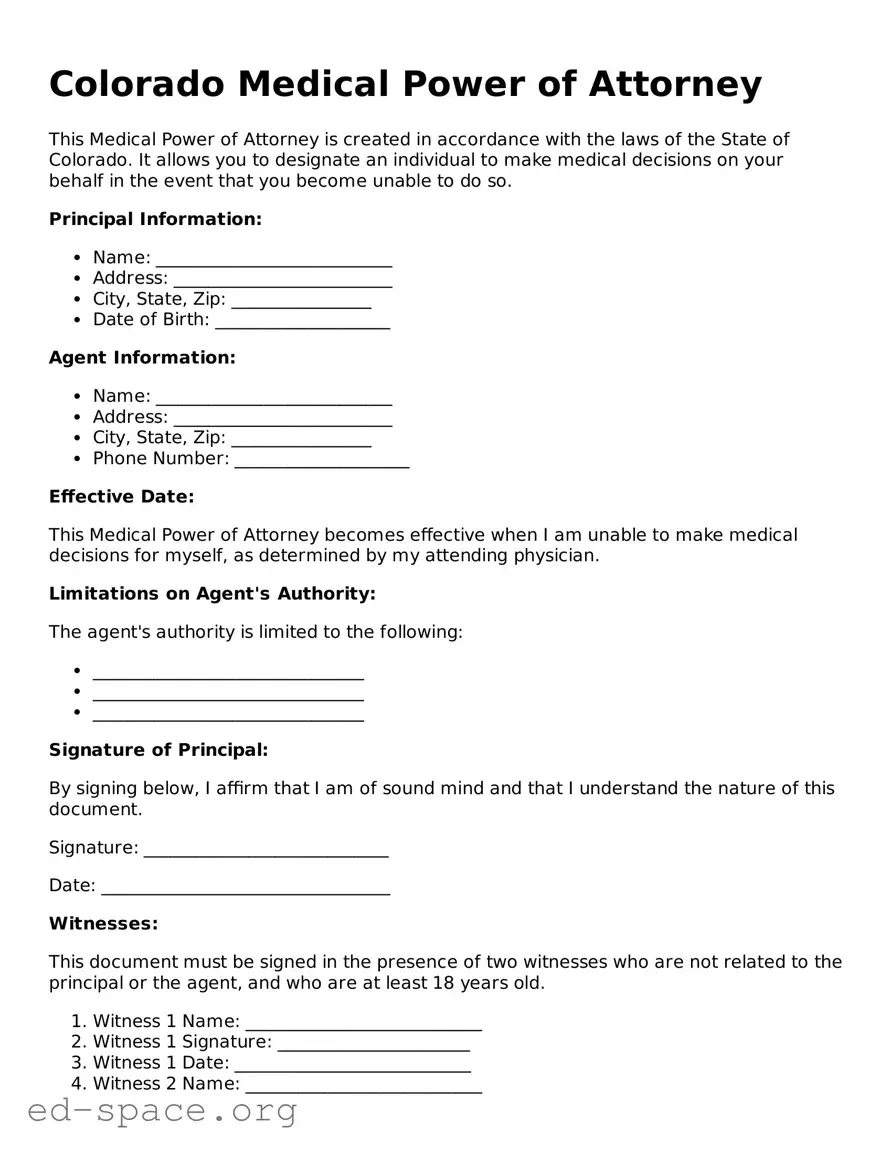
In Colorado, the Medical Power of Attorney form plays a crucial role in ensuring that your healthcare preferences are respected when you cannot speak for yourself. This document allows you to designate a trusted individual, often referred to as your agent, to make medical decisions on your behalf. It outlines the specific powers you grant to your agent, which can include choices about treatments, surgeries, and end-of-life care. Importantly, the form also provides guidance on your wishes regarding life-sustaining measures, allowing you to express your values and preferences clearly. By completing this form, you empower your agent to act in your best interest, while also relieving your loved ones from the burden of making difficult decisions during challenging times. Understanding the nuances of this form is essential for anyone looking to secure their medical care wishes in advance.
Colorado Medical Power of Attorney
This Medical Power of Attorney is created in accordance with the laws of the State of Colorado. It allows you to designate an individual to make medical decisions on your behalf in the event that you become unable to do so.
Principal Information:
Agent Information:
Effective Date:
This Medical Power of Attorney becomes effective when I am unable to make medical decisions for myself, as determined by my attending physician.
Limitations on Agent's Authority:
The agent's authority is limited to the following:
Signature of Principal:
By signing below, I affirm that I am of sound mind and that I understand the nature of this document.
Signature: ____________________________
Date: _________________________________
Witnesses:
This document must be signed in the presence of two witnesses who are not related to the principal or the agent, and who are at least 18 years old.
This Medical Power of Attorney may be revoked at any time by the principal, provided that the revocation is communicated to the agent and any healthcare providers involved.
| Fact Name | Description |
|---|---|
| Purpose | The Colorado Medical Power of Attorney form allows individuals to appoint someone to make medical decisions on their behalf if they become incapacitated. |
| Governing Law | This form is governed by Colorado Revised Statutes, Title 15, Article 18. |
| Eligibility | Any adult resident of Colorado can create a Medical Power of Attorney. |
| Agent Requirements | The appointed agent must be at least 18 years old and cannot be the patient's healthcare provider or an employee of the healthcare provider. |
| Signature Requirements | The form must be signed by the principal in the presence of a notary public or two witnesses. |
| Revocation | The principal can revoke the Medical Power of Attorney at any time, as long as they are competent to do so. |
| Durability | This document remains effective even if the principal becomes incapacitated, unless revoked. |
| Health Care Decisions | The agent can make a wide range of healthcare decisions, including consent to or refusal of medical treatment. |
Completing the Colorado Medical Power of Attorney form is a straightforward process that allows you to designate someone to make medical decisions on your behalf if you become unable to do so. Follow these steps carefully to ensure the form is filled out correctly.
Once you have completed these steps, ensure that everyone involved understands your wishes and has access to the document. It is important to keep the form in a safe but accessible place.
What is a Colorado Medical Power of Attorney?
A Colorado Medical Power of Attorney is a legal document that allows an individual, known as the principal, to designate another person, called the agent, to make medical decisions on their behalf if they become unable to do so. This document ensures that the principal's healthcare preferences are respected and followed by medical professionals when they cannot communicate their wishes directly.
Who can be appointed as an agent in a Colorado Medical Power of Attorney?
In Colorado, any competent adult can be appointed as an agent. This includes family members, friends, or trusted individuals. It is essential to choose someone who understands your values and healthcare preferences. The appointed agent should be willing to take on this responsibility and act in the best interest of the principal.
How does one create a Colorado Medical Power of Attorney?
To create a Colorado Medical Power of Attorney, the principal must complete the form, which can be obtained from various sources, including legal websites or healthcare providers. The document must include the principal's name, the agent's name, and any specific instructions regarding medical treatment. After completing the form, the principal must sign it in the presence of a notary public or two witnesses who are not related to the principal or the agent.
Can a Colorado Medical Power of Attorney be revoked?
Yes, a Colorado Medical Power of Attorney can be revoked at any time by the principal. To revoke the document, the principal should inform the agent and any healthcare providers in writing. It is advisable to create a new Medical Power of Attorney if the principal wishes to appoint a different agent or change their healthcare preferences.
What happens if I do not have a Medical Power of Attorney in Colorado?
If an individual does not have a Medical Power of Attorney in place and becomes incapacitated, medical decisions may be made by family members or guardians. This process can lead to disputes or decisions that may not align with the individual's wishes. Having a Medical Power of Attorney helps avoid confusion and ensures that healthcare decisions reflect the principal's values and preferences.
Not naming an agent. Failing to designate a specific person as your agent can lead to confusion and disputes about who should make decisions on your behalf.
Choosing the wrong agent. Selecting someone who may not fully understand your wishes or who may not be available when needed can cause issues. It's important to choose someone trustworthy and reliable.
Not discussing your wishes. It's crucial to have a conversation with your chosen agent about your healthcare preferences. Without this discussion, they may not know how to advocate for you.
Inadequate witness signatures. The form requires signatures from two witnesses or a notary. Missing or improperly completed signatures can invalidate the document.
Using outdated forms. Ensure you are using the most current version of the Colorado Medical Power of Attorney form. Outdated forms may not comply with current laws.
Not reviewing the document regularly. Life changes, and so do your preferences. Regularly reviewing and updating your Medical Power of Attorney ensures it reflects your current wishes.
Neglecting to provide copies. After completing the form, share copies with your agent, healthcare providers, and family members. This ensures everyone knows your wishes and who is authorized to make decisions.
When preparing a Colorado Medical Power of Attorney, several other forms and documents may be beneficial to ensure comprehensive healthcare planning. Each of these documents serves a specific purpose in managing medical decisions and related affairs.
These documents work together to create a clear plan for medical care and decision-making. Having them in place can provide peace of mind for both individuals and their families during challenging times.
A Medical Power of Attorney (MPOA) is a crucial document that allows individuals to designate someone to make healthcare decisions on their behalf if they become unable to do so. Several other legal documents serve similar purposes in different contexts. Here are seven documents that share similarities with the MPOA:
Each of these documents plays a vital role in ensuring that an individual's wishes regarding health and financial matters are respected, especially during times when they may not be able to communicate those wishes themselves.
When filling out the Colorado Medical Power of Attorney form, it is crucial to be thorough and accurate. Here are some important guidelines to consider.
Many individuals have misunderstandings about the Colorado Medical Power of Attorney form. Clarifying these misconceptions can help ensure that people make informed decisions regarding their healthcare choices. Below are six common misconceptions:
Understanding these points can help individuals navigate their healthcare planning more effectively and ensure their wishes are honored.
When considering the Colorado Medical Power of Attorney form, it’s essential to understand its purpose and how to properly complete it. Here are some key takeaways to keep in mind:
By understanding these key points, you can ensure that your Medical Power of Attorney is completed correctly and serves its intended purpose effectively.