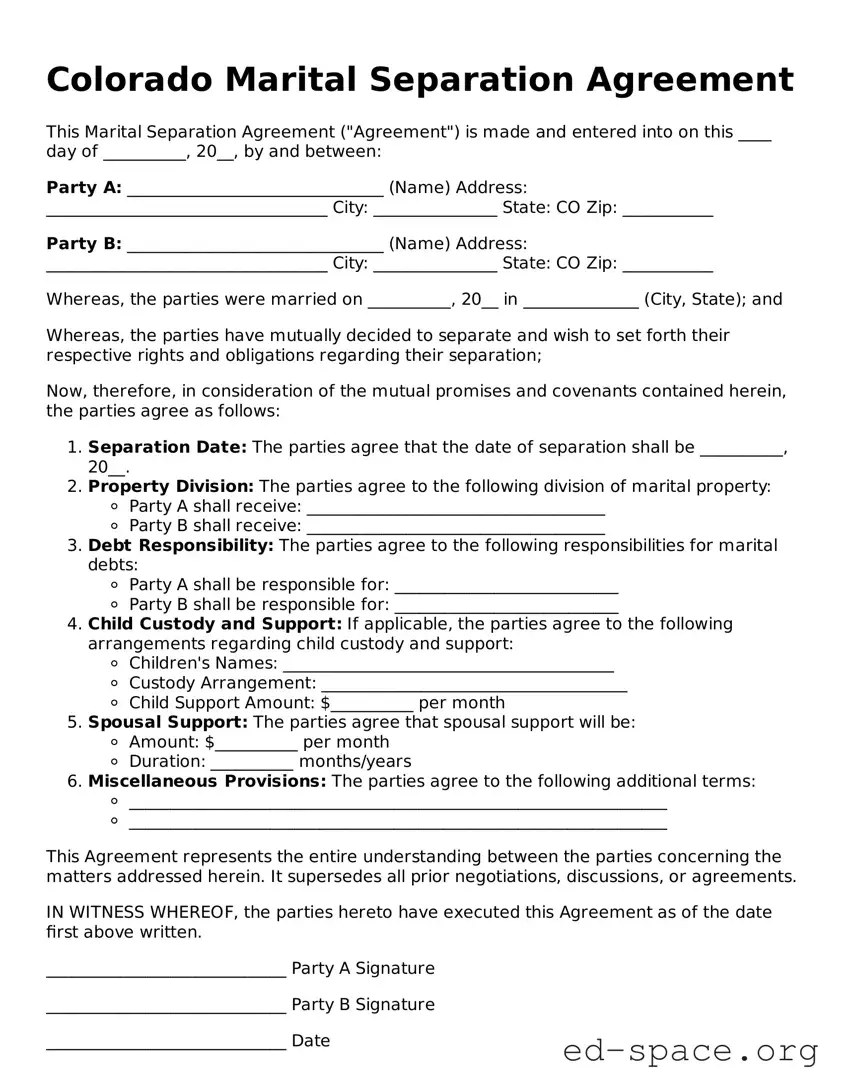
In the state of Colorado, a Marital Separation Agreement serves as a crucial document for couples who choose to live apart while navigating the complexities of their relationship. This form outlines essential terms and conditions that both parties agree upon, addressing issues such as division of property, spousal support, and child custody arrangements. It acts as a roadmap for the separation period, helping to clarify responsibilities and expectations. By detailing the rights and obligations of each spouse, the agreement aims to minimize conflict and provide a clear framework for the future. Additionally, the Marital Separation Agreement can play a significant role in any subsequent divorce proceedings, as it may be incorporated into the final divorce decree. Understanding the components of this form is vital for couples seeking to ensure a fair and equitable separation process.
Colorado Marital Separation Agreement
This Marital Separation Agreement ("Agreement") is made and entered into on this ____ day of __________, 20__, by and between:
Party A: _______________________________ (Name) Address: __________________________________ City: _______________ State: CO Zip: ___________
Party B: _______________________________ (Name) Address: __________________________________ City: _______________ State: CO Zip: ___________
Whereas, the parties were married on __________, 20__ in ______________ (City, State); and
Whereas, the parties have mutually decided to separate and wish to set forth their respective rights and obligations regarding their separation;
Now, therefore, in consideration of the mutual promises and covenants contained herein, the parties agree as follows:
This Agreement represents the entire understanding between the parties concerning the matters addressed herein. It supersedes all prior negotiations, discussions, or agreements.
IN WITNESS WHEREOF, the parties hereto have executed this Agreement as of the date first above written.
_____________________________ Party A Signature
_____________________________ Party B Signature
_____________________________ Date
| Fact Name | Description |
|---|---|
| Purpose | The Colorado Marital Separation Agreement is designed to outline the terms of separation between spouses, including asset division, child custody, and support obligations. |
| Governing Law | This agreement is governed by Colorado state law, specifically the Colorado Revised Statutes Title 14, Article 10. |
| Enforceability | Once signed by both parties, the agreement becomes legally binding and enforceable in court. |
| Filing Requirement | While the agreement itself does not need to be filed with the court, it may be referenced in divorce proceedings. |
| Modification | Both parties can modify the agreement, but any changes must be made in writing and signed by both spouses to be valid. |
After obtaining the Colorado Marital Separation Agreement form, you will need to complete it accurately. This document outlines the terms of your separation and helps both parties understand their rights and responsibilities moving forward.
What is a Colorado Marital Separation Agreement?
A Colorado Marital Separation Agreement is a legal document that outlines the terms of a couple's separation. It addresses issues such as property division, debt allocation, child custody, and support obligations. This agreement helps both parties understand their rights and responsibilities during the separation period and can serve as a foundation for future divorce proceedings if desired.
Do both parties need to sign the Marital Separation Agreement?
Yes, both parties must sign the Marital Separation Agreement for it to be valid. This signature indicates that both individuals agree to the terms outlined in the document. It is advisable for each party to review the agreement with their own legal counsel before signing to ensure that their interests are adequately protected.
Can the Marital Separation Agreement be modified after it is signed?
Yes, the Marital Separation Agreement can be modified after it is signed, but both parties must agree to the changes. Any modifications should be documented in writing and signed by both parties to ensure enforceability. It is important to keep a copy of the original agreement and any amendments for future reference.
Is a Marital Separation Agreement legally binding?
Yes, a properly executed Marital Separation Agreement is legally binding in Colorado. This means that both parties are obligated to adhere to the terms set forth in the agreement. If one party fails to comply, the other party can seek enforcement through the court system.
What happens if we do not have a Marital Separation Agreement?
If a couple does not have a Marital Separation Agreement, they may face uncertainty regarding their rights and obligations during the separation. This can lead to disputes over property, finances, and child custody. Without a formal agreement, the court may have to intervene to resolve these issues, which can be time-consuming and costly for both parties.
Failing to include all necessary personal information. It’s essential to provide complete names, addresses, and contact information for both parties involved. Missing this information can delay the process.
Not specifying the date of separation. This date is crucial for establishing the timeline of the separation and can impact various legal aspects, such as property division and support obligations.
Overlooking the division of assets and debts. Many individuals forget to list all marital assets and debts. A comprehensive inventory is necessary to ensure an equitable division.
Neglecting to address child custody and support arrangements. If children are involved, it is vital to clearly outline custody arrangements and child support obligations to avoid future disputes.
Using vague language. Ambiguity can lead to misunderstandings. Clear and precise language helps both parties understand their rights and responsibilities.
Failing to consider tax implications. The separation agreement can have significant tax consequences. Consulting a tax professional can provide clarity on potential liabilities or benefits.
Not reviewing the agreement with legal counsel. Even if both parties agree on terms, having a lawyer review the document can help identify potential issues that may arise later.
Ignoring state-specific requirements. Each state has its own laws regarding marital separation agreements. It’s important to ensure compliance with Colorado’s specific regulations.
Failing to sign and date the agreement properly. Both parties must sign and date the document for it to be legally binding. Incomplete signatures can render the agreement invalid.
Not keeping copies of the agreement. After finalizing the document, both parties should retain copies for their records. This ensures that everyone has access to the agreed-upon terms.
When navigating a marital separation in Colorado, several forms and documents may accompany the Colorado Marital Separation Agreement. Each of these documents serves a specific purpose and helps ensure that both parties understand their rights and responsibilities. Below is a list of commonly used forms that may be relevant in this process.
Understanding these forms and documents can provide clarity and reassurance during a challenging time. Each plays a crucial role in establishing a fair and equitable separation process, ensuring that both parties are informed and protected throughout the journey.
When filling out the Colorado Marital Separation Agreement form, it is important to follow specific guidelines to ensure accuracy and compliance. Here are four key actions to take and avoid:
Understanding the Colorado Marital Separation Agreement form is essential for those navigating separation. However, several misconceptions can lead to confusion. Here are eight common misunderstandings:
Many believe that a marital separation agreement automatically leads to divorce. In reality, it is a temporary arrangement that outlines how to manage finances, custody, and other matters while living apart.
Some think that simply signing the agreement makes it enforceable. However, it must be submitted to the court and approved to have legal standing.
While the agreement addresses many issues, it may not resolve every potential conflict that arises after separation. Future disputes may still require additional legal intervention.
Although individuals can draft their own agreements, consulting a lawyer can help ensure that all legal requirements are met and that the agreement is fair.
Many assume that only couples with children need a separation agreement. In fact, any couple can benefit from outlining their financial and property arrangements, regardless of children.
Some believe that once the agreement is signed, it cannot be changed. However, couples can modify the agreement if both parties consent and the court approves the changes.
People often think that the agreement will automatically result in a 50/50 split of assets. The agreement allows for negotiation, and the final division may differ based on circumstances.
Some individuals think that separation agreements are only relevant for couples who have been married for many years. In reality, they can be beneficial for couples of any duration.
Being informed about these misconceptions can help individuals approach the Colorado Marital Separation Agreement with clarity and confidence.
Filling out and using the Colorado Marital Separation Agreement form is an important step for couples considering separation. Here are key takeaways to keep in mind:
By following these key takeaways, individuals can navigate the process of creating a Marital Separation Agreement more effectively and with greater confidence.