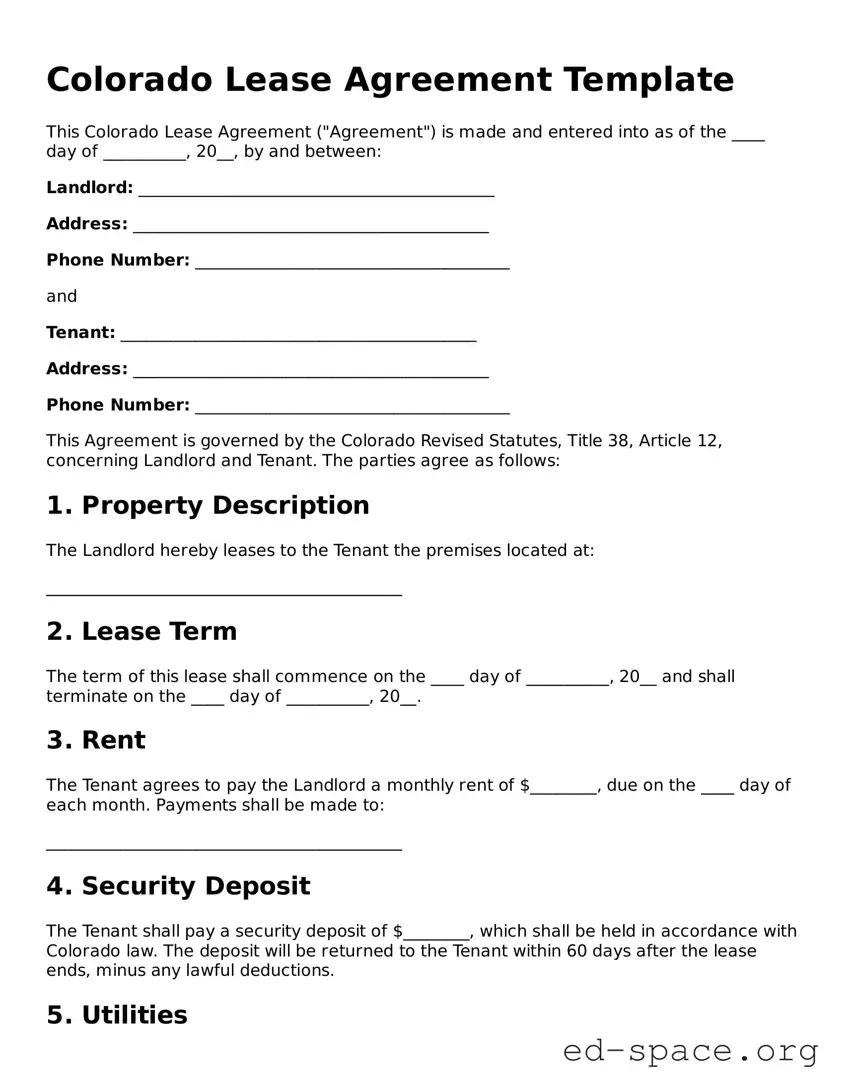
In the state of Colorado, a Lease Agreement form serves as a vital document that outlines the terms and conditions governing the rental of residential or commercial property. This legally binding contract is designed to protect the interests of both landlords and tenants by specifying essential details such as the duration of the lease, the amount of rent due, and the responsibilities for maintenance and repairs. Additionally, it includes provisions related to security deposits, late fees, and the procedures for terminating the lease. By clearly defining the rights and obligations of each party, the Lease Agreement form minimizes the potential for disputes and fosters a transparent rental relationship. It is important for both landlords and tenants to understand the nuances of this document, as it not only serves as a reference point during the tenancy but also plays a crucial role in the event of any legal issues that may arise. Familiarity with the form can lead to a smoother rental experience and ensure compliance with Colorado state laws.
Colorado Lease Agreement Template
This Colorado Lease Agreement ("Agreement") is made and entered into as of the ____ day of __________, 20__, by and between:
Landlord: ___________________________________________
Address: ___________________________________________
Phone Number: ______________________________________
and
Tenant: ___________________________________________
Address: ___________________________________________
Phone Number: ______________________________________
This Agreement is governed by the Colorado Revised Statutes, Title 38, Article 12, concerning Landlord and Tenant. The parties agree as follows:
1. Property Description
The Landlord hereby leases to the Tenant the premises located at:
___________________________________________
2. Lease Term
The term of this lease shall commence on the ____ day of __________, 20__ and shall terminate on the ____ day of __________, 20__.
3. Rent
The Tenant agrees to pay the Landlord a monthly rent of $________, due on the ____ day of each month. Payments shall be made to:
___________________________________________
4. Security Deposit
The Tenant shall pay a security deposit of $________, which shall be held in accordance with Colorado law. The deposit will be returned to the Tenant within 60 days after the lease ends, minus any lawful deductions.
5. Utilities
The Tenant shall be responsible for the following utilities:
6. Maintenance and Repairs
The Tenant agrees to maintain the premises in good condition. The Landlord shall be responsible for major repairs unless damage is caused by the Tenant’s negligence.
7. Use of Premises
The Tenant shall use the premises solely for residential purposes and shall not engage in any illegal activities on the property.
8. Termination
Either party may terminate this lease by providing written notice at least 30 days prior to the desired termination date.
9. Governing Law
This Agreement shall be governed by the laws of the State of Colorado.
IN WITNESS WHEREOF, the parties hereto have executed this Lease Agreement as of the date first above written.
Landlord Signature: ___________________________ Date: _______________
Tenant Signature: ___________________________ Date: _______________
| Fact Name | Description |
|---|---|
| Purpose | The Colorado Lease Agreement form is used to outline the terms and conditions between a landlord and tenant for renting residential or commercial property. |
| Governing Laws | This lease agreement is governed by the Colorado Revised Statutes, specifically Title 38, Article 12, which covers landlord-tenant relationships. |
| Security Deposit | In Colorado, landlords may require a security deposit, which cannot exceed one month's rent unless otherwise agreed upon in writing. |
| Duration | The lease can be for a fixed term, such as one year, or it can be month-to-month, providing flexibility for both parties. |
| Disclosures | Landlords must provide certain disclosures, including information about lead-based paint and any known hazards in the property. |
Completing the Colorado Lease Agreement form is an important step in establishing the terms of a rental arrangement. This process ensures that both the landlord and tenant understand their rights and responsibilities. Follow these steps carefully to fill out the form accurately.
What is a Colorado Lease Agreement form?
A Colorado Lease Agreement form is a legal document that outlines the terms and conditions under which a landlord rents property to a tenant. It details the responsibilities of both parties, including rent payment, maintenance duties, and other important aspects of the rental relationship.
What information is typically included in a Colorado Lease Agreement?
This agreement generally includes the names of the landlord and tenant, the property address, rental amount, security deposit details, lease duration, and specific rules regarding pets, maintenance, and utilities. It may also cover what happens if either party breaks the lease.
How long does a typical lease last in Colorado?
In Colorado, leases can vary in length. A common duration is one year, but they can also be month-to-month or for a shorter term. The specific duration should be clearly stated in the lease agreement to avoid confusion.
Can a landlord increase rent during a lease term?
Generally, landlords cannot increase rent during a fixed-term lease unless the lease explicitly allows for it. If the lease is month-to-month, the landlord can increase rent with proper notice, typically 30 days in Colorado.
What is a security deposit, and how is it handled?
A security deposit is a sum of money that a tenant pays to cover potential damages or unpaid rent. In Colorado, landlords can charge up to one month's rent as a security deposit. Upon lease termination, landlords must return the deposit within 60 days, minus any deductions for damages or unpaid rent.
Are there any specific tenant rights in Colorado?
Yes, tenants in Colorado have various rights, including the right to a habitable living space, privacy, and protection against retaliation for exercising their rights. It’s essential for tenants to know these rights to ensure they are treated fairly.
What should I do if I need to break my lease early?
If you need to break your lease early, review your lease agreement first. Many leases include an early termination clause that outlines the process and potential penalties. Communicating with your landlord about your situation can also help, as they may be willing to negotiate.
Is a written lease agreement required in Colorado?
While a written lease is not legally required for leases shorter than one year, it is highly recommended. A written lease provides clarity and protects both parties by clearly outlining their rights and responsibilities.
What happens if a tenant violates the lease agreement?
If a tenant violates the lease, the landlord has the right to take action, which may include issuing a warning or starting eviction proceedings. The specific consequences depend on the nature of the violation and the terms outlined in the lease agreement.
Can a lease be renewed automatically in Colorado?
Some leases include an automatic renewal clause, which means the lease will renew for another term unless either party provides notice to terminate. If no such clause exists, tenants and landlords must negotiate a new lease agreement before the current one expires.
Failing to include all required personal information. This includes the names of all tenants and landlords. Omitting any party can lead to confusion later.
Not specifying the lease term. It is crucial to clearly state the start and end dates of the lease. A lack of clarity can result in misunderstandings about when the lease begins and ends.
Ignoring the security deposit details. The amount of the deposit, the conditions for its return, and any deductions should be clearly outlined. This helps prevent disputes when the lease ends.
Overlooking maintenance responsibilities. Both landlords and tenants should understand who is responsible for repairs and maintenance. Clearly defining these responsibilities can avoid conflicts.
Not including rules about pets. If pets are allowed, the agreement should specify any restrictions or additional deposits required. This helps set clear expectations for both parties.
Failing to address early termination clauses. Both parties should know what happens if one party needs to end the lease early. This can save time and money in the long run.
Neglecting to clarify the payment method. The lease should specify how rent is to be paid, whether by check, online transfer, or another method. This can help avoid payment disputes.
Not reviewing the entire document before signing. It is essential for both parties to read the lease thoroughly. Understanding every clause can prevent future issues.
When entering into a lease agreement in Colorado, various forms and documents often accompany the main lease. These additional documents help clarify responsibilities, outline terms, and ensure both parties are protected. Below is a list of commonly used forms that may be relevant in conjunction with a Colorado Lease Agreement.
These documents play a crucial role in the leasing process. They not only protect the interests of both landlords and tenants but also help create a clear understanding of expectations and responsibilities. Having these forms readily available can streamline communication and reduce potential conflicts throughout the rental period.
When filling out the Colorado Lease Agreement form, it's important to approach the task with care. Here are five things you should and shouldn't do:
Following these guidelines can help ensure that the lease agreement is filled out correctly and meets the legal requirements in Colorado.
Understanding the Colorado Lease Agreement form is crucial for both landlords and tenants. However, several misconceptions can lead to confusion. Here are five common misunderstandings:
While it is highly recommended to have a written lease for clarity and protection, verbal agreements can also be enforceable in Colorado. However, proving the terms of a verbal agreement can be challenging.
This is not true. Lease agreements can vary significantly based on the property, the landlord's preferences, and local laws. Each lease should be tailored to fit specific needs and circumstances.
Many leases include a renewal clause, but this does not mean they renew indefinitely. Terms for renewal should be clearly outlined in the lease agreement, and tenants should be aware of any notice requirements.
In Colorado, security deposits are generally refundable, provided that the tenant fulfills the lease terms and leaves the property in good condition. Landlords must return the deposit within a specified time frame after the lease ends.
Landlords must provide reasonable notice before entering a rental property, typically 24 hours, unless there is an emergency. Tenants have the right to privacy, and landlords should respect that right.
By addressing these misconceptions, both landlords and tenants can better navigate their lease agreements and foster a positive rental experience.
When filling out and using the Colorado Lease Agreement form, it's essential to keep a few key points in mind. Here are some takeaways to ensure a smooth process:
By following these takeaways, you can navigate the Colorado Lease Agreement form with confidence and clarity.