Creating a Last Will and Testament is a crucial step in ensuring that your wishes regarding asset distribution and guardianship are honored after your passing. In Colorado, this legal document serves as a roadmap for your estate, detailing how your property should be divided among beneficiaries and who will take care of any minor children. The form typically includes essential elements such as the appointment of an executor, who will oversee the administration of your estate, as well as specific bequests to individuals or organizations. Additionally, it allows you to express your preferences regarding funeral arrangements and the management of debts. Understanding the nuances of the Colorado Last Will and Testament form can help individuals navigate the complexities of estate planning, ensuring that their intentions are clearly communicated and legally recognized. By taking the time to draft this document thoughtfully, you can provide peace of mind for both yourself and your loved ones during a difficult time.
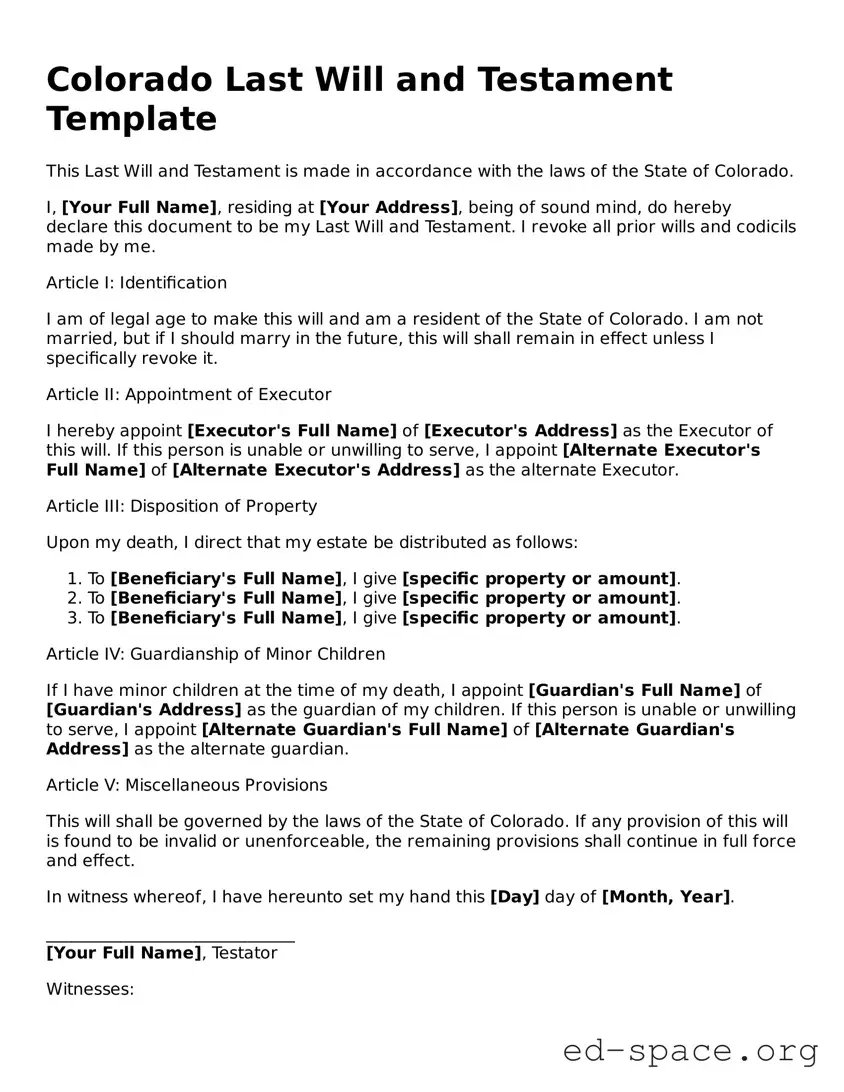
Colorado Last Will and Testament Template
This Last Will and Testament is made in accordance with the laws of the State of Colorado.
I, [Your Full Name], residing at [Your Address], being of sound mind, do hereby declare this document to be my Last Will and Testament. I revoke all prior wills and codicils made by me.
Article I: Identification
I am of legal age to make this will and am a resident of the State of Colorado. I am not married, but if I should marry in the future, this will shall remain in effect unless I specifically revoke it.
Article II: Appointment of Executor
I hereby appoint [Executor's Full Name] of [Executor's Address] as the Executor of this will. If this person is unable or unwilling to serve, I appoint [Alternate Executor's Full Name] of [Alternate Executor's Address] as the alternate Executor.
Article III: Disposition of Property
Upon my death, I direct that my estate be distributed as follows:
Article IV: Guardianship of Minor Children
If I have minor children at the time of my death, I appoint [Guardian's Full Name] of [Guardian's Address] as the guardian of my children. If this person is unable or unwilling to serve, I appoint [Alternate Guardian's Full Name] of [Alternate Guardian's Address] as the alternate guardian.
Article V: Miscellaneous Provisions
This will shall be governed by the laws of the State of Colorado. If any provision of this will is found to be invalid or unenforceable, the remaining provisions shall continue in full force and effect.
In witness whereof, I have hereunto set my hand this [Day] day of [Month, Year].
______________________________
[Your Full Name], Testator
Witnesses:
We, the undersigned witnesses, hereby declare that the above-named Testator signed this Last Will and Testament in our presence, and we affirm that the Testator is of sound mind and free from undue influence.
Signed in the presence of the above witnesses on this [Day] day of [Month, Year].
| Fact Name | Description |
|---|---|
| Legal Foundation | The Colorado Last Will and Testament is governed by the Colorado Revised Statutes, specifically Title 15, Article 11. |
| Age Requirement | To create a valid will in Colorado, the testator must be at least 18 years old. |
| Witness Requirement | Colorado law requires that a will be signed in the presence of at least two witnesses, who must also sign the document. |
| Holographic Wills | A handwritten will, or holographic will, is valid in Colorado if it is signed by the testator and the material provisions are in the testator's handwriting. |
| Revocation | A will can be revoked in Colorado by creating a new will or by physically destroying the existing will with the intent to revoke it. |
| Self-Proving Wills | In Colorado, a will can be made self-proving by including a notarized affidavit from the witnesses, simplifying the probate process. |
| Distribution of Assets | Without a will, Colorado law dictates that assets will be distributed according to intestacy laws, which may not align with the deceased's wishes. |
Filling out the Colorado Last Will and Testament form is an important step in ensuring that your wishes regarding your estate are clearly communicated. After completing the form, it is advisable to have it signed and witnessed according to state requirements. This will help ensure that your will is legally valid and enforceable.
What is a Colorado Last Will and Testament form?
A Colorado Last Will and Testament form is a legal document that outlines how a person wishes to distribute their assets after they pass away. It allows individuals to specify who will receive their property, appoint guardians for minor children, and name an executor to manage their estate. This document is essential for ensuring that a person's wishes are honored and can help avoid disputes among family members.
Do I need to have a lawyer to create a will in Colorado?
No, you do not need a lawyer to create a will in Colorado. You can draft your own will using templates or forms available online. However, it is often beneficial to consult with a lawyer, especially if your estate is complex or if you have specific concerns. A lawyer can help ensure that your will meets all legal requirements and reflects your wishes accurately.
What are the requirements for a valid will in Colorado?
In Colorado, for a will to be valid, it must be in writing and signed by the person making the will (the testator). Additionally, the will must be witnessed by at least two people who are not beneficiaries. These witnesses must sign the will in the presence of the testator. It is also recommended to include a self-proving affidavit, which can simplify the probate process later on.
Can I change my will after it is created?
Yes, you can change your will at any time while you are still alive. To make changes, you can either create a new will or add a codicil, which is an amendment to the existing will. It is important to follow the same legal requirements for signing and witnessing when making changes. Regularly reviewing and updating your will ensures that it reflects your current wishes and circumstances.
Not being specific about beneficiaries. Individuals often fail to clearly identify who will receive their assets. Vague terms can lead to confusion and disputes among family members.
Forgetting to include alternate beneficiaries. In the event that a primary beneficiary passes away before the testator, the absence of alternate beneficiaries can create complications. It is essential to name backups to ensure assets are distributed as intended.
Neglecting to sign the document properly. A will must be signed in accordance with Colorado law. If the signature is missing or not witnessed correctly, the will may be deemed invalid.
Failing to update the will after major life changes. Events such as marriage, divorce, or the birth of a child should prompt a review of the will. Outdated information can lead to unintended distributions.
Not considering the implications of digital assets. Many individuals overlook their online accounts and digital properties. It is important to specify how these assets should be handled in the will.
A Last Will and Testament is an essential document for anyone looking to outline their wishes regarding the distribution of their assets after passing. However, several other forms and documents are often used alongside a will to ensure that all aspects of estate planning are addressed. Below is a list of commonly used documents that complement the Colorado Last Will and Testament.
Considering these additional documents can help provide clarity and ensure that your wishes are honored. Proper estate planning encompasses various aspects, and having the right forms in place can ease the burden on your loved ones during difficult times.
When filling out the Colorado Last Will and Testament form, it is essential to follow certain guidelines to ensure that your wishes are clearly articulated and legally recognized. Below is a list of dos and don’ts to consider:
Following these guidelines can help ensure that your Last Will and Testament reflects your true intentions and adheres to Colorado law.
Understanding the Colorado Last Will and Testament form is essential for effective estate planning. However, several misconceptions can lead to confusion. Here are six common misconceptions:
Clarifying these misconceptions can help individuals in Colorado navigate the estate planning process more effectively.
Filling out a Last Will and Testament in Colorado is an important step in ensuring your wishes are honored after you pass away. Here are some key takeaways to keep in mind: