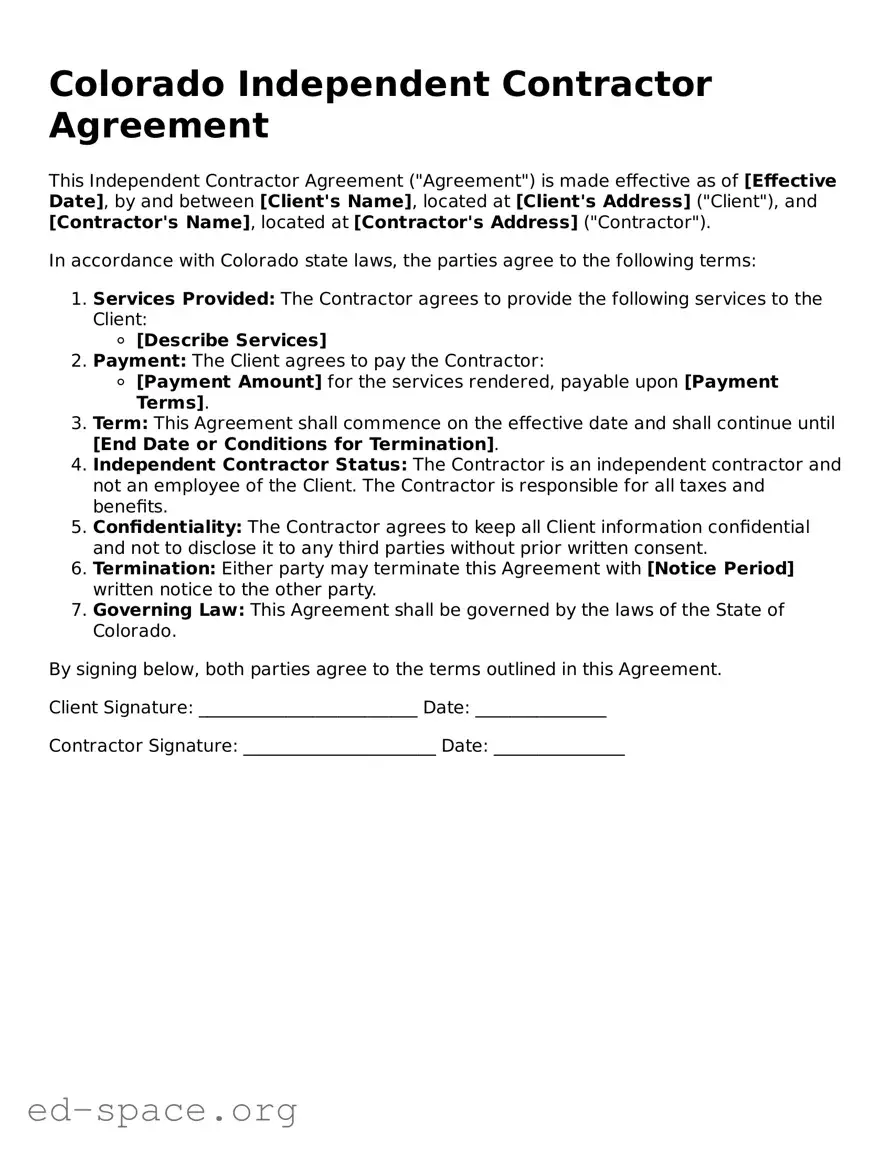
The Colorado Independent Contractor Agreement form serves as a crucial tool for both businesses and independent contractors in the state. This document outlines the terms and conditions of the working relationship, ensuring clarity and mutual understanding. Key elements typically included in the agreement are the scope of work, payment terms, and the duration of the contract. Additionally, it addresses the rights and responsibilities of both parties, which helps prevent misunderstandings down the line. By specifying whether the contractor will provide their own tools and materials, the form delineates the level of control the business has over the contractor's work. This agreement also often includes provisions related to confidentiality and intellectual property, safeguarding sensitive information and creative outputs. Overall, the Colorado Independent Contractor Agreement form is designed to protect the interests of both the contractor and the hiring entity, making it an essential component of freelance and contract work in the state.
Colorado Independent Contractor Agreement
This Independent Contractor Agreement ("Agreement") is made effective as of [Effective Date], by and between [Client's Name], located at [Client's Address] ("Client"), and [Contractor's Name], located at [Contractor's Address] ("Contractor").
In accordance with Colorado state laws, the parties agree to the following terms:
By signing below, both parties agree to the terms outlined in this Agreement.
Client Signature: _________________________ Date: _______________
Contractor Signature: ______________________ Date: _______________
| Fact Name | Detail |
|---|---|
| Definition | The Colorado Independent Contractor Agreement form outlines the terms between a contractor and a hiring entity. |
| Purpose | This form clarifies the relationship, responsibilities, and expectations of both parties involved in the contract. |
| Governing Law | The agreement is governed by the laws of the State of Colorado. |
| Key Components | Essential elements include payment terms, project scope, and duration of the contract. |
| Signatures | Both parties must sign the agreement to make it legally binding. |
Filling out the Colorado Independent Contractor Agreement form is an important step in establishing a clear working relationship between a contractor and a client. This form outlines the terms of the agreement, ensuring both parties understand their rights and responsibilities. Below are the steps to complete the form accurately.
Once the form is filled out and signed, both parties should retain a copy for their records. This ensures that everyone has a clear understanding of the terms of the agreement moving forward.
What is a Colorado Independent Contractor Agreement?
A Colorado Independent Contractor Agreement is a legal document that outlines the terms and conditions between a business and an independent contractor. This agreement specifies the scope of work, payment terms, and responsibilities of both parties. It is essential for establishing the nature of the working relationship and protecting the rights of both the contractor and the business.
Why is it important to have a written Independent Contractor Agreement?
Having a written agreement is crucial for several reasons. It provides clarity on the expectations and obligations of both parties, which can help prevent misunderstandings. A written agreement also serves as evidence in case of disputes, ensuring that both parties can refer back to the agreed-upon terms. Additionally, it helps to define the contractor's status, which is important for tax and liability purposes.
What key elements should be included in the agreement?
Key elements of a Colorado Independent Contractor Agreement include the following: a clear description of the services to be provided, payment terms, deadlines, confidentiality clauses, and termination conditions. It is also advisable to include provisions regarding intellectual property rights and dispute resolution methods. These elements help ensure that both parties understand their rights and responsibilities.
How does this agreement affect tax obligations?
The Independent Contractor Agreement affects tax obligations by clarifying the contractor's status as a self-employed individual. Unlike employees, independent contractors are responsible for their own taxes, including income tax and self-employment tax. The agreement should specify that the contractor will receive a Form 1099 for tax reporting purposes, rather than a W-2, which is used for employees.
Can the terms of the agreement be modified after signing?
Yes, the terms of the agreement can be modified after signing, but both parties must agree to the changes in writing. This ensures that any amendments are legally binding and clear to both parties. It is advisable to document any changes to avoid confusion and maintain a clear record of the agreement's evolution over time.
Failing to provide accurate personal information. It is essential to include the correct name, address, and contact details. Inaccuracies can lead to delays or disputes.
Not specifying the scope of work clearly. The agreement should detail the services to be provided. Vague descriptions can result in misunderstandings.
Neglecting to outline payment terms. Clearly stating the payment amount, schedule, and method is crucial. Omitting this information can lead to payment issues.
Overlooking the inclusion of deadlines. Setting specific timelines for project completion helps both parties manage expectations and responsibilities.
Failing to address confidentiality. If sensitive information will be shared, including a confidentiality clause is important to protect both parties.
Not considering liability and indemnification. Clarifying responsibilities in case of damages or disputes can prevent future legal complications.
Ignoring the need for signatures. Both parties must sign the agreement for it to be valid. Without signatures, the agreement may not hold up in court.
Not reviewing the agreement before submission. Taking the time to read through the entire document can help catch errors or omissions that could be problematic later.
When entering into a business relationship with an independent contractor in Colorado, several forms and documents may be necessary to ensure clarity and compliance. These documents help outline the terms of the relationship, protect both parties, and provide a framework for managing the agreement effectively. Below is a list of commonly used forms and documents that often accompany the Colorado Independent Contractor Agreement.
Utilizing these forms and documents in conjunction with the Colorado Independent Contractor Agreement can help foster a professional relationship, minimize misunderstandings, and ensure compliance with legal requirements. Each document serves a specific purpose and contributes to a well-structured agreement between the contractor and the client.
Service Agreement: This document outlines the terms under which services will be provided. Like the Independent Contractor Agreement, it specifies the responsibilities of both parties, payment terms, and duration of the service.
Consulting Agreement: Similar to the Independent Contractor Agreement, this document is used when a consultant is hired to provide expert advice. It details the scope of work, compensation, and confidentiality obligations.
Freelance Agreement: This agreement is tailored for freelancers and shares many similarities with the Independent Contractor Agreement, including project scope, payment schedules, and ownership of work produced.
Non-Disclosure Agreement (NDA): While primarily focused on confidentiality, an NDA often accompanies an Independent Contractor Agreement. It protects sensitive information shared during the working relationship.
Partnership Agreement: Though it involves two or more parties collaborating, it can resemble an Independent Contractor Agreement in terms of outlining roles, responsibilities, and profit-sharing arrangements.
Employment Agreement: While typically for employees, certain sections may mirror those found in an Independent Contractor Agreement, such as job duties and compensation, but with different legal implications.
Joint Venture Agreement: This document outlines the terms of collaboration between two or more parties for a specific project. It shares similarities in defining roles, contributions, and profit-sharing, akin to an Independent Contractor Agreement.
Memorandum of Understanding (MOU): An MOU establishes a mutual agreement between parties. It is less formal than a contract but can outline similar terms regarding expectations and responsibilities.
License Agreement: This document allows one party to use another's intellectual property under specified conditions. It can include terms similar to those in an Independent Contractor Agreement regarding usage rights and obligations.
Project Agreement: This agreement is specifically focused on the details of a particular project. It outlines deliverables, timelines, and payment terms, much like an Independent Contractor Agreement.
When filling out the Colorado Independent Contractor Agreement form, it's essential to follow certain guidelines to ensure the process goes smoothly. Below is a list of things you should and shouldn't do.
Understanding the Colorado Independent Contractor Agreement form is crucial for both businesses and independent contractors. However, several misconceptions can lead to confusion. Here are four common misunderstandings:
By addressing these misconceptions, both businesses and independent contractors can navigate their agreements more effectively and foster successful working relationships.
When navigating the Colorado Independent Contractor Agreement form, it's important to keep several key points in mind. These takeaways will help ensure clarity and compliance throughout the process.
By paying attention to these elements, both contractors and hiring entities can foster a successful working relationship while minimizing potential disputes.