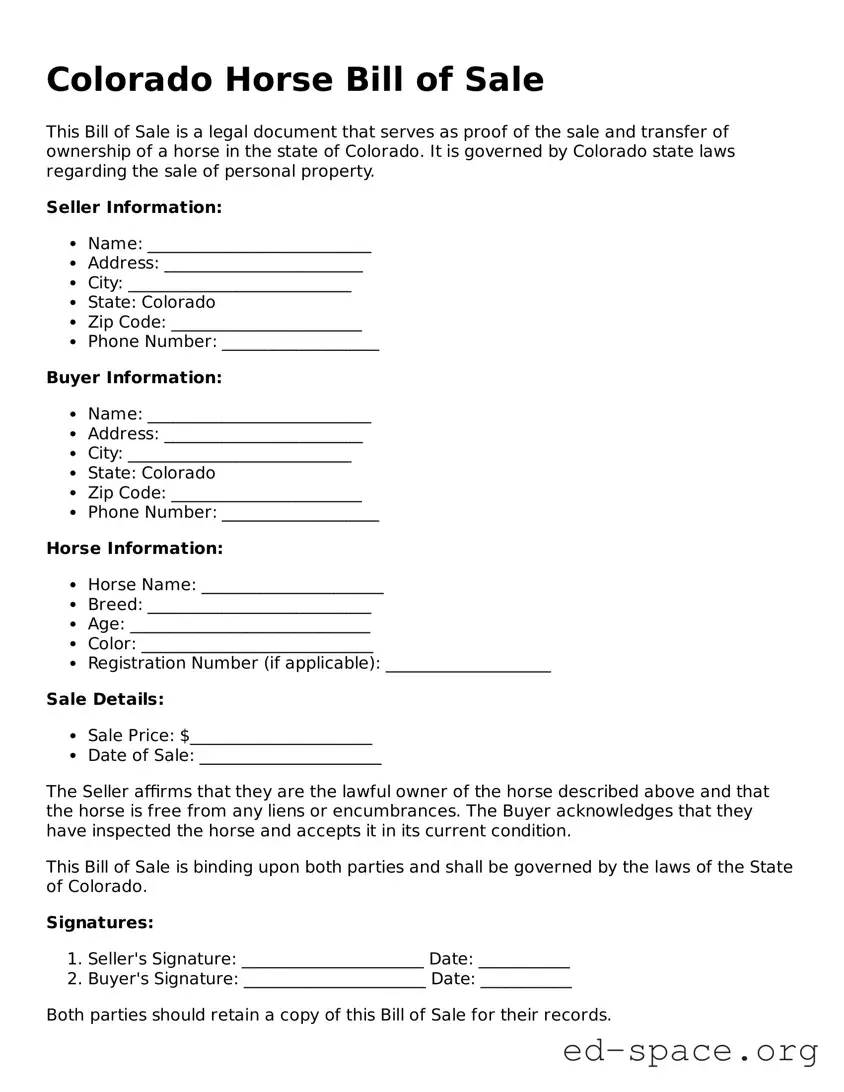
The Colorado Horse Bill of Sale form serves as a crucial document in equine transactions, providing both buyers and sellers with a clear record of the sale. This form typically includes essential information such as the names and contact details of both parties, a detailed description of the horse being sold—including breed, age, color, and any identifying marks—and the agreed-upon sale price. Additionally, the form may outline any warranties or representations made by the seller regarding the horse's health and soundness, ensuring that both parties have a mutual understanding of the terms. By documenting the transaction, this form helps protect the interests of both buyers and sellers, reducing the potential for disputes in the future. Understanding the importance of this document is vital for anyone involved in the buying or selling of horses in Colorado, as it not only serves as proof of ownership but also provides a legal framework that governs the transaction.
Colorado Horse Bill of Sale
This Bill of Sale is a legal document that serves as proof of the sale and transfer of ownership of a horse in the state of Colorado. It is governed by Colorado state laws regarding the sale of personal property.
Seller Information:
Buyer Information:
Horse Information:
Sale Details:
The Seller affirms that they are the lawful owner of the horse described above and that the horse is free from any liens or encumbrances. The Buyer acknowledges that they have inspected the horse and accepts it in its current condition.
This Bill of Sale is binding upon both parties and shall be governed by the laws of the State of Colorado.
Signatures:
Both parties should retain a copy of this Bill of Sale for their records.
| Fact Name | Details |
|---|---|
| Purpose | The Colorado Horse Bill of Sale form is used to document the sale and transfer of ownership of a horse in Colorado. |
| Requirements | The form should include details such as the buyer's and seller's names, the horse's description, and the sale price. |
| Governing Law | This form is governed by Colorado state law, specifically the Uniform Commercial Code (UCC) as it pertains to the sale of goods. |
| Signatures | Both the buyer and seller must sign the document to validate the sale and transfer of ownership. |
Completing the Colorado Horse Bill of Sale form is a straightforward process. This document serves to officially transfer ownership of a horse from one party to another. Follow the steps below to ensure all necessary information is accurately recorded.
What is a Colorado Horse Bill of Sale form?
A Colorado Horse Bill of Sale form is a legal document that serves as proof of the sale and transfer of ownership of a horse. This form outlines essential details such as the horse's description, the sale price, and the names of both the seller and buyer. Having this document is crucial for both parties, as it provides clarity and protects their rights in the transaction. It can also be useful for future reference, especially in cases of disputes or if the new owner needs to register the horse with an association.
Why is it important to use a Bill of Sale when selling or buying a horse?
Using a Bill of Sale is important for several reasons. First, it establishes a clear record of the transaction, which can help prevent misunderstandings between the seller and buyer. This document acts as evidence of the sale, which can be vital if any legal issues arise later. Additionally, the Bill of Sale can protect both parties from potential liabilities, such as undisclosed health issues or prior ownership disputes. It also serves as a formal acknowledgment that the buyer has taken possession of the horse.
What information should be included in a Colorado Horse Bill of Sale?
A comprehensive Colorado Horse Bill of Sale should include specific information to ensure clarity and legality. Essential details include the horse's name, breed, age, color, and any unique identifying marks. The document should also state the sale price and the date of the transaction. Both the seller's and buyer's names, addresses, and signatures are required to validate the agreement. Additionally, including any warranties or representations about the horse's health or training can further protect both parties.
Is it necessary to have the Bill of Sale notarized?
While it is not legally required to have a Colorado Horse Bill of Sale notarized, doing so can add an extra layer of protection. Notarization verifies the identities of the parties involved and confirms that they willingly signed the document. This can be particularly beneficial if disputes arise in the future. Some buyers or sellers may prefer to have the Bill of Sale notarized to ensure its validity and to bolster their legal standing should any issues occur down the line.
Failing to provide complete and accurate information about the horse. This includes the horse's name, breed, age, and color.
Not including the seller's and buyer's full names and contact information. It is essential to have clear identification of both parties involved.
Omitting the sale price. This is a critical component of the bill of sale and should be clearly stated.
Not signing the document. Both the seller and buyer must sign the bill of sale to make it legally binding.
Using unclear or ambiguous language. Be specific in describing the terms of the sale to avoid misunderstandings.
Neglecting to include any warranties or guarantees. If there are specific conditions regarding the horse's health or behavior, they should be documented.
Not providing a date for the transaction. Including the date helps establish when the sale took place.
Failing to keep copies of the bill of sale. Both parties should retain a copy for their records.
Not checking local regulations. Different areas may have specific requirements for horse sales that need to be adhered to.
When buying or selling a horse in Colorado, several forms and documents may accompany the Horse Bill of Sale. These documents help ensure a smooth transaction and provide necessary information for both parties involved. Below is a list of commonly used forms that you might consider.
Utilizing these forms can provide clarity and protection for both the buyer and seller. It is advisable to review each document carefully and ensure that all necessary information is included to facilitate a successful horse transaction.
The Horse Bill of Sale form is an important document in the transfer of ownership of a horse. It serves as proof of the sale and outlines the terms agreed upon by both the buyer and the seller. Several other documents share similar purposes and functions in various transactions. Here is a list of eight documents that are similar to the Horse Bill of Sale form:
Each of these documents plays a vital role in ensuring that transactions are legally recognized and that both parties have a clear understanding of the terms involved.
When completing the Colorado Horse Bill of Sale form, follow these guidelines to ensure accuracy and compliance.
Do's:
Don'ts:
The Colorado Horse Bill of Sale form is often misunderstood. Here are five common misconceptions about it:
Many people believe that a bill of sale is just a piece of paper with no real legal weight. In reality, a properly executed bill of sale serves as a legal document that can protect both the buyer and the seller in case of disputes.
Some think that a bill of sale is only required for high-value transactions. However, regardless of the horse's price, having a bill of sale is a smart practice to document the sale and transfer of ownership.
While notarization is not always required, having the bill of sale notarized adds an extra layer of protection. It helps verify the identities of the parties involved and the authenticity of the document.
Some believe that the bill of sale is primarily for the seller's benefit. In fact, it protects both parties by outlining the terms of the sale, including any warranties or guarantees.
While a receipt confirms payment, a bill of sale includes more detailed information about the horse, such as its registration, health records, and any conditions of the sale. This makes it a more comprehensive document.
When engaging in the sale or purchase of a horse in Colorado, utilizing a Horse Bill of Sale form is essential. Here are some key takeaways to consider:
By following these guidelines, individuals can navigate the process of buying or selling a horse in Colorado more confidently and effectively.