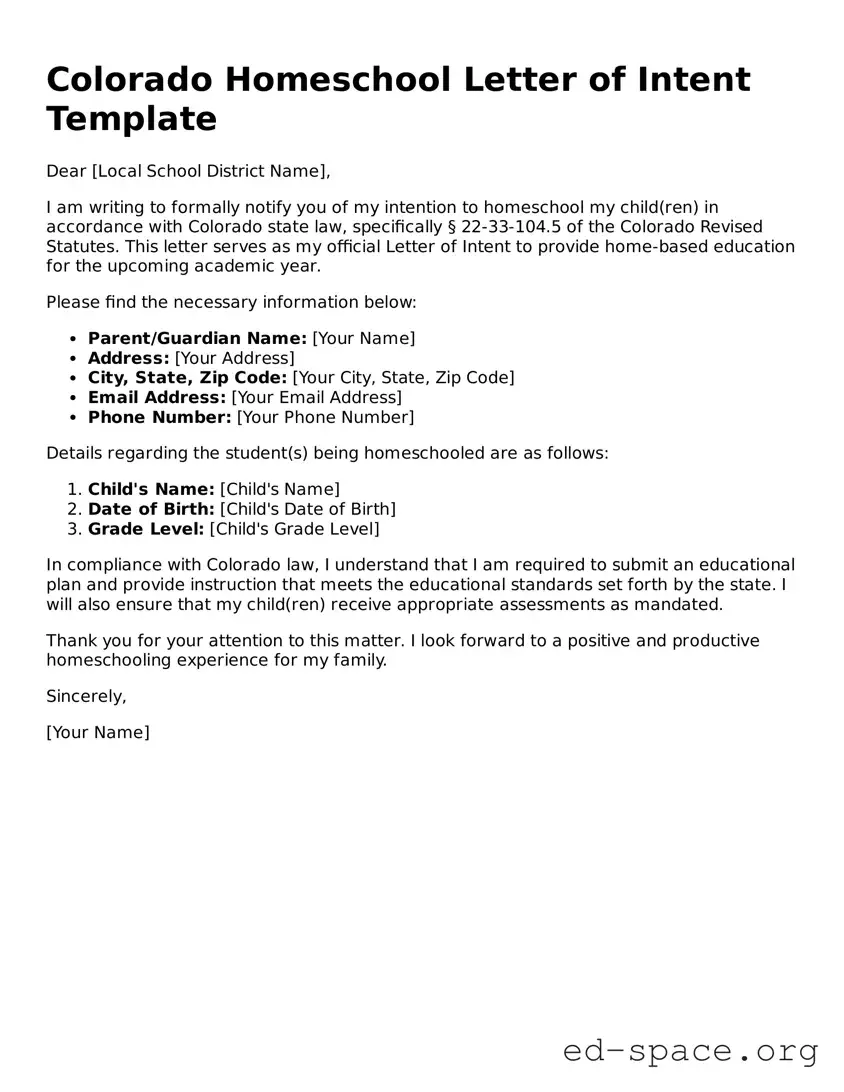
In Colorado, families choosing to educate their children at home are required to submit a Homeschool Letter of Intent to their local school district. This form serves as a formal notification of a family's intention to homeschool, outlining essential details such as the names and ages of the children being homeschooled, the educational curriculum or instructional methods to be used, and the anticipated duration of the homeschooling arrangement. By completing this form, parents affirm their commitment to providing a comprehensive educational experience that meets state requirements. Additionally, the letter must be submitted annually, ensuring that school districts are informed about homeschooling families within their jurisdiction. Understanding the specific requirements and implications of the Homeschool Letter of Intent is crucial for parents to navigate the homeschooling landscape effectively and comply with state regulations.
Colorado Homeschool Letter of Intent Template
Dear [Local School District Name],
I am writing to formally notify you of my intention to homeschool my child(ren) in accordance with Colorado state law, specifically § 22-33-104.5 of the Colorado Revised Statutes. This letter serves as my official Letter of Intent to provide home-based education for the upcoming academic year.
Please find the necessary information below:
Details regarding the student(s) being homeschooled are as follows:
In compliance with Colorado law, I understand that I am required to submit an educational plan and provide instruction that meets the educational standards set forth by the state. I will also ensure that my child(ren) receive appropriate assessments as mandated.
Thank you for your attention to this matter. I look forward to a positive and productive homeschooling experience for my family.
Sincerely,
[Your Name]
| Fact Name | Description |
|---|---|
| Purpose | The Colorado Homeschool Letter of Intent form is used to officially notify the state of a parent's intent to homeschool their child. |
| Governing Law | The form is governed by Colorado Revised Statutes § 22-33-104.5, which outlines the requirements for homeschooling in the state. |
| Submission Deadline | Parents must submit the Letter of Intent within 14 days of beginning homeschooling. |
| Required Information | The form requires basic information such as the child's name, age, and the address of the homeschooling location. |
| Annual Updates | Parents must submit a new Letter of Intent each year to continue homeschooling their child. |
| Record Keeping | While the form does not need to be submitted annually, parents are advised to keep a copy for their records. |
| Notification of Changes | If there are any changes in the homeschooling situation, parents must notify the school district promptly. |
| District Responsibilities | Upon receipt of the form, the school district is responsible for acknowledging the intent to homeschool. |
| Access to Resources | Filing the Letter of Intent may provide access to certain educational resources and support from local homeschooling groups. |
After you complete the Colorado Homeschool Letter of Intent form, you will submit it to your school district. This step is essential for officially notifying the district of your intention to homeschool your child. Make sure to keep a copy for your records.
What is the Colorado Homeschool Letter of Intent?
The Colorado Homeschool Letter of Intent is a formal document that parents or guardians must submit to notify their local school district of their intention to homeschool their children. This letter serves as a crucial first step in the homeschooling process, ensuring that families comply with state regulations regarding home education.
Who needs to submit the Letter of Intent?
Any parent or guardian who wishes to homeschool their child in Colorado must submit this letter. This requirement applies to all children who are of compulsory school age, typically between the ages of 6 and 17. Even if you have previously homeschooled, a new Letter of Intent is necessary if you are starting a new academic year or if your child is transitioning from public or private school.
When should I submit the Letter of Intent?
The Letter of Intent should be submitted at least 14 days before you begin homeschooling. It’s best to send it in as early as possible to avoid any delays. By planning ahead, you ensure that your homeschooling experience starts smoothly and without unnecessary interruptions.
What information is required in the Letter of Intent?
Your Letter of Intent should include your name, address, and the names and ages of the children you plan to homeschool. Additionally, you may want to specify the educational curriculum you intend to use, although this is not mandatory. Providing clear and accurate information helps the school district process your intent efficiently.
Where do I send the Letter of Intent?
The completed Letter of Intent must be sent to your local school district. Each district may have its own preferred method of submission, whether by mail, email, or an online portal. Check your district's website for specific instructions to ensure your letter reaches the right place.
What happens after I submit the Letter of Intent?
Once your Letter of Intent is submitted, the school district will review it. They may reach out for any additional information if needed. After approval, you are free to start homeschooling your child. Keep a copy of the letter for your records, as it may be useful for future reference.
Do I need to submit a new Letter of Intent every year?
Yes, you must submit a new Letter of Intent for each academic year. This requirement helps ensure that your homeschooling status is up-to-date with the school district. It also allows you to make any necessary updates regarding your educational plans or any changes in your child's status.
What if I decide to stop homeschooling?
If you choose to discontinue homeschooling, it is important to notify your local school district. While there is no formal requirement to submit a letter for this, informing them helps maintain clear communication. If your child will be enrolling back into a public or private school, follow the school’s enrollment procedures.
Are there any consequences for not submitting the Letter of Intent?
Failing to submit the Letter of Intent can lead to complications. The state requires this notification to ensure that all children receive an education. If you do not comply, your child may be considered truant, which can lead to legal issues. To avoid any potential problems, it is crucial to submit the letter on time and follow all homeschooling regulations.
Incomplete Information: Many parents forget to fill out all required fields. Missing details can lead to delays or even rejection of the application.
Incorrect Student Age: Some individuals mistakenly provide the wrong age or grade level for their child. This can create confusion regarding educational requirements.
Failure to Sign: It's easy to overlook the importance of a signature. An unsigned form is invalid and will not be processed.
Not Submitting on Time: Parents often miss the deadline for submitting the letter of intent. Timeliness is crucial to ensure compliance with state regulations.
Ignoring Local Guidelines: Each school district may have specific requirements. Failing to check local guidelines can lead to additional complications.
When families decide to homeschool their children in Colorado, they often need to complete various forms and documents in addition to the Homeschool Letter of Intent. Each of these documents serves a specific purpose and helps ensure compliance with state regulations while supporting the educational journey of the student. Below is a list of commonly used forms that accompany the Homeschool Letter of Intent.
Utilizing these forms and documents can help streamline the homeschooling process and ensure compliance with state laws. Each document plays a vital role in documenting the educational experience and supporting the child's learning journey.
When filling out the Colorado Homeschool Letter of Intent form, it is important to adhere to specific guidelines to ensure compliance with state regulations. Below are seven recommendations that outline what to do and what to avoid during this process.
Following these guidelines will help ensure a smooth process when submitting the Homeschool Letter of Intent in Colorado.
Many families considering homeschooling in Colorado may have questions or misunderstandings about the Homeschool Letter of Intent form. Here are six common misconceptions that can help clarify the process.
Understanding these misconceptions can empower families to make informed decisions about their educational options. Homeschooling can be a rewarding journey, and clarity about the requirements can help ease any concerns.
When it comes to homeschooling in Colorado, completing the Homeschool Letter of Intent form is an essential step. Here are some key takeaways to keep in mind:
By following these guidelines, you can ensure a smooth homeschooling experience in Colorado. Stay organized and informed to make the most of your educational journey.