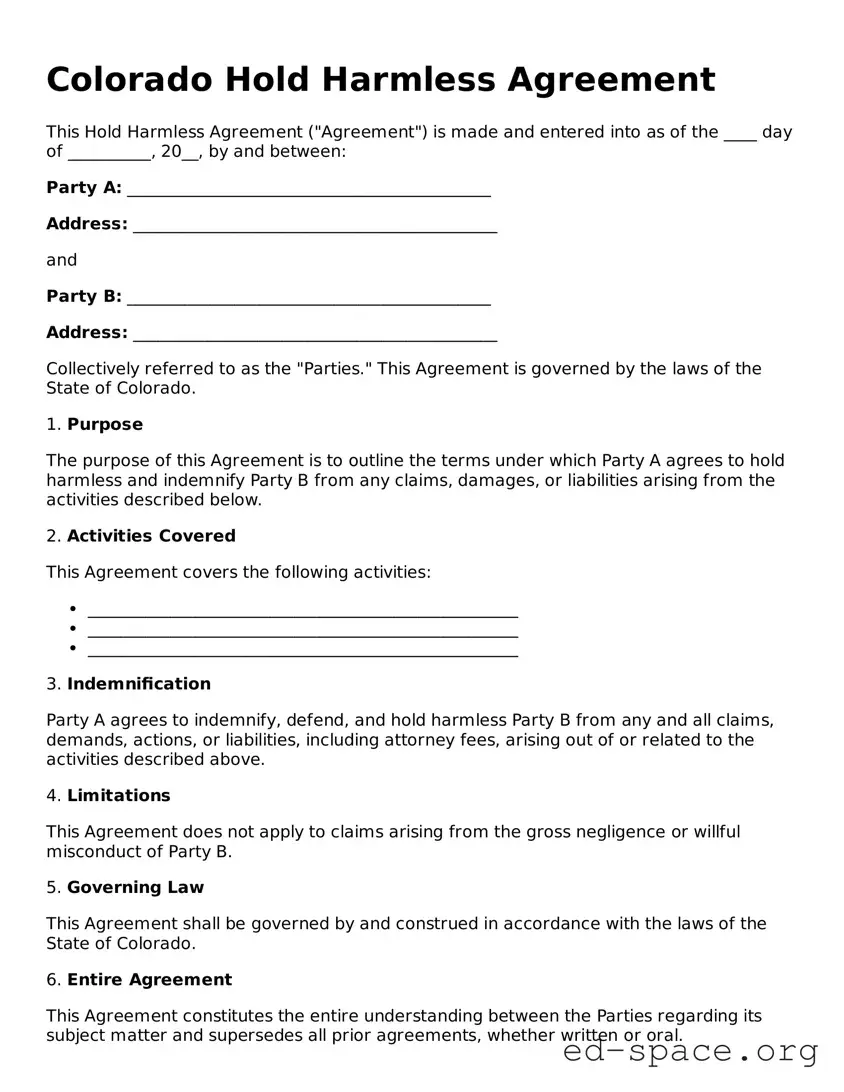
The Colorado Hold Harmless Agreement form is an essential legal document designed to protect one party from liability for any injuries or damages that may occur during a specific activity or event. This form typically outlines the responsibilities of each party involved, ensuring that one party agrees not to hold the other responsible for any potential claims. It is commonly used in various contexts, such as rental agreements, recreational activities, and contractor agreements. By signing this document, participants acknowledge the inherent risks associated with the activity and voluntarily assume those risks. The agreement also emphasizes the importance of clear communication between parties, as it sets forth the terms and conditions under which liability is waived. Understanding the nuances of this form can help individuals and organizations safeguard their interests while promoting a culture of safety and accountability.
Colorado Hold Harmless Agreement
This Hold Harmless Agreement ("Agreement") is made and entered into as of the ____ day of __________, 20__, by and between:
Party A: ____________________________________________
Address: ____________________________________________
and
Party B: ____________________________________________
Address: ____________________________________________
Collectively referred to as the "Parties." This Agreement is governed by the laws of the State of Colorado.
1. Purpose
The purpose of this Agreement is to outline the terms under which Party A agrees to hold harmless and indemnify Party B from any claims, damages, or liabilities arising from the activities described below.
2. Activities Covered
This Agreement covers the following activities:
3. Indemnification
Party A agrees to indemnify, defend, and hold harmless Party B from any and all claims, demands, actions, or liabilities, including attorney fees, arising out of or related to the activities described above.
4. Limitations
This Agreement does not apply to claims arising from the gross negligence or willful misconduct of Party B.
5. Governing Law
This Agreement shall be governed by and construed in accordance with the laws of the State of Colorado.
6. Entire Agreement
This Agreement constitutes the entire understanding between the Parties regarding its subject matter and supersedes all prior agreements, whether written or oral.
IN WITNESS WHEREOF, the Parties hereto have executed this Hold Harmless Agreement as of the date first above written.
Party A Signature: ________________________________
Date: ____________________________________________
Party B Signature: ________________________________
Date: ____________________________________________
| Fact Name | Description |
|---|---|
| Definition | A Hold Harmless Agreement is a contract where one party agrees to indemnify another against certain losses or damages. |
| Purpose | This agreement is often used to protect one party from legal liability arising from the actions of another party. |
| Common Uses | These agreements are frequently utilized in rental agreements, construction contracts, and event planning. |
| Governing Law | In Colorado, the agreement is governed by state contract laws, specifically Title 4 of the Colorado Revised Statutes. |
| Requirements | For a Hold Harmless Agreement to be valid, it must include clear language outlining the responsibilities of each party. |
| Enforceability | The agreement is generally enforceable unless it contains unconscionable terms or violates public policy. |
| Limitations | Parties cannot waive liability for gross negligence or willful misconduct in Colorado. |
| Mutual Agreements | Hold Harmless Agreements can be mutual, meaning both parties agree to indemnify each other under specified circumstances. |
| Written Format | While verbal agreements can exist, a written Hold Harmless Agreement is strongly recommended for clarity and enforceability. |
| Consultation | It is advisable to consult with a legal professional when drafting or signing a Hold Harmless Agreement to ensure it meets legal standards. |
Once you have the Colorado Hold Harmless Agreement form, you can begin filling it out. This process involves providing specific information about the parties involved and the nature of the agreement. Follow these steps carefully to ensure that the form is completed correctly.
After completing the form, review it for accuracy. Ensure all required fields are filled out and that the signatures are in place. You may need to provide copies to the involved parties or keep it for your records.
What is a Hold Harmless Agreement in Colorado?
A Hold Harmless Agreement is a legal document designed to protect one party from liability for certain actions or events. In Colorado, these agreements are commonly used in various contexts, such as construction projects, events, or recreational activities. By signing this agreement, one party agrees not to hold the other party responsible for any damages or injuries that may occur during the specified activity or project.
Why should I consider using a Hold Harmless Agreement?
Using a Hold Harmless Agreement can provide peace of mind. It helps clarify responsibilities and expectations between parties involved in a project or event. By clearly outlining who is responsible for what, you can reduce the risk of disputes and protect yourself from potential lawsuits. This is especially important in high-risk situations, such as construction or outdoor activities.
Who typically signs a Hold Harmless Agreement?
Typically, the parties involved in a project or event will sign the agreement. This can include contractors, property owners, event organizers, and participants. Each party's role and responsibilities should be clearly defined in the agreement to ensure everyone understands their obligations and protections.
Are Hold Harmless Agreements enforceable in Colorado?
Yes, Hold Harmless Agreements are generally enforceable in Colorado, provided they meet certain legal requirements. The agreement must be clear, specific, and voluntary. It should not violate public policy or attempt to waive liability for gross negligence or willful misconduct. To ensure enforceability, it is advisable to consult with a legal expert when drafting or signing such agreements.
Can a Hold Harmless Agreement protect against all types of liability?
No, a Hold Harmless Agreement cannot protect against all types of liability. While it can shield parties from certain claims, it typically does not cover instances of gross negligence, willful misconduct, or illegal activities. It's crucial to understand the limitations of the agreement and ensure that it aligns with your specific needs and circumstances.
How do I create a Hold Harmless Agreement?
Creating a Hold Harmless Agreement involves several key steps. First, clearly identify the parties involved and the specific activity or project. Next, outline the scope of the agreement, including the liabilities being waived. It's essential to use clear and concise language to avoid ambiguity. Finally, both parties should sign and date the agreement. For added protection, consider having it reviewed by a legal professional.
What should I do if I have questions about a Hold Harmless Agreement?
If you have questions about a Hold Harmless Agreement, it is wise to seek legal advice. A qualified attorney can help clarify your rights and obligations, ensuring that you fully understand the implications of the agreement. They can also assist in drafting or reviewing the document to ensure it meets legal standards and adequately protects your interests.
Not providing complete personal information. Individuals often forget to include their full name, address, or contact details, which can delay processing.
Failing to read the agreement thoroughly. Many people overlook important clauses and conditions, leading to misunderstandings later.
Omitting signatures. Some individuals neglect to sign the form, which renders it invalid.
Incorrectly identifying the parties involved. It is essential to accurately list all parties to avoid future disputes.
Using vague language. Clear and specific terms should be used to define the scope of the agreement.
Not including the date. Failing to date the agreement can create confusion regarding when the terms were accepted.
Ignoring local laws and regulations. Each state may have specific requirements, and overlooking these can lead to legal issues.
Not consulting with a legal professional. Some individuals may attempt to fill out the form without seeking guidance, which can result in errors.
Assuming the agreement is standard. Each situation may require unique considerations, and using a generic template may not suffice.
The Colorado Hold Harmless Agreement is a crucial document used to protect parties from liability claims. However, it is often accompanied by several other forms and documents that serve various purposes in legal and business transactions. Below is a list of common documents that may be utilized alongside the Hold Harmless Agreement.
Each of these documents plays a significant role in managing risk and ensuring clarity between parties. When used together with the Colorado Hold Harmless Agreement, they help create a comprehensive framework for liability protection and risk management.
A Hold Harmless Agreement is a legal document that protects one party from liability for certain actions or events. Several other documents serve similar purposes, each tailored to specific situations. Here are nine documents that share similarities with a Hold Harmless Agreement:
Each of these documents serves a protective function, aiming to limit liability and clarify responsibilities in various contexts.
When filling out the Colorado Hold Harmless Agreement form, it’s important to follow certain guidelines to ensure accuracy and compliance. Here are six things you should and shouldn’t do:
Understanding the Colorado Hold Harmless Agreement can be challenging due to common misconceptions. Below are ten prevalent misunderstandings about this legal document.
Many believe that a Hold Harmless Agreement offers blanket protection from any and all liabilities. In reality, it typically covers specific risks outlined in the agreement.
Some think that only businesses use Hold Harmless Agreements. Individuals can also utilize these agreements for personal transactions or events.
People often assume that signing the agreement waives their right to legal action entirely. However, this is not always the case, especially if negligence can be proven.
Many individuals believe that one standard form suffices for all situations. Each agreement should be tailored to fit the specific circumstances and risks involved.
Some think that signing a Hold Harmless Agreement removes all risk associated with an activity. While it can limit liability, it does not eliminate risk entirely.
There is a misconception that these agreements are always enforceable. Courts may not uphold them if they are deemed unfair or if the terms are ambiguous.
Some believe that notarization is a requirement for validity. While notarization can add an extra layer of authenticity, it is not always necessary.
Many think that Hold Harmless Agreements are only required for activities with a high risk of injury. However, they can be beneficial for any situation where liability may arise.
People often assume that the terms of the agreement are set in stone. In fact, parties can negotiate and amend the agreement as long as all involved consent.
Some confuse Hold Harmless Agreements with insurance coverage. While both address liability, they serve different purposes and should not be viewed as interchangeable.
By clarifying these misconceptions, individuals can better understand the purpose and limitations of the Colorado Hold Harmless Agreement.
When filling out and using the Colorado Hold Harmless Agreement form, it is essential to understand its purpose and implications. Here are key takeaways to consider:
By following these key points, individuals and organizations can effectively utilize the Colorado Hold Harmless Agreement form while minimizing potential legal risks.