When it comes to managing your affairs, having a reliable plan in place is essential. The Colorado General Power of Attorney form serves as a vital tool that allows you to designate someone you trust to make decisions on your behalf, particularly in financial matters. This form grants your chosen agent the authority to handle a wide range of responsibilities, from managing bank accounts and real estate transactions to paying bills and filing taxes. It’s important to note that this power can be tailored to your specific needs; you can specify the extent of the authority you wish to grant. Additionally, this form can remain effective even if you become incapacitated, ensuring that your affairs continue to be managed smoothly. Understanding the implications and responsibilities that come with this designation is crucial, as it places significant power in the hands of your agent. Therefore, careful consideration should be given when choosing the right person for this role. As you navigate the complexities of this form, remember that having a well-prepared General Power of Attorney can provide peace of mind for both you and your loved ones.
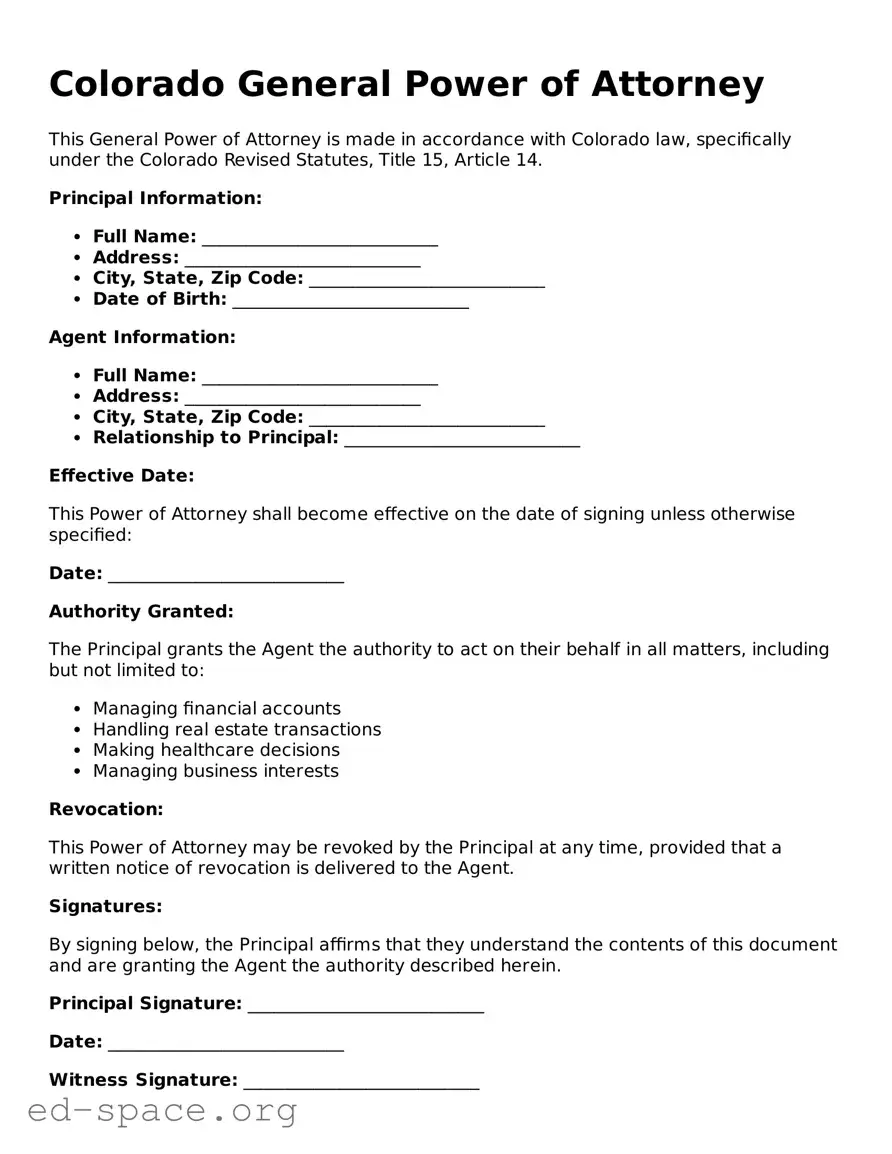
Colorado General Power of Attorney
This General Power of Attorney is made in accordance with Colorado law, specifically under the Colorado Revised Statutes, Title 15, Article 14.
Principal Information:
Agent Information:
Effective Date:
This Power of Attorney shall become effective on the date of signing unless otherwise specified:
Date: ___________________________
Authority Granted:
The Principal grants the Agent the authority to act on their behalf in all matters, including but not limited to:
Revocation:
This Power of Attorney may be revoked by the Principal at any time, provided that a written notice of revocation is delivered to the Agent.
Signatures:
By signing below, the Principal affirms that they understand the contents of this document and are granting the Agent the authority described herein.
Principal Signature: ___________________________
Date: ___________________________
Witness Signature: ___________________________
Date: ___________________________
Notary Public:
State of Colorado
County of ___________________________
Subscribed and sworn before me on this ____ day of __________, 20__.
Notary Public Signature: ___________________________
My Commission Expires: ___________________________
| Fact Name | Detail |
|---|---|
| Definition | A General Power of Attorney allows an individual to appoint someone else to handle their financial and legal matters. |
| Governing Law | The Colorado General Power of Attorney is governed by Colorado Revised Statutes, Title 15, Article 14. |
| Durability | This form can be durable, meaning it remains effective even if the principal becomes incapacitated. |
| Agent Authority | The appointed agent can perform a wide range of tasks, from managing bank accounts to selling property. |
| Principal's Signature | The form must be signed by the principal, the person granting the power. |
| Witness Requirement | In Colorado, the signature of the principal must be witnessed by at least one person or notarized. |
| Revocation | The principal can revoke the power of attorney at any time, as long as they are mentally competent. |
| Limitations | Some powers may be limited or excluded based on the principal's preferences and specific instructions. |
| Agent's Duties | Agents are required to act in the best interest of the principal and keep accurate records of their actions. |
| Use Cases | This form is often used for managing finances, healthcare decisions, and legal matters when the principal is unavailable. |
After obtaining the Colorado General Power of Attorney form, you will need to complete it accurately. Ensure that all required fields are filled out to avoid delays or complications.
What is a Colorado General Power of Attorney form?
A Colorado General Power of Attorney form is a legal document that allows an individual, known as the principal, to grant another person, called the agent or attorney-in-fact, the authority to make decisions on their behalf. This authority can cover a wide range of matters, including financial transactions, property management, and legal affairs, depending on the specific powers granted in the document.
Who can be appointed as an agent in a General Power of Attorney?
In Colorado, anyone who is at least 18 years old and mentally competent can be appointed as an agent. This can include family members, friends, or professionals such as attorneys or financial advisors. It is essential to choose someone trustworthy, as they will have significant control over the principal's affairs.
What powers can be granted through a General Power of Attorney?
The powers granted can be broad or specific, depending on the principal's wishes. Common powers include managing bank accounts, buying or selling property, handling tax matters, and making healthcare decisions. It’s important for the principal to clearly outline the powers they wish to grant to avoid any confusion later on.
Is a General Power of Attorney effective immediately?
Yes, a Colorado General Power of Attorney typically becomes effective immediately upon signing. However, the principal can also choose to make it effective at a later date or upon the occurrence of a specific event, such as their incapacity. This is known as a springing power of attorney.
Can a General Power of Attorney be revoked?
Yes, a principal can revoke a General Power of Attorney at any time, as long as they are mentally competent. This can be done by creating a written revocation document and notifying the agent. It’s also advisable to inform any institutions or individuals that were relying on the original document to prevent any confusion.
Do I need to have the General Power of Attorney form notarized?
In Colorado, it is recommended to have the General Power of Attorney notarized to ensure its validity. While notarization is not strictly required, having a notary public witness the signing can help prevent disputes and provide additional assurance to third parties who may rely on the document.
What happens if the principal becomes incapacitated?
If the principal becomes incapacitated and has not set up a springing power of attorney, the General Power of Attorney remains effective. The agent can continue to act on behalf of the principal. However, if the principal has not designated an agent or if the agent is unable to serve, a court may need to appoint a guardian or conservator to manage the principal's affairs.
Can I use a General Power of Attorney for healthcare decisions?
A General Power of Attorney can include healthcare decisions, but it is often better to use a separate document called a Medical Power of Attorney or Advance Directive for healthcare-related matters. This ensures that specific healthcare wishes are clearly articulated and legally recognized.
How long does a General Power of Attorney last?
A General Power of Attorney remains in effect until the principal revokes it, the principal passes away, or the specific terms of the document state otherwise. If the principal becomes incapacitated, the General Power of Attorney can still be effective unless it is a springing power of attorney that only activates upon incapacity.
Not Specifying the Powers Granted: Individuals often fail to clearly outline the specific powers they wish to grant. This can lead to confusion about what the agent is allowed to do on their behalf.
Forgetting to Sign and Date: A common mistake is neglecting to sign and date the form. Without a signature, the document is not legally binding, rendering it ineffective.
Choosing the Wrong Agent: Selecting an agent who is not trustworthy or lacks the necessary skills can create problems. It’s essential to choose someone who understands the responsibilities involved.
Not Considering State Requirements: Each state has specific requirements for a power of attorney. Failing to follow Colorado's rules may invalidate the document.
Overlooking Revocation Procedures: Many people do not understand how to revoke a power of attorney once it is established. It is important to know the steps to take if circumstances change.
When creating a Colorado General Power of Attorney, it’s important to consider other forms and documents that can complement it. Each of these documents serves a specific purpose, helping to ensure that your legal and financial matters are handled according to your wishes.
Having these documents in place alongside your General Power of Attorney can provide peace of mind. They ensure that your wishes are respected and that your affairs are managed smoothly, even if you are unable to do so yourself.
A General Power of Attorney (GPOA) is a legal document that allows one person to act on behalf of another in various matters. There are several other documents that share similarities with a GPOA. Here are five of them:
When filling out the Colorado General Power of Attorney form, it is essential to approach the task with care and attention. This document grants someone the authority to make decisions on your behalf, so ensuring accuracy and clarity is crucial. Here are some important do's and don'ts to consider:
By following these guidelines, you can help ensure that your General Power of Attorney accurately reflects your wishes and protects your interests.
Understanding the Colorado General Power of Attorney form is crucial for anyone considering this legal document. However, several misconceptions can lead to confusion. Here are four common misunderstandings:
This is not accurate. While a General Power of Attorney primarily handles financial decisions, it can also grant authority over medical decisions, real estate transactions, and other personal matters, depending on how it is drafted.
This is misleading. A standard General Power of Attorney typically becomes invalid if the principal is incapacitated. However, a durable power of attorney can remain effective even after the principal loses the ability to make decisions.
This is partially true. While most adults can serve as agents, certain individuals may be disqualified, such as those who are minors or those who have been convicted of a felony. It is essential to choose a trustworthy and competent agent.
This is incorrect. The General Power of Attorney can be customized to meet the specific needs and preferences of the principal. It is vital to tailor the document to reflect the unique circumstances and intentions of the individual creating it.
When considering the Colorado General Power of Attorney form, there are several important aspects to keep in mind. Understanding these can help ensure that the document is completed correctly and serves its intended purpose.
By understanding these key points, individuals can navigate the process of filling out and using the Colorado General Power of Attorney form more effectively.