In Colorado, the Durable Power of Attorney (DPOA) form serves as a crucial legal tool that empowers individuals to designate someone they trust to manage their financial and legal affairs in the event they become incapacitated. This form is particularly significant because it remains effective even if the principal, the person granting the authority, loses the capacity to make decisions. By completing a DPOA, individuals can ensure that their financial matters, such as paying bills, managing investments, and handling real estate transactions, are taken care of without the need for court intervention. The form allows for a broad range of powers, which can be tailored to fit specific needs, providing flexibility and peace of mind. Additionally, the DPOA can be revoked at any time, as long as the principal is still mentally competent, offering a safeguard against unwanted authority. Understanding the nuances of this form is essential for anyone looking to plan for the future and protect their interests.
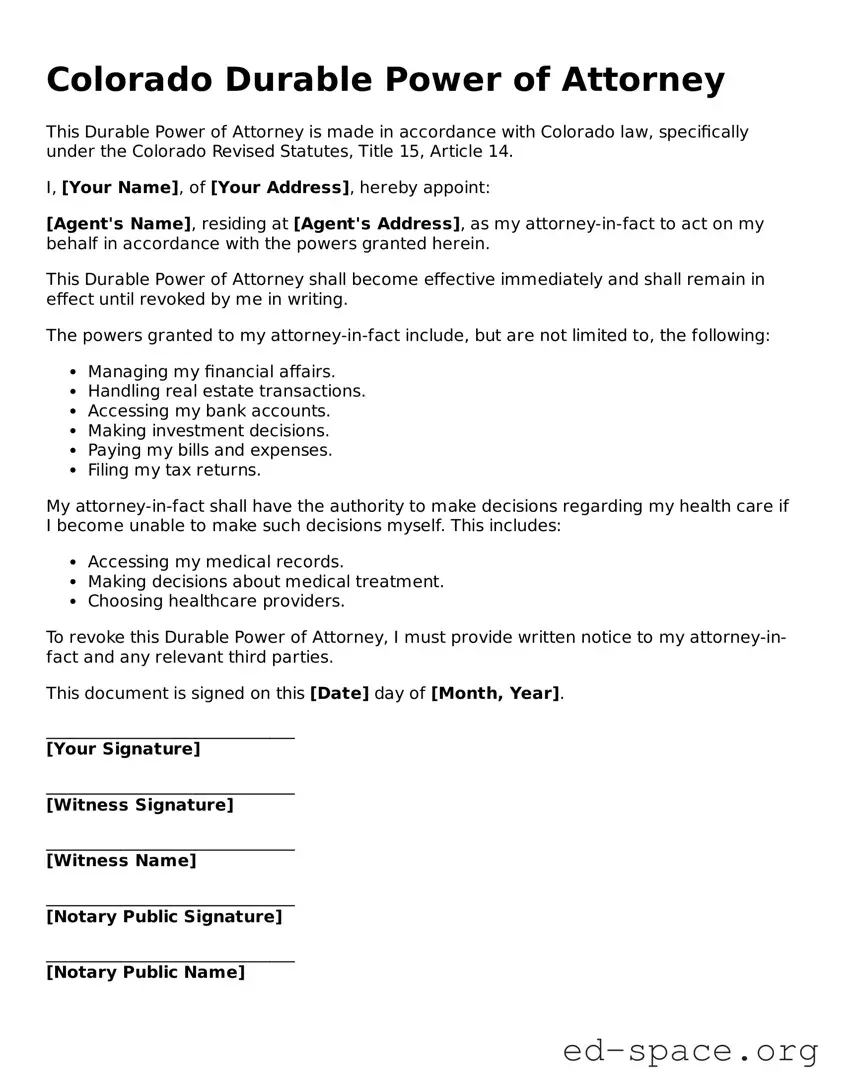
Colorado Durable Power of Attorney
This Durable Power of Attorney is made in accordance with Colorado law, specifically under the Colorado Revised Statutes, Title 15, Article 14.
I, [Your Name], of [Your Address], hereby appoint:
[Agent's Name], residing at [Agent's Address], as my attorney-in-fact to act on my behalf in accordance with the powers granted herein.
This Durable Power of Attorney shall become effective immediately and shall remain in effect until revoked by me in writing.
The powers granted to my attorney-in-fact include, but are not limited to, the following:
My attorney-in-fact shall have the authority to make decisions regarding my health care if I become unable to make such decisions myself. This includes:
To revoke this Durable Power of Attorney, I must provide written notice to my attorney-in-fact and any relevant third parties.
This document is signed on this [Date] day of [Month, Year].
______________________________
[Your Signature]
______________________________
[Witness Signature]
______________________________
[Witness Name]
______________________________
[Notary Public Signature]
______________________________
[Notary Public Name]
| Fact Name | Description |
|---|---|
| Definition | A Colorado Durable Power of Attorney allows an individual to appoint someone else to make financial and legal decisions on their behalf if they become incapacitated. |
| Governing Law | This form is governed by the Colorado Revised Statutes, specifically Title 15, Article 14. |
| Durability | The "durable" aspect means that the authority granted remains effective even if the principal becomes incapacitated. |
| Agent's Authority | The agent can handle a variety of tasks, including managing bank accounts, paying bills, and making investment decisions. |
| Revocation | The principal can revoke the Durable Power of Attorney at any time, as long as they are mentally competent. |
| Witness Requirements | The form must be signed in the presence of two witnesses or a notary public to be valid. |
Filling out the Colorado Durable Power of Attorney form requires careful attention to detail. Once completed, the form will allow you to designate someone to act on your behalf in financial matters. Follow these steps to ensure the form is filled out correctly.
What is a Colorado Durable Power of Attorney?
A Colorado Durable Power of Attorney is a legal document that allows you to appoint someone else, known as your agent, to make decisions on your behalf. This can include financial matters, healthcare decisions, or other personal affairs. The "durable" aspect means that the authority granted to your agent continues even if you become incapacitated.
Who can be appointed as an agent?
You can choose any competent adult to serve as your agent. This may be a family member, friend, or trusted advisor. It’s important to select someone who understands your values and wishes, as they will be responsible for making decisions that align with your best interests.
How does the Durable Power of Attorney become effective?
The Durable Power of Attorney can become effective immediately upon signing or can be set to activate at a later date or upon a specific event, such as your incapacity. You should clearly outline when the powers begin in the document to avoid any confusion.
Can I revoke my Durable Power of Attorney?
Yes, you can revoke your Durable Power of Attorney at any time, as long as you are mentally competent. To do this, you should create a written revocation document and notify your agent as well as any institutions or individuals that were relying on the original document.
What are the limitations of a Durable Power of Attorney?
Do I need a lawyer to create a Durable Power of Attorney in Colorado?
While it's not legally required to have a lawyer to create a Durable Power of Attorney, consulting one is advisable. A lawyer can help ensure that the document meets all legal requirements and accurately reflects your wishes, reducing the risk of disputes in the future.
Not clearly identifying the principal. Ensure your full name and address are included at the top of the form.
Failing to select the right agent. Choose someone you trust to make decisions on your behalf.
Overlooking the date of signing. The form must be dated when you sign it to be valid.
Not having witnesses present. In Colorado, two witnesses are required to sign the document.
Neglecting to notarize the document. A notary public must witness your signature for the form to be legally binding.
Leaving out specific powers. Clearly outline the powers you are granting to your agent to avoid confusion.
Not reviewing the form after completion. Double-check all information for accuracy and completeness.
Using outdated forms. Ensure you are using the most current version of the Durable Power of Attorney form.
Failing to inform your agent. Discuss your wishes and the responsibilities with your chosen agent before signing.
Not storing the document safely. Keep the signed form in a secure location and inform trusted individuals where it can be found.
A Colorado Durable Power of Attorney is an important document that allows someone to make decisions on your behalf if you become unable to do so. However, it is often used alongside other documents to ensure comprehensive planning for your legal and financial needs. Below is a list of other forms and documents commonly associated with a Durable Power of Attorney.
Utilizing these documents in conjunction with a Durable Power of Attorney can help create a comprehensive plan that addresses both healthcare and financial matters. It is advisable to consider your unique circumstances and consult with a legal professional to ensure all necessary documents are in place.
The Durable Power of Attorney (DPOA) is an important legal document that allows someone to make decisions on your behalf if you become unable to do so. Here are four other documents that share similarities with the DPOA:
When filling out the Colorado Durable Power of Attorney form, it is important to follow certain guidelines to ensure that the document is valid and effective. Below is a list of things to do and not to do.
When it comes to the Colorado Durable Power of Attorney form, there are several misconceptions that can lead to confusion. Understanding these misconceptions can help individuals make informed decisions about their financial and medical affairs. Here are five common misunderstandings:
Many people believe that a Durable Power of Attorney is solely for financial decisions. However, it can also cover medical and healthcare decisions if specified. This means you can designate someone to make important health-related choices on your behalf.
Contrary to popular belief, a Durable Power of Attorney remains effective even if the person who created it becomes incapacitated. This is what makes it "durable." It is designed to ensure that your chosen agent can act on your behalf when you are unable to do so.
While you can choose anyone you trust to act as your agent, it is important to note that some restrictions may apply. For example, certain professionals, like your healthcare provider, may not be able to serve as your agent for medical decisions due to potential conflicts of interest.
Some individuals think that a Durable Power of Attorney gives the agent unlimited power. However, you can specify the scope of authority in the document. This means you can outline exactly what decisions your agent can make, ensuring your preferences are respected.
Many people assume that once a Durable Power of Attorney is signed, it cannot be modified. In reality, you can revoke or change it at any time as long as you are mentally competent. This flexibility allows you to adapt to changing circumstances and relationships.
Understanding these misconceptions can empower individuals to take control of their future planning. By clarifying these points, it becomes easier to navigate the responsibilities and benefits associated with a Durable Power of Attorney in Colorado.
Filling out and using the Colorado Durable Power of Attorney form is an important step in planning for future financial and medical decisions. Here are some key takeaways to consider: