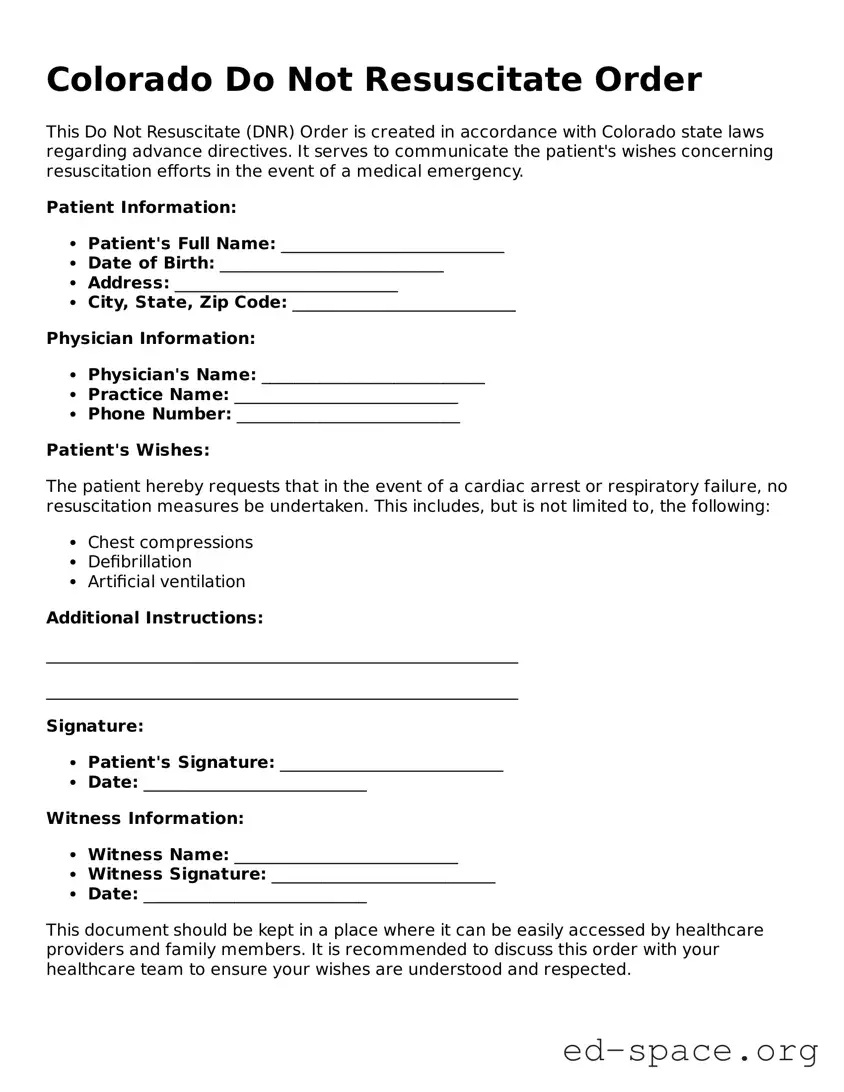
In Colorado, the Do Not Resuscitate (DNR) Order form serves as a crucial tool for individuals who wish to express their preferences regarding medical treatment in the event of a life-threatening situation. This legally binding document allows patients to communicate their desire not to receive cardiopulmonary resuscitation (CPR) or other life-sustaining measures if their heart stops beating or they stop breathing. The form is typically completed by patients, often in consultation with their healthcare providers, and it requires the signature of a physician to be valid. Importantly, the DNR Order is designed to ensure that a patient’s wishes are respected, allowing for a dignified approach to end-of-life care. The document is easily recognizable, often printed on a bright yellow background, which helps medical personnel quickly identify it in emergency situations. Additionally, it is essential for individuals to understand that the DNR Order does not affect the provision of other medical treatments, and it can be revoked at any time, offering flexibility and peace of mind to those who choose to use it.
Colorado Do Not Resuscitate Order
This Do Not Resuscitate (DNR) Order is created in accordance with Colorado state laws regarding advance directives. It serves to communicate the patient's wishes concerning resuscitation efforts in the event of a medical emergency.
Patient Information:
Physician Information:
Patient's Wishes:
The patient hereby requests that in the event of a cardiac arrest or respiratory failure, no resuscitation measures be undertaken. This includes, but is not limited to, the following:
Additional Instructions:
_________________________________________________________
_________________________________________________________
Signature:
Witness Information:
This document should be kept in a place where it can be easily accessed by healthcare providers and family members. It is recommended to discuss this order with your healthcare team to ensure your wishes are understood and respected.
| Fact Name | Description |
|---|---|
| Purpose | The Colorado Do Not Resuscitate (DNR) Order form allows individuals to express their wish not to receive cardiopulmonary resuscitation (CPR) in case of cardiac arrest. |
| Eligibility | Any adult who is capable of making informed medical decisions can complete a DNR order in Colorado. |
| Governing Law | The Colorado DNR Order is governed by the Colorado Revised Statutes, specifically § 25-48-101 et seq. |
| Signature Requirement | The form must be signed by the individual or their authorized representative and a physician to be valid. |
Filling out the Colorado Do Not Resuscitate Order form is an important step in expressing your healthcare preferences. Once you have completed the form, it should be shared with your healthcare provider and kept in a place where it can be easily accessed in case of an emergency.
What is a Do Not Resuscitate (DNR) Order in Colorado?
A Do Not Resuscitate Order (DNR) is a legal document that allows individuals to express their wishes regarding resuscitation efforts in the event of a medical emergency. In Colorado, this order specifically instructs healthcare providers not to perform cardiopulmonary resuscitation (CPR) or other life-saving measures if a person’s heart stops beating or they stop breathing. It is important for individuals to discuss their wishes with family members and healthcare providers to ensure everyone understands their preferences regarding end-of-life care.
Who can request a DNR Order in Colorado?
In Colorado, any adult who is of sound mind can request a DNR Order. This includes individuals who are facing a terminal illness or have a condition that may lead to a medical emergency. Additionally, a legal representative, such as a healthcare proxy or power of attorney, can also request a DNR Order on behalf of someone who is unable to make decisions for themselves. It is crucial to have clear communication and documentation to ensure that the individual’s wishes are honored.
How do I obtain a DNR Order in Colorado?
To obtain a DNR Order in Colorado, individuals must fill out a specific form provided by the Colorado Department of Public Health and Environment. This form requires personal information, including the individual’s name, date of birth, and medical history. After completing the form, it must be signed by the individual and a physician. It is essential to keep copies of the signed DNR Order in easily accessible locations, such as with medical records or on the refrigerator, to ensure that emergency responders are aware of the individual’s wishes.
Is a DNR Order valid in all healthcare settings?
Yes, a DNR Order is generally valid across all healthcare settings in Colorado, including hospitals, nursing homes, and home care situations. However, it is important to inform all healthcare providers about the existence of the DNR Order. In some cases, specific healthcare facilities may have their own policies regarding DNR Orders, so it is advisable to check with the facility to ensure compliance and understanding of the order.
Can a DNR Order be revoked or changed?
Yes, individuals have the right to revoke or change their DNR Order at any time. This can be done by destroying the original document or by creating a new DNR Order that explicitly states the updated wishes. It is important to communicate any changes to family members and healthcare providers to avoid confusion during medical emergencies. Keeping everyone informed ensures that the individual’s current preferences are respected and followed.
Failing to include the patient’s full legal name. Ensure the name matches official identification.
Not providing the date of birth. This information helps to confirm the identity of the patient.
Leaving the physician's signature blank. A valid signature from a licensed physician is required.
Not specifying the date the form was completed. This is essential for the validity of the order.
Using outdated versions of the form. Always ensure you have the most current version available.
Failing to discuss the order with family members. Communication can prevent confusion and ensure everyone is informed.
Not keeping copies of the completed form. Retain copies for personal records and to share with healthcare providers.
Overlooking the need for witnesses. Some forms require signatures from witnesses to be valid.
Neglecting to review the form periodically. Changes in health status may require updates to the order.
Misunderstanding the implications of the order. Ensure clarity on what a Do Not Resuscitate Order means for care.
When considering end-of-life care, the Colorado Do Not Resuscitate (DNR) Order form is an important document. However, it is often accompanied by other forms and documents that provide comprehensive guidance for medical decisions. Below is a list of additional documents commonly used alongside the Colorado DNR Order.
These documents work together to ensure that a person's healthcare preferences are respected and followed. Understanding each form's purpose can help individuals make informed decisions about their medical care and end-of-life wishes.
When filling out the Colorado Do Not Resuscitate (DNR) Order form, it’s important to approach the process with care and clarity. Here are some essential tips to consider, along with common pitfalls to avoid.
By following these guidelines, you can navigate the process of completing a DNR order with confidence and clarity.
Understanding the Colorado Do Not Resuscitate (DNR) Order form is essential for patients and their families. Here are five common misconceptions about this important document:
This is false. A DNR order specifically addresses resuscitation efforts in the event of cardiac arrest. Patients with a DNR can still receive other forms of medical care, including pain management and comfort measures.
This misconception overlooks the fact that individuals of any age or health status may choose a DNR order. It is a personal decision based on individual values and preferences regarding end-of-life care.
In reality, a DNR order can be revoked or modified at any time by the patient or their authorized representative. It’s important to communicate any changes to healthcare providers.
While a physician's signature is typically required for the DNR order to be legally recognized, patients can also express their wishes verbally to healthcare providers, who can then document those wishes appropriately.
This belief is misleading. Studies show that having a DNR order does not hasten death. Instead, it ensures that patients receive care aligned with their wishes, which can lead to a more peaceful end-of-life experience.
Filling out and using the Colorado Do Not Resuscitate (DNR) Order form is an important process for individuals who wish to express their preferences regarding resuscitation efforts in medical emergencies. Here are some key takeaways: