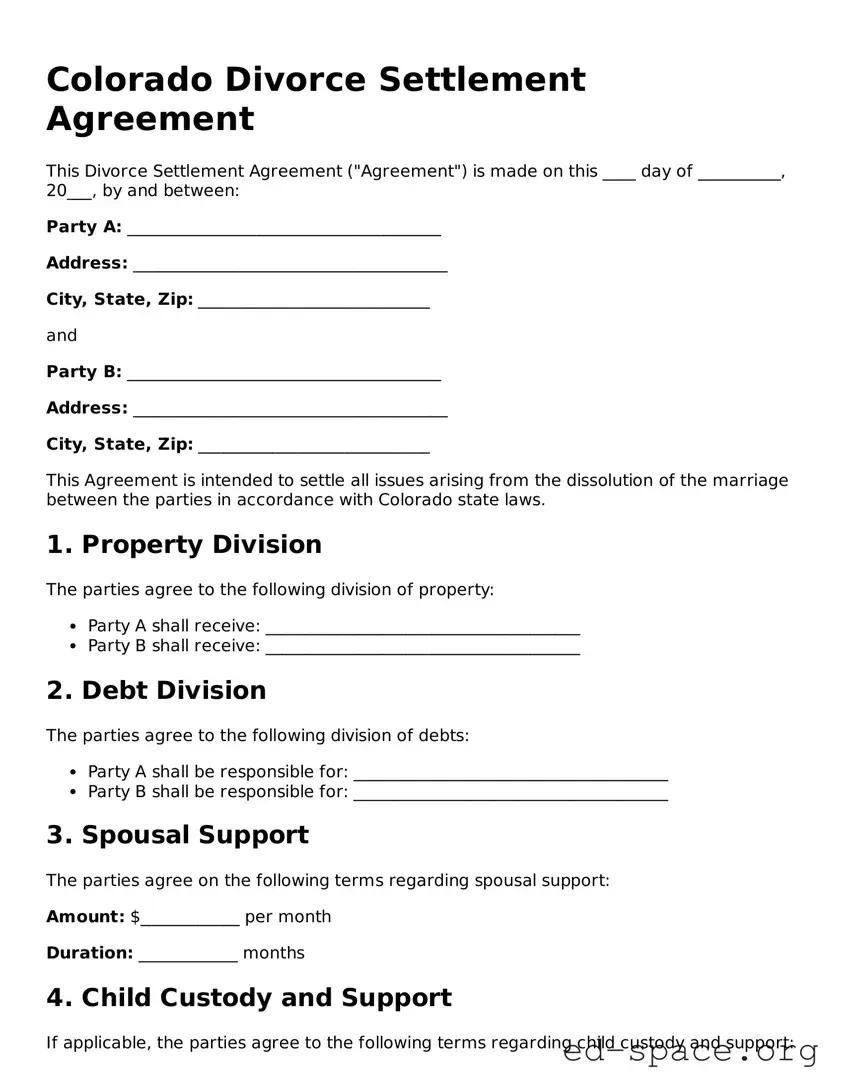
The Colorado Divorce Settlement Agreement form plays a critical role in the divorce process, providing a structured way for both parties to outline their decisions regarding various aspects of their separation. This form addresses key issues such as the division of marital property, allocation of debts, child custody arrangements, and spousal support. By clearly delineating the terms agreed upon by both spouses, the form helps to minimize misunderstandings and disputes that may arise post-divorce. Additionally, it requires both parties to disclose their financial situations, ensuring transparency throughout the settlement process. Once completed and signed, the agreement must be submitted to the court for approval, making it a binding legal document that governs the terms of the divorce. Understanding the nuances of this form is essential for individuals navigating the complexities of divorce in Colorado, as it ultimately impacts their financial and familial future.
Colorado Divorce Settlement Agreement
This Divorce Settlement Agreement ("Agreement") is made on this ____ day of __________, 20___, by and between:
Party A: ______________________________________
Address: ______________________________________
City, State, Zip: ____________________________
and
Party B: ______________________________________
Address: ______________________________________
City, State, Zip: ____________________________
This Agreement is intended to settle all issues arising from the dissolution of the marriage between the parties in accordance with Colorado state laws.
1. Property Division
The parties agree to the following division of property:
2. Debt Division
The parties agree to the following division of debts:
3. Spousal Support
The parties agree on the following terms regarding spousal support:
Amount: $____________ per month
Duration: ____________ months
4. Child Custody and Support
If applicable, the parties agree to the following terms regarding child custody and support:
5. Miscellaneous
The parties agree to the following additional terms:
This Agreement represents the entire understanding between the parties. Both parties acknowledge that they have read and understood this Agreement and voluntarily enter into it.
IN WITNESS WHEREOF, the parties have executed this Agreement as of the date first above written.
Party A Signature: ____________________________
Date: ____________________________
Party B Signature: ____________________________
Date: ____________________________
| Fact Name | Description |
|---|---|
| Purpose | The Colorado Divorce Settlement Agreement form outlines the terms of the divorce, including asset division, child custody, and support arrangements. |
| Governing Law | This form is governed by the Colorado Revised Statutes, specifically Title 14, which covers domestic relations. |
| Mutual Agreement | Both parties must agree to the terms laid out in the settlement agreement for it to be valid and enforceable. |
| Filing Requirements | The completed form must be filed with the court as part of the divorce proceedings to finalize the agreement. |
| Modification | Changes to the agreement can be made if both parties consent, but these modifications must also be documented and filed with the court. |
| Child Support Guidelines | If children are involved, the agreement must adhere to Colorado's child support guidelines, ensuring fair support is provided. |
| Legal Representation | While it's possible to complete the form without an attorney, seeking legal advice is recommended to ensure all rights are protected. |
Once you have gathered the necessary information and documents, you can begin filling out the Colorado Divorce Settlement Agreement form. This form will guide you through the process of outlining the terms of your divorce. Be sure to read each section carefully and provide accurate information to avoid any delays in the proceedings.
After completing the form, you will need to submit it to the court along with any required documents. Ensure that you keep copies for your records. Once filed, the court will review your agreement and set a date for a hearing, if necessary.
What is a Colorado Divorce Settlement Agreement?
A Colorado Divorce Settlement Agreement is a legal document that outlines the terms and conditions agreed upon by both parties during a divorce. This document typically addresses issues such as asset division, child custody, child support, and spousal support. It serves as a comprehensive guide for how the couple will manage their responsibilities and rights post-divorce.
Who needs to complete a Divorce Settlement Agreement?
Both spouses involved in a divorce must complete a Divorce Settlement Agreement if they wish to resolve their issues amicably and avoid a lengthy court process. This agreement is particularly important for couples with children or significant assets, as it ensures that all parties are clear on their obligations and rights moving forward.
How do I start the process of creating a Divorce Settlement Agreement?
To begin creating a Divorce Settlement Agreement, both parties should gather all relevant financial documents and information regarding assets, debts, and any children involved. Open communication is crucial; discussing each party's needs and expectations can lead to a more effective agreement. It may also be beneficial to consult with a mediator or attorney to facilitate this process.
What topics should be covered in the agreement?
Key topics that should be covered in a Divorce Settlement Agreement include the division of marital property and debts, child custody arrangements, visitation schedules, child support obligations, and spousal support. Each topic should be detailed to minimize misunderstandings in the future.
Is a Divorce Settlement Agreement legally binding?
Yes, once both parties sign the Divorce Settlement Agreement and it is approved by the court, it becomes legally binding. This means that both parties are obligated to adhere to the terms outlined in the agreement. Failure to comply can result in legal consequences.
Can the terms of the Divorce Settlement Agreement be modified later?
Yes, the terms of a Divorce Settlement Agreement can be modified after the divorce is finalized, but only under specific circumstances. If there is a significant change in circumstances, such as a job loss or a change in the needs of the children, either party can petition the court for a modification. Both parties must agree to the changes for them to be legally recognized.
Do I need a lawyer to create a Divorce Settlement Agreement?
While it is not required to have a lawyer to create a Divorce Settlement Agreement, it is highly recommended. A lawyer can provide legal advice, ensure that the agreement complies with state laws, and help protect your rights. If both parties can agree on the terms, they may choose to use mediation services to facilitate the process.
How long does it take to finalize a Divorce Settlement Agreement?
The time it takes to finalize a Divorce Settlement Agreement can vary widely depending on the complexity of the issues involved and the willingness of both parties to negotiate. Some couples may reach an agreement within a few weeks, while others may take several months. Prompt communication and cooperation can help expedite the process.
What should I do if we cannot agree on the terms?
If both parties cannot agree on the terms of the Divorce Settlement Agreement, mediation or arbitration may be necessary. A neutral third party can help facilitate discussions and find common ground. If these methods fail, the case may need to be resolved in court, where a judge will make the final decisions regarding the contested issues.
Where can I obtain a Divorce Settlement Agreement form?
Divorce Settlement Agreement forms can typically be obtained from the Colorado state court website, local courthouses, or through legal aid organizations. Many online resources also offer templates that can be customized to fit individual circumstances. It is essential to ensure that any form used complies with Colorado law.
Incomplete Information: Failing to fill out all required sections can lead to delays in the divorce process. Each party must provide accurate personal details, including names, addresses, and other identifying information.
Ignoring State Guidelines: Colorado has specific laws governing divorce settlements. Not adhering to these can result in an agreement that is unenforceable or subject to modification.
Underestimating Assets: It is crucial to disclose all marital assets fully. Omitting properties, bank accounts, or investments can lead to complications later on.
Inaccurate Valuation: Assigning incorrect values to assets can skew the settlement. Each party should conduct thorough research or seek professional appraisals to ensure fairness.
Neglecting Debts: Failing to account for marital debts is a common oversight. Both parties should list all liabilities to avoid future disputes over who is responsible for what.
Overlooking Child Support and Custody: When children are involved, it is vital to address custody arrangements and support obligations clearly. Vague terms can lead to misunderstandings.
Rushing the Process: Taking the time to review the agreement thoroughly is essential. Hasty decisions can result in unfavorable terms that one or both parties may regret later.
Not Seeking Legal Advice: Many individuals attempt to navigate the process without professional guidance. Consulting with a legal expert can provide clarity and help avoid common pitfalls.
When navigating the process of divorce in Colorado, several forms and documents accompany the Divorce Settlement Agreement. Each of these documents plays a crucial role in ensuring that the divorce proceedings are handled smoothly and that both parties' rights are protected. Below is a list of common forms that are often used alongside the Divorce Settlement Agreement.
Understanding these documents and their purposes can significantly ease the divorce process. Each form contributes to a clearer, more organized approach to reaching a resolution that respects the needs and rights of both parties involved.
When filling out the Colorado Divorce Settlement Agreement form, it's important to approach the task with care. Here are some guidelines to help ensure accuracy and completeness.
Following these guidelines can help you navigate the process more smoothly and reduce potential issues later on.
Understanding the Colorado Divorce Settlement Agreement form is crucial for anyone going through a divorce. However, several misconceptions can lead to confusion and mistakes. Here are eight common misconceptions about this important document:
Being aware of these misconceptions can help individuals navigate the divorce process more effectively. Clarity and understanding are key to achieving a fair and satisfactory outcome.
Filling out the Colorado Divorce Settlement Agreement form is an important step in the divorce process. Here are some key takeaways to keep in mind:
By keeping these points in mind, individuals can navigate the divorce settlement process more effectively and ensure that their rights and interests are protected.