When navigating the complexities of real estate transactions in Colorado, understanding the Colorado Deed form is essential for both buyers and sellers. This legal document serves as a formal instrument for transferring property ownership, ensuring that the rights of all parties involved are clearly defined and protected. The form typically includes vital information such as the names of the grantor and grantee, a detailed description of the property, and any specific conditions or covenants that may apply. Additionally, it requires signatures from the involved parties, often necessitating notarization to validate the transfer. By adhering to the requirements set forth in this deed, individuals can mitigate potential disputes and ensure a smooth transition of property rights. As such, familiarity with this form is crucial for anyone engaged in real estate dealings within the state.
Colorado Deed Template
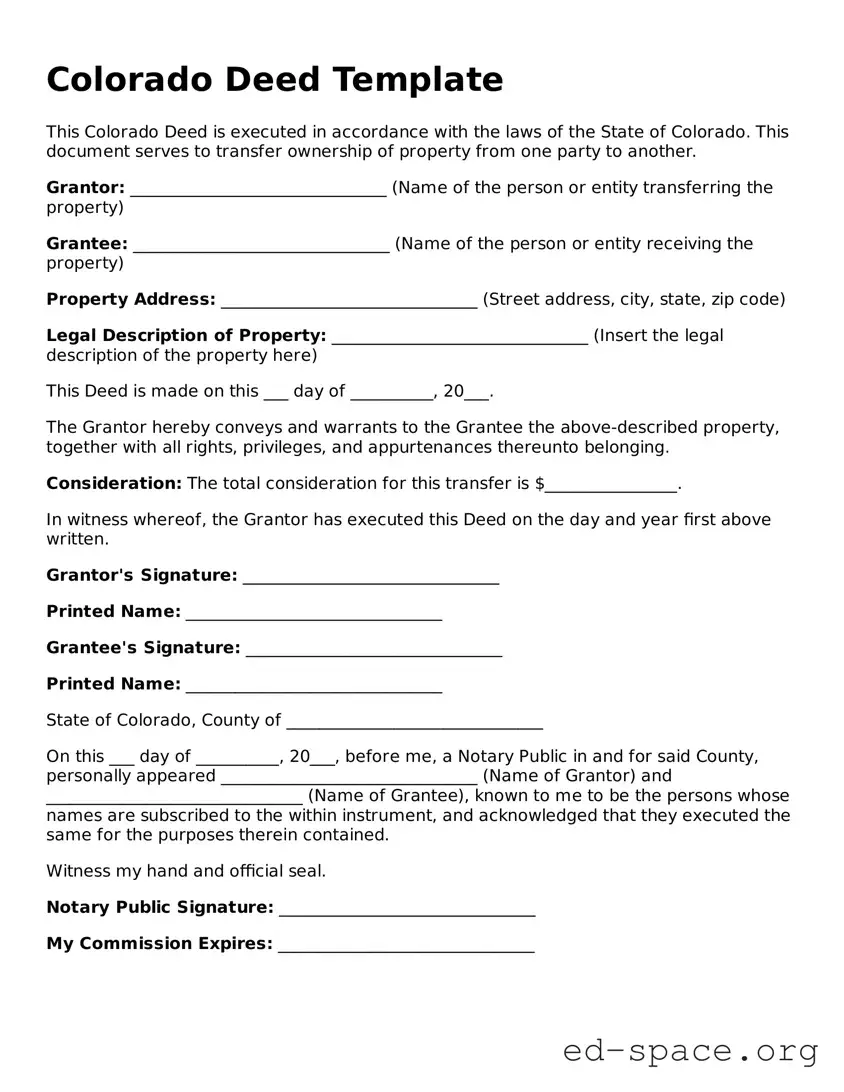
This Colorado Deed is executed in accordance with the laws of the State of Colorado. This document serves to transfer ownership of property from one party to another.
Grantor: _______________________________ (Name of the person or entity transferring the property)
Grantee: _______________________________ (Name of the person or entity receiving the property)
Property Address: _______________________________ (Street address, city, state, zip code)
Legal Description of Property: _______________________________ (Insert the legal description of the property here)
This Deed is made on this ___ day of __________, 20___.
The Grantor hereby conveys and warrants to the Grantee the above-described property, together with all rights, privileges, and appurtenances thereunto belonging.
Consideration: The total consideration for this transfer is $________________.
In witness whereof, the Grantor has executed this Deed on the day and year first above written.
Grantor's Signature: _______________________________
Printed Name: _______________________________
Grantee's Signature: _______________________________
Printed Name: _______________________________
State of Colorado, County of _______________________________
On this ___ day of __________, 20___, before me, a Notary Public in and for said County, personally appeared _______________________________ (Name of Grantor) and _______________________________ (Name of Grantee), known to me to be the persons whose names are subscribed to the within instrument, and acknowledged that they executed the same for the purposes therein contained.
Witness my hand and official seal.
Notary Public Signature: _______________________________
My Commission Expires: _______________________________
| Fact Name | Details |
|---|---|
| Governing Law | The Colorado Deed form is governed by Colorado state law. |
| Types of Deeds | Common types include warranty deeds, quitclaim deeds, and special warranty deeds. |
| Required Signatures | All grantors must sign the deed for it to be valid. |
| Notarization | A notary public must witness the signatures on the deed. |
| Recording | The deed must be recorded in the county where the property is located to provide public notice. |
| Legal Description | A legal description of the property must be included in the deed. |
| Consideration | The deed should state the consideration paid for the property, although it is not always required. |
| Transfer of Ownership | The deed serves as the official document to transfer ownership of real property. |
| Use of Additional Forms | Additional forms may be needed for specific circumstances, such as tax exemptions or easements. |
Filling out the Colorado Deed form is a straightforward process that requires attention to detail. Once you have completed the form, it will need to be filed with the appropriate county clerk and recorder's office to ensure the transfer of property is legally recognized.
What is a Colorado Deed form?
A Colorado Deed form is a legal document used to transfer ownership of real property from one party to another in the state of Colorado. This form outlines the details of the transaction, including the names of the parties involved, a description of the property, and any conditions of the transfer. Various types of deeds exist, such as warranty deeds and quitclaim deeds, each serving different purposes and offering different levels of protection to the buyer.
How do I complete a Colorado Deed form?
To complete a Colorado Deed form, you will need to provide specific information. Start by entering the names of the grantor (the person transferring the property) and the grantee (the person receiving the property). Next, include a legal description of the property, which can typically be found in previous deeds or property tax records. After filling in the necessary details, the form must be signed by the grantor in the presence of a notary public. This step is crucial, as notarization verifies the identity of the signer and the authenticity of the document.
Do I need to file the Colorado Deed form with the county?
Yes, once the Colorado Deed form is completed and notarized, it must be filed with the county clerk and recorder in the county where the property is located. Filing the deed officially records the transfer of ownership and makes it part of the public record. There may be a filing fee, so it is advisable to check with the local county office for the exact amount and any additional requirements.
What happens if I do not file the Colorado Deed form?
If you do not file the Colorado Deed form after completing it, the transfer of ownership may not be legally recognized. This could lead to complications, such as disputes over property rights or issues when trying to sell or mortgage the property in the future. Filing the deed is an essential step in ensuring that the transaction is documented and that the new owner has clear title to the property.
Incorrect Names: One of the most common mistakes is failing to accurately spell the names of the grantor (the person transferring the property) and the grantee (the person receiving the property). Even minor typos can lead to significant legal issues.
Missing Signatures: All required parties must sign the deed. Omitting a signature can render the deed invalid, complicating the transfer process.
Improper Notarization: A deed must typically be notarized to be legally binding. Failing to have the document properly notarized can lead to challenges in its validity.
Inaccurate Property Description: The legal description of the property must be precise. Errors in the description can create confusion and disputes over property boundaries.
Not Including a Consideration Amount: The deed should state the consideration, or the amount paid for the property. Leaving this blank may raise questions about the legitimacy of the transfer.
Failure to Identify the Type of Deed: It is crucial to specify the type of deed being used, such as a warranty deed or quitclaim deed. Each type has different implications for the parties involved.
Ignoring Local Regulations: Each county may have specific requirements for filing a deed. Ignoring these local rules can result in delays or rejections of the filing.
Not Keeping Copies: After filing, it is important to retain copies of the deed for personal records. Failing to do so can create challenges in future transactions.
Incorrect Recording Information: When submitting the deed for recording, ensure that it is sent to the correct office. Misfiling can complicate ownership verification.
Neglecting to Check for Liens: Before transferring property, it is wise to check for any existing liens or encumbrances. Overlooking this step can lead to unexpected legal complications for the grantee.
When dealing with property transactions in Colorado, several forms and documents are commonly used alongside the Colorado Deed form. Each of these documents serves a specific purpose and helps ensure a smooth transfer of property ownership.
Understanding these documents can help you navigate the property transfer process more effectively. Each plays a vital role in ensuring that the transaction is legally sound and that all parties are protected.
The Deed form is an important legal document, but it shares similarities with several other documents. Here are seven documents that are similar to the Deed form:
When filling out the Colorado Deed form, it is essential to follow specific guidelines to ensure accuracy and compliance. Below is a list of things to do and avoid.
Many people have misunderstandings about the Colorado Deed form. Here are seven common misconceptions:
Not all deeds serve the same purpose. Different types of deeds, like warranty deeds and quitclaim deeds, have different legal implications and protections.
While notarization is often required for a deed to be recorded, it is not always necessary for the deed to be legally binding between the parties involved.
A deed can be amended or revoked, but this process must follow legal procedures to ensure validity.
While having a lawyer can help, individuals can prepare their own deeds as long as they understand the required information and format.
Deeds can also be used for other purposes, such as creating a life estate or establishing a trust.
Recording a deed is not mandatory, but it is highly recommended to protect ownership rights and provide public notice.
Even after recording, a deed can be challenged in court under certain circumstances, such as fraud or lack of capacity.
When filling out and using the Colorado Deed form, it is essential to understand several key aspects to ensure proper execution and legal validity. Below are five important takeaways: