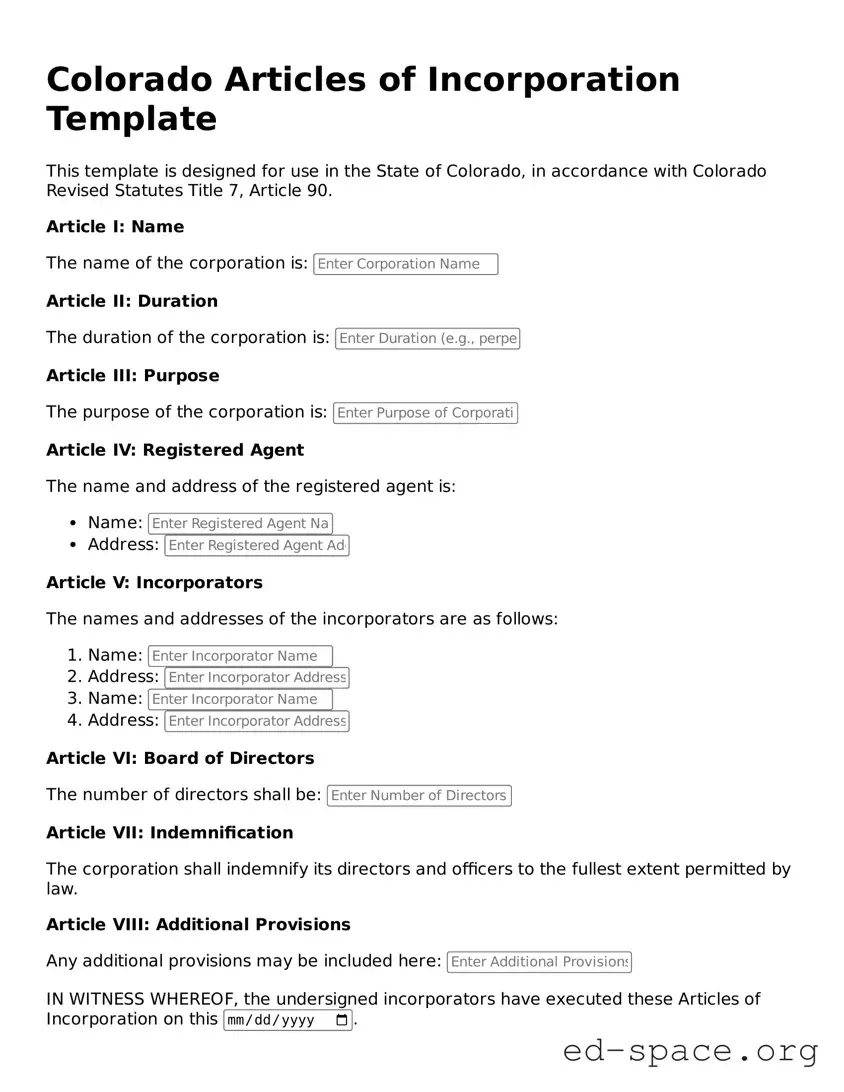
When establishing a business in Colorado, one of the first steps is to complete the Articles of Incorporation form. This essential document serves as the foundation for your corporation, outlining key information that defines its structure and purpose. It typically includes the corporation's name, which must be unique and not misleading to the public. Additionally, the form requires the designation of a registered agent, who will be responsible for receiving legal documents on behalf of the corporation. The principal office address must also be provided, ensuring that there is a clear point of contact. Furthermore, the Articles of Incorporation specify the number of shares the corporation is authorized to issue, which is crucial for determining ownership and investment opportunities. Lastly, the form may include information about the corporation's duration, which can be perpetual or for a specified period. Understanding these components is vital for anyone looking to navigate the incorporation process successfully in Colorado.
Colorado Articles of Incorporation Template
This template is designed for use in the State of Colorado, in accordance with Colorado Revised Statutes Title 7, Article 90.
Article I: Name
The name of the corporation is:
Article II: Duration
The duration of the corporation is:
Article III: Purpose
The purpose of the corporation is:
Article IV: Registered Agent
The name and address of the registered agent is:
Article V: Incorporators
The names and addresses of the incorporators are as follows:
Article VI: Board of Directors
The number of directors shall be:
Article VII: Indemnification
The corporation shall indemnify its directors and officers to the fullest extent permitted by law.
Article VIII: Additional Provisions
Any additional provisions may be included here:
IN WITNESS WHEREOF, the undersigned incorporators have executed these Articles of Incorporation on this .
Signature of Incorporator:
| Fact Name | Description |
|---|---|
| Purpose | The Colorado Articles of Incorporation form is used to officially create a corporation in the state of Colorado. |
| Governing Law | This form is governed by the Colorado Business Corporation Act, specifically under Title 7 of the Colorado Revised Statutes. |
| Filing Requirements | To file the Articles of Incorporation, you must submit the form to the Colorado Secretary of State along with the required filing fee. |
| Information Needed | Essential details include the corporation's name, registered agent, and the number of shares the corporation is authorized to issue. |
Once you have the Colorado Articles of Incorporation form ready, you will need to fill it out accurately to establish your business. After completing the form, you'll submit it to the Colorado Secretary of State along with the necessary filing fee.
What are the Articles of Incorporation in Colorado?
The Articles of Incorporation is a legal document that establishes a corporation in Colorado. It outlines essential information about the corporation, such as its name, purpose, registered agent, and the number of shares it is authorized to issue. Filing this document with the Colorado Secretary of State is a crucial step in forming a corporation.
Who needs to file Articles of Incorporation?
Any individual or group looking to create a corporation in Colorado must file Articles of Incorporation. This includes businesses of all sizes, from small startups to larger enterprises. Nonprofit organizations also need to file this document to gain legal recognition.
What information is required in the Articles of Incorporation?
The form requires several key pieces of information. This includes the corporation's name, its principal office address, the registered agent's name and address, the purpose of the corporation, and details about the shares the corporation is authorized to issue. Additionally, the names and addresses of the incorporators must be included.
How do I file the Articles of Incorporation?
Filing can be done online through the Colorado Secretary of State's website. Alternatively, you can submit a paper form by mail. Online filing is generally faster and more efficient. Be sure to pay the required filing fee, which varies depending on the type of corporation being formed.
What is the filing fee for the Articles of Incorporation?
The filing fee for the Articles of Incorporation in Colorado typically ranges from $50 to $100, depending on the type of corporation. It's essential to check the current fee schedule on the Colorado Secretary of State's website, as fees may change.
Can I amend the Articles of Incorporation after filing?
Yes, you can amend the Articles of Incorporation after they have been filed. To do this, you must submit an amendment form to the Colorado Secretary of State. This may involve a fee, and the process allows you to change information such as the corporation's name, registered agent, or purpose.
How long does it take to process the Articles of Incorporation?
Processing times can vary. Generally, online filings are processed within a few business days, while paper filings may take longer. For expedited processing, additional fees may apply. Always check the Secretary of State's website for the most current processing times.
What happens after I file the Articles of Incorporation?
Once the Articles of Incorporation are filed and approved, your corporation is officially formed. You will receive a confirmation from the Secretary of State, and you should keep this document for your records. After incorporation, you may need to obtain additional licenses or permits to operate legally.
Do I need to create bylaws for my corporation?
Yes, while not required to be filed with the state, creating bylaws is a critical step for your corporation. Bylaws outline the internal rules and procedures for managing the corporation, including how meetings are conducted and how decisions are made. Having bylaws helps ensure smooth operations and compliance with legal requirements.
Is legal assistance necessary when filing Articles of Incorporation?
While it is not mandatory to hire a lawyer to file Articles of Incorporation, it can be beneficial. Legal assistance can help ensure that all information is accurate and compliant with state laws. This is especially important for complex corporations or those with unique needs.
Failing to choose a unique name for the corporation. The name must not be similar to any existing business in Colorado. A quick name search on the Colorado Secretary of State's website can prevent this mistake.
Not including the correct designation. It’s essential to indicate that the entity is a corporation by using terms like “Corporation,” “Incorporated,” or abbreviations like “Inc.”
Omitting the registered agent information. This section is crucial as it identifies the person or entity responsible for receiving legal documents on behalf of the corporation.
Neglecting to provide a valid business address. The address must be a physical location in Colorado, not just a P.O. Box.
Incorrectly stating the purpose of the corporation. While a general purpose statement is acceptable, it should clearly reflect the intended business activities.
Forgetting to include the names and addresses of the incorporators. This information is necessary to establish who is responsible for setting up the corporation.
Not signing the form. Every incorporator must sign the Articles of Incorporation. Without a signature, the form is incomplete.
Submitting the form without checking for errors. Simple typos or incorrect information can lead to delays or rejections. Always review the document carefully before submission.
When forming a corporation in Colorado, several other forms and documents may be necessary alongside the Articles of Incorporation. These documents help ensure compliance with state regulations and facilitate smooth business operations. Below is a list of commonly used forms.
Each of these documents plays a role in establishing and maintaining a corporation in Colorado. Ensuring all necessary forms are completed accurately can help avoid potential issues down the line.
When filling out the Colorado Articles of Incorporation form, it’s important to follow specific guidelines to ensure a smooth process. Here are seven key dos and don’ts to keep in mind:
Following these guidelines will help you complete the Articles of Incorporation form correctly and efficiently.
When considering the Colorado Articles of Incorporation form, several misconceptions often arise. Understanding these misconceptions can help clarify the incorporation process and ensure that individuals and businesses proceed correctly.
This is not true. Any business entity, regardless of size, can benefit from filing Articles of Incorporation. Small businesses, startups, and nonprofits also use this form to establish their legal status.
While there are some costs associated with incorporation, the process itself is straightforward. Many resources are available to guide individuals through the necessary steps, and the benefits often outweigh the initial expenses.
Although having legal counsel can be beneficial, it is not a requirement. Many individuals successfully complete the form on their own, utilizing online resources and templates.
Incorporation provides legal protection and structure, but it does not ensure profitability or success. Business planning, market research, and management are crucial components of a successful venture.
This is incorrect. Amendments can be made to the Articles of Incorporation if changes are necessary. It is essential to follow the proper procedures to ensure that these changes are legally recognized.
While it is common to incorporate in your home state, individuals from other states can also file for incorporation in Colorado. Many businesses choose to incorporate in states that offer favorable laws and regulations.
Incorporation is just one step in the business formation process. Other requirements, such as obtaining permits, licenses, and tax registrations, must also be addressed to operate legally.
When filling out and using the Colorado Articles of Incorporation form, there are several important points to consider. Below are key takeaways that can guide individuals through the process.
These takeaways provide a foundational understanding of the Colorado Articles of Incorporation form, ensuring a smoother incorporation process for individuals and businesses alike.