As students embark on their journey toward higher education, one crucial element often stands between them and their college aspirations: the recommendation letter. This document, typically crafted by a teacher, counselor, or mentor, serves as a vital endorsement of a student’s character, achievements, and potential. Within the College Recommendation Letter form, several key aspects come into play, including the recommender’s relationship with the student, an assessment of the student’s academic performance, and insights into their extracurricular involvement and personal qualities. It may also request specific examples that highlight the student’s strengths and contributions to their school community. Understanding the nuances of this form can significantly impact the quality of the recommendation, making it essential for both students and recommenders to approach it thoughtfully. By effectively communicating a student’s unique story, the recommendation letter can illuminate their path to college acceptance, showcasing not just grades and test scores, but the individual behind those numbers.
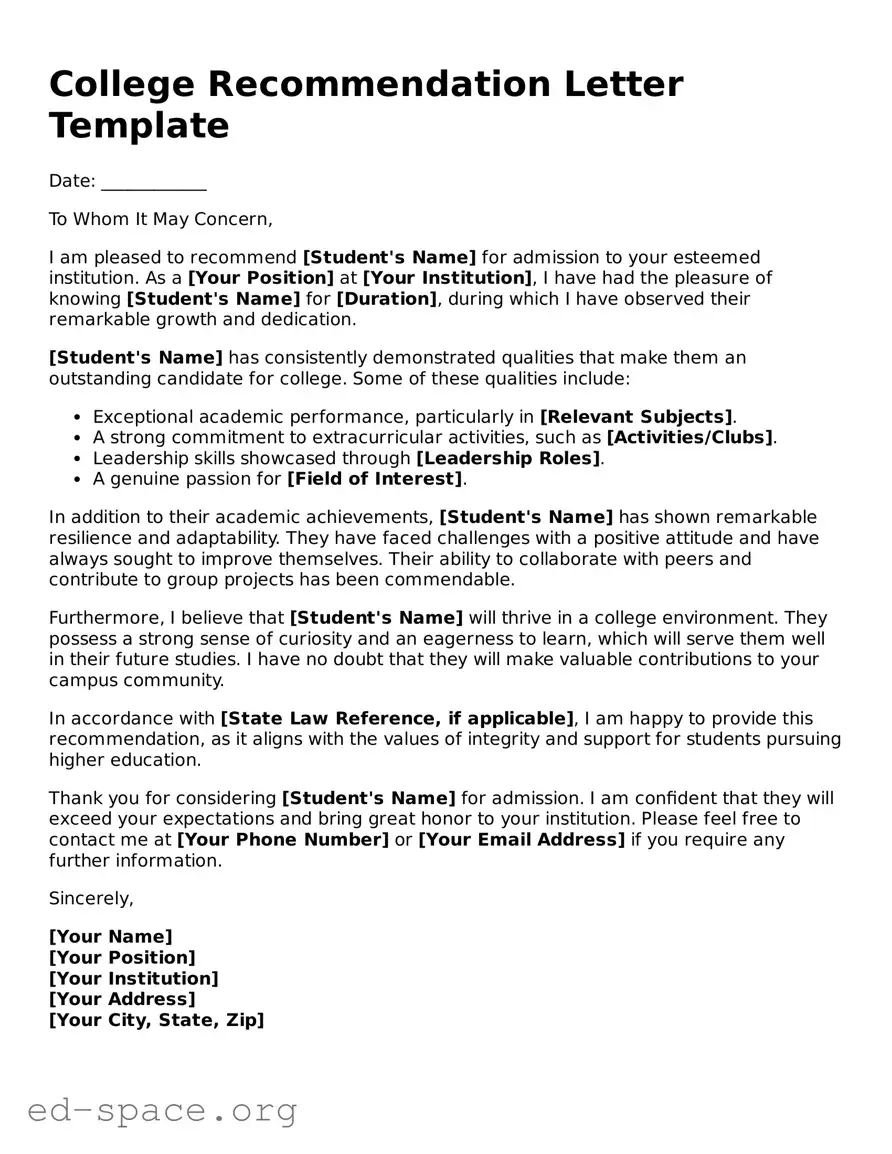
College Recommendation Letter Template
Date: ____________
To Whom It May Concern,
I am pleased to recommend [Student's Name] for admission to your esteemed institution. As a [Your Position] at [Your Institution], I have had the pleasure of knowing [Student's Name] for [Duration], during which I have observed their remarkable growth and dedication.
[Student's Name] has consistently demonstrated qualities that make them an outstanding candidate for college. Some of these qualities include:
In addition to their academic achievements, [Student's Name] has shown remarkable resilience and adaptability. They have faced challenges with a positive attitude and have always sought to improve themselves. Their ability to collaborate with peers and contribute to group projects has been commendable.
Furthermore, I believe that [Student's Name] will thrive in a college environment. They possess a strong sense of curiosity and an eagerness to learn, which will serve them well in their future studies. I have no doubt that they will make valuable contributions to your campus community.
In accordance with [State Law Reference, if applicable], I am happy to provide this recommendation, as it aligns with the values of integrity and support for students pursuing higher education.
Thank you for considering [Student's Name] for admission. I am confident that they will exceed your expectations and bring great honor to your institution. Please feel free to contact me at [Your Phone Number] or [Your Email Address] if you require any further information.
Sincerely,
[Your Name]
[Your Position]
[Your Institution]
[Your Address]
[Your City, State, Zip]
| Fact Name | Description |
|---|---|
| Purpose | The College Recommendation Letter form is used to provide insight into a student's character and achievements from a third-party perspective. |
| Submission Process | Typically, the form must be submitted directly to the college by the recommender, ensuring confidentiality. |
| State-Specific Forms | Some states may have specific guidelines or requirements for recommendation letters, governed by local education laws. |
| Importance | A strong recommendation can significantly enhance a student's application, influencing admission decisions. |
After obtaining the College Recommendation Letter form, it is essential to complete it accurately and thoroughly. This process ensures that the information provided reflects the candidate's strengths and suitability for college admission. Follow the steps outlined below to fill out the form effectively.
What is a College Recommendation Letter?
A College Recommendation Letter is a document written by a teacher, counselor, or another individual who knows the student well. This letter provides insight into the student’s character, academic performance, and potential for success in college. It serves as a way for colleges to understand the applicant beyond their grades and test scores.
Who should I ask to write my recommendation letter?
Choose someone who knows you well and can speak positively about your abilities and character. This could be a teacher from a subject you excelled in, a school counselor, or even a coach or mentor. Make sure the person you ask can provide specific examples of your strengths and contributions.
How much time should I give my recommender?
It is best to give your recommender at least four to six weeks before the submission deadline. This allows them ample time to write a thoughtful and comprehensive letter. Be sure to communicate your deadlines clearly and follow up politely as the date approaches.
What information should I provide to my recommender?
Provide your recommender with your resume, a list of your accomplishments, and any specific points you would like them to address. Include information about the colleges you are applying to and why you are interested in those institutions. This will help them tailor the letter to fit your goals.
Can I read my recommendation letter before it is submitted?
Typically, recommendation letters are confidential. Most colleges expect that the recommender will write candidly without the student’s input. However, you can discuss your strengths and goals with your recommender to guide them in writing a more effective letter.
What if my recommender misses the deadline?
If your recommender misses the deadline, contact them immediately to ensure they are aware of the situation. Politely remind them of the importance of the submission and see if they need any assistance. If necessary, consider asking another person to write a letter for you, but do this as a last resort.
How do I submit my recommendation letter?
Most colleges have an online application system where recommenders can submit letters directly. Ensure your recommender knows how to access this system and follows the submission guidelines provided by the college. If a hard copy is required, provide them with the necessary address and any specific instructions.
What should I do if I need to change my recommender?
If you find it necessary to change your recommender, do so as soon as possible. Inform your original recommender respectfully and explain your reasons. Then, reach out to the new person you wish to ask and provide them with all relevant information and deadlines. Clear communication is essential in this process.
Failing to provide specific examples of the student’s achievements can weaken the recommendation. Generic praise does not convey the student’s unique qualities.
Not adhering to the word limit can lead to important information being overlooked. Keeping the letter concise yet informative is essential.
Using overly formal language might make the letter feel impersonal. A friendly, conversational tone can better reflect the student’s character.
Neglecting to mention the student’s extracurricular activities can miss highlighting their well-roundedness. Colleges appreciate candidates who are engaged beyond academics.
Not proofreading for grammatical errors or typos can undermine the credibility of the recommendation. A polished letter reflects attention to detail.
Forgetting to include the relationship between the recommender and the student can leave the reader without context. This connection helps establish credibility.
Being vague about the student’s strengths can dilute the impact of the recommendation. Clear, specific attributes resonate more with admissions committees.
Submitting the letter late can jeopardize the student’s application. Timeliness is crucial in the college admissions process.
Not customizing the letter for each application can lead to missed opportunities. Tailoring the content shows genuine interest in the student’s future.
Including irrelevant information can distract from the main message. Staying focused on the student’s qualifications and character is key.
When applying to colleges, students often need to submit various documents alongside the College Recommendation Letter. Each of these forms plays a crucial role in presenting a comprehensive picture of the applicant. Below is a list of common documents that are typically required in the college application process.
Each of these documents contributes to a student's application, helping admissions committees understand their unique strengths and potential. Together, they create a narrative that supports the recommendation letter, providing a holistic view of the applicant.
When filling out a College Recommendation Letter form, it is essential to approach the task thoughtfully. Here are five things you should and shouldn't do:
Misconceptions about the College Recommendation Letter form can lead to confusion for both students and recommenders. Here are eight common misunderstandings:
Understanding these misconceptions can help students navigate the recommendation process more effectively and ensure they receive strong, supportive letters.
When preparing to fill out and use the College Recommendation Letter form, consider the following key takeaways: