Traveling with children often requires careful planning and consideration, especially when it comes to legal permissions. One essential document that parents and guardians should be aware of is the Child Travel Consent Form. This form serves as a written authorization, allowing a child to travel with someone other than their parent or legal guardian. It is particularly important in situations where a child is flying internationally or crossing borders. The form typically includes details such as the child's name, the names of the accompanying adults, and the travel itinerary. Additionally, it may require signatures from both parents or guardians, ensuring that everyone is in agreement. Having this document can prevent misunderstandings and complications at airports or borders, making the travel experience smoother for everyone involved. Understanding the requirements and best practices for completing this form is crucial for any adult planning to take a child on a trip.
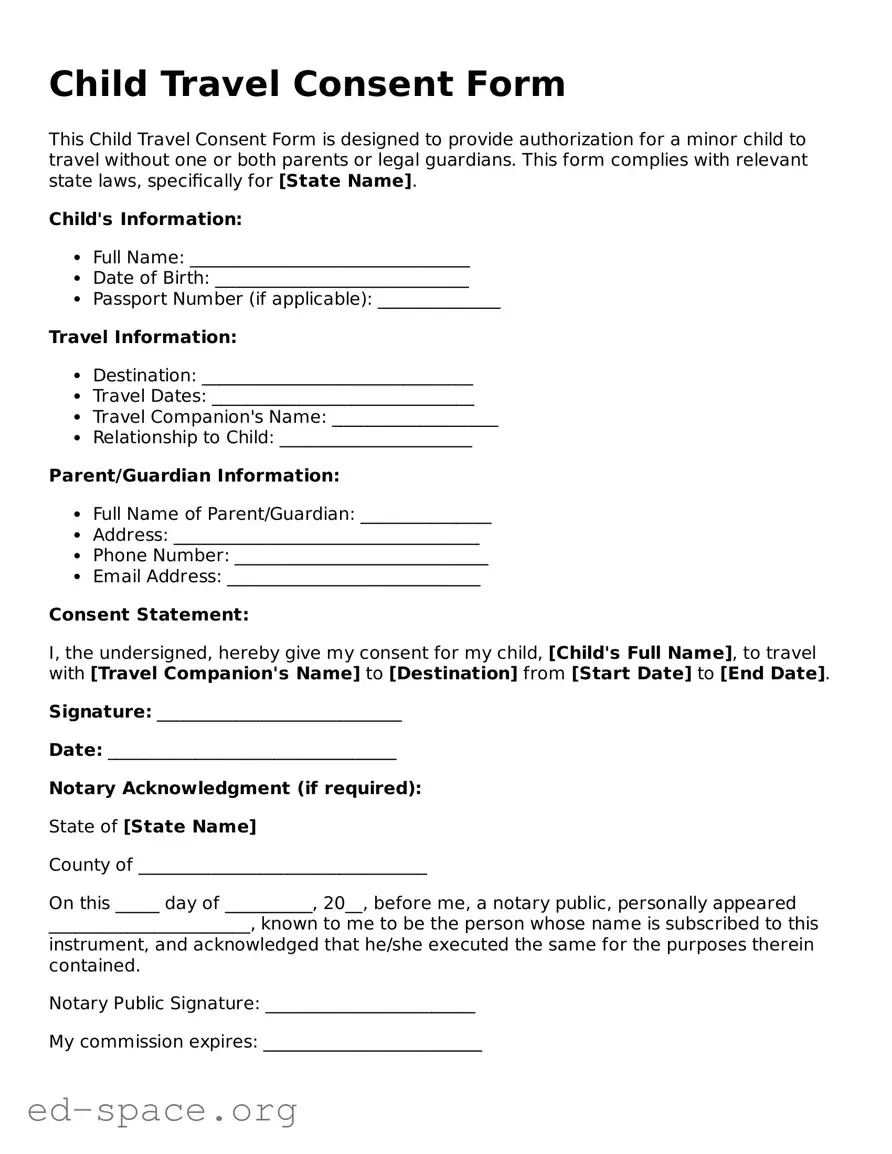
Child Travel Consent Form
This Child Travel Consent Form is designed to provide authorization for a minor child to travel without one or both parents or legal guardians. This form complies with relevant state laws, specifically for [State Name].
Child's Information:
Travel Information:
Parent/Guardian Information:
Consent Statement:
I, the undersigned, hereby give my consent for my child, [Child's Full Name], to travel with [Travel Companion's Name] to [Destination] from [Start Date] to [End Date].
Signature: ____________________________
Date: _________________________________
Notary Acknowledgment (if required):
State of [State Name]
County of _________________________________
On this _____ day of __________, 20__, before me, a notary public, personally appeared _______________________, known to me to be the person whose name is subscribed to this instrument, and acknowledged that he/she executed the same for the purposes therein contained.
Notary Public Signature: ________________________
My commission expires: _________________________
| Fact Name | Description |
|---|---|
| Purpose | A Child Travel Consent Form allows a minor to travel with someone other than their parents or legal guardians. |
| Legal Requirement | Some states require this form for minors traveling domestically or internationally. |
| Parental Consent | Both parents or legal guardians typically need to sign the form to grant permission. |
| Identification | It is advisable to include copies of the child's and accompanying adult's identification. |
| State-Specific Forms | Each state may have its own version of the form, reflecting local laws. |
| Governing Laws | For example, in California, Family Code Section 6940 governs travel consent for minors. |
| Duration | The consent is usually valid for a specific period, often up to one year. |
| Emergency Contact | Including an emergency contact number on the form can be beneficial during travel. |
Filling out the Child Travel Consent Form is an important step in ensuring that a child can travel safely and legally with a designated adult. Once the form is completed, it should be signed and dated by the parent or legal guardian. This document may be required by airlines or border officials, so it's crucial to have it ready before travel.
What is a Child Travel Consent Form?
A Child Travel Consent Form is a legal document that grants permission for a child to travel with someone who is not their parent or legal guardian. This form is often required by airlines, border control, and other authorities to ensure the safety and well-being of the child during travel. It typically includes details such as the child's name, travel itinerary, and the names of the accompanying adult(s).
When is a Child Travel Consent Form necessary?
This form is generally necessary when a child is traveling domestically or internationally without their parent or legal guardian. Many airlines and countries require this document to prevent child abduction and ensure that the child is traveling with the consent of their guardians. It is advisable to check the specific requirements of the airline and destination country before travel.
What information should be included in the form?
The Child Travel Consent Form should include the child's full name, date of birth, and passport information if applicable. Additionally, it should list the names and contact information of the accompanying adult(s) as well as the parents or legal guardians providing consent. Travel details such as the destination, dates of travel, and any relevant medical information may also be included to ensure a smooth journey.
How can I obtain a Child Travel Consent Form?
A Child Travel Consent Form can be obtained online through various legal document websites, or it can be created using templates available from reputable sources. It is important to ensure that the form complies with the specific requirements of the airline and destination. Consulting with a legal professional may also be beneficial to ensure that all necessary information is included and properly formatted.
Not providing all required information. Many people overlook sections that ask for specific details about the child, the traveling adult, or the trip itself.
Failing to sign the form. A signature is essential. Without it, the form may be considered invalid.
Using outdated forms. Laws and requirements can change. Always ensure you are using the most current version of the Child Travel Consent Form.
Not including contact information. Providing a way to reach the parents or guardians during the trip is crucial. This can help in emergencies.
Overlooking notarization. Some jurisdictions require the form to be notarized. Failing to do this can lead to complications at borders or during travel.
Neglecting to check for additional requirements. Different states or countries may have specific rules. It’s important to research any additional documentation needed for travel.
When planning to travel with a child, several important documents may be required in addition to the Child Travel Consent Form. These documents help ensure that the trip goes smoothly and that all necessary permissions are in place. Below are some commonly used forms and documents that accompany the Child Travel Consent Form.
Having these documents prepared and organized can make traveling with a child more manageable and enjoyable. Always check the specific requirements for your destination, as regulations may vary by country or airline.
When filling out a Child Travel Consent Form, it is crucial to approach the task with care. This form is essential for ensuring that a child can travel without complications. Below are some important dos and don’ts to consider.
By following these guidelines, you can help ensure a smooth travel experience for the child involved. Proper preparation is key to avoiding potential legal complications during travel.
Understanding the Child Travel Consent Form is essential for parents and guardians planning to travel with minors. However, several misconceptions can lead to confusion. Here are ten common misconceptions about this form:
Many believe that a Child Travel Consent Form is necessary only for trips outside the United States. In fact, it can also be beneficial for domestic travel, especially when a child is traveling with someone other than their parent or legal guardian.
While one parent's consent may suffice in some cases, it's often advisable to obtain consent from both parents. This helps avoid potential disputes or misunderstandings.
Although the form is a useful document, its enforceability can vary by state and circumstance. It's important to understand local laws regarding child travel consent.
Some people think that a verbal agreement is enough. However, having a written consent form is crucial for clarity and legal protection.
Many travelers assume that the form is only necessary for flights. However, it is also recommended for road trips or other modes of transportation.
While it's wise to have a consent form for minors, children over a certain age (typically 18) are considered adults and do not require this document.
Although notarization is not always required, having the form notarized can add an extra layer of authenticity and may be requested by some authorities.
Some believe that once the form is completed, it remains valid indefinitely. In reality, it may need to be updated for different trips or circumstances.
Both the adult accompanying the child and the parents or guardians should keep copies of the consent form. This ensures that everyone has access to the necessary documentation.
Even if a child is traveling with a family member, a consent form is still advisable. This helps prevent any misunderstandings or issues during travel.
By clarifying these misconceptions, parents and guardians can better prepare for their travels with minors and ensure a smoother journey.
When preparing to fill out and use the Child Travel Consent Form, consider the following key takeaways: