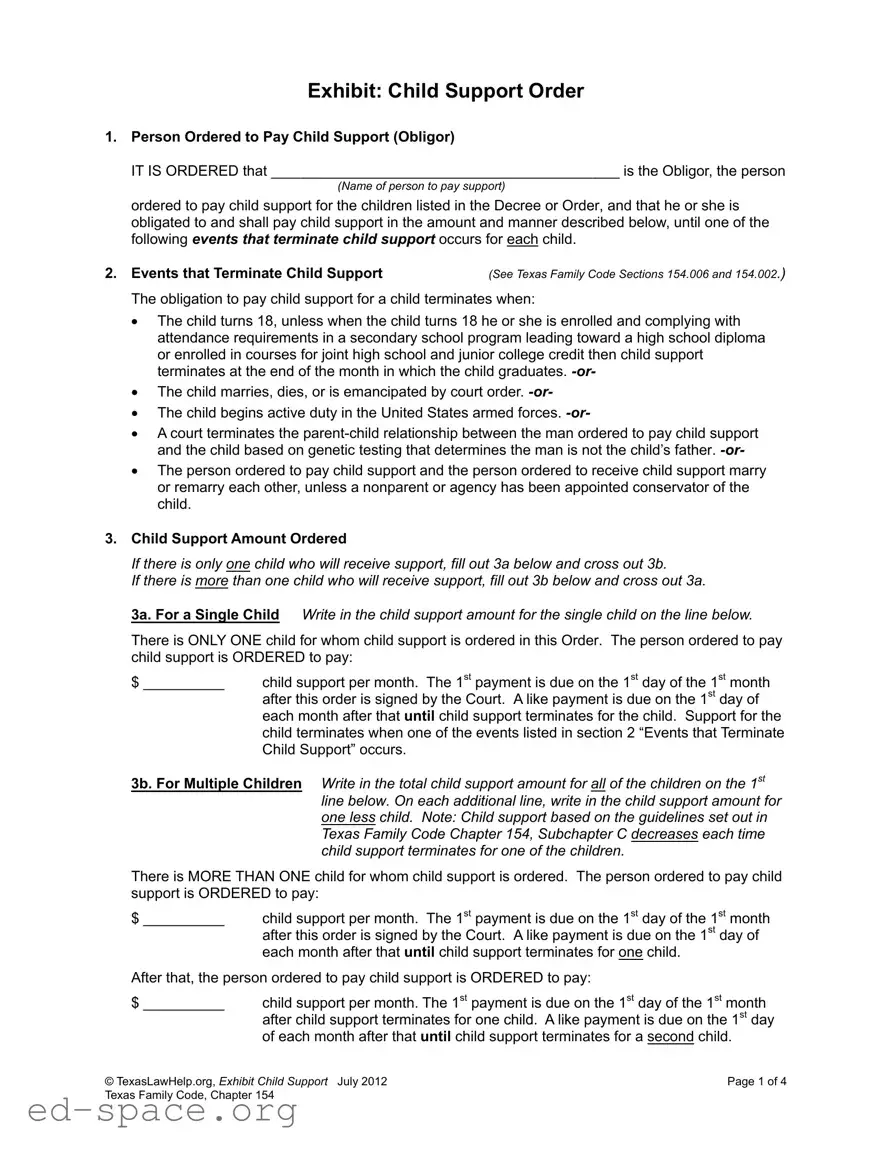
Understanding the Child Support Texas form is essential for anyone navigating the complexities of child support obligations in Texas. This form outlines the responsibilities of the person required to pay child support, known as the Obligor, and details the rights of the person receiving the payments, referred to as the Obligee. Key components include the specific amount of child support to be paid monthly, the timeline for payments, and the events that can terminate these obligations, such as the child reaching adulthood or other significant life changes. Additionally, the form addresses the payment process, stipulating that all payments must be sent to the Texas Child Support State Disbursement Unit, ensuring proper documentation and distribution. Provisions also exist for situations where informal payments are made, clarifying that these do not count towards the formal obligation. By filling out this form accurately, both parties can ensure clarity and compliance with Texas law, ultimately serving the best interests of the child involved.
Exhibit: Child Support Order
1.Person Ordered to Pay Child Support (Obligor)
IT IS ORDERED that ___________________________________________ is the Obligor, the person
(Name of person to pay support)
ordered to pay child support for the children listed in the Decree or Order, and that he or she is obligated to and shall pay child support in the amount and manner described below, until one of the following events that terminate child support occurs for each child.
2. Events that Terminate Child Support |
(See Texas Family Code Sections 154.006 and 154.002.) |
The obligation to pay child support for a child terminates when:
The child turns 18, unless when the child turns 18 he or she is enrolled and complying with attendance requirements in a secondary school program leading toward a high school diploma or enrolled in courses for joint high school and junior college credit then child support terminates at the end of the month in which the child graduates.
The child marries, dies, or is emancipated by court order.
The child begins active duty in the United States armed forces.
A court terminates the
The person ordered to pay child support and the person ordered to receive child support marry or remarry each other, unless a nonparent or agency has been appointed conservator of the child.
3.Child Support Amount Ordered
If there is only one child who will receive support, fill out 3a below and cross out 3b.
If there is more than one child who will receive support, fill out 3b below and cross out 3a.
3a. For a Single Child Write in the child support amount for the single child on the line below.
There is ONLY ONE child for whom child support is ordered in this Order. The person ordered to pay child support is ORDERED to pay:
$ __________ |
child support per month. The 1st payment is due on the 1st day of the 1st month |
|
after this order is signed by the Court. A like payment is due on the 1st day of |
|
each month after that until child support terminates for the child. Support for the |
|
child terminates when one of the events listed in section 2 “Events that Terminate |
|
Child Support” occurs. |
3b. For Multiple Children Write in the total child support amount for all of the children on the 1st line below. On each additional line, write in the child support amount for one less child. Note: Child support based on the guidelines set out in Texas Family Code Chapter 154, Subchapter C decreases each time child support terminates for one of the children.
There is MORE THAN ONE child for whom child support is ordered. The person ordered to pay child support is ORDERED to pay:
$ __________ |
child support per month. The 1st payment is due on the 1st day of the 1st month |
|
after this order is signed by the Court. A like payment is due on the 1st day of |
|
each month after that until child support terminates for one child. |
After that, the person ordered to pay child support is ORDERED to pay:
$ __________ |
child support per month. The 1st payment is due on the 1st day of the 1st month |
|
|
after child support terminates for one child. A like payment is due on the 1st day |
|
|
of each month after that until child support terminates for a second child. |
|
© TexasLawHelp.org, Exhibit Child Support July 2012 |
Page 1 of 4 |
|
Texas Family Code, Chapter 154 |
|
|

After that, the person ordered to pay child support is ORDERED to pay:
$ __________ |
child support per month. The 1st payment is due on the 1st day of the 1st month |
|
after child support terminates for a second child. A like payment is due on the 1st |
|
day of each month after that until child support terminates for a third child. |
After that, the person ordered to pay child support is ORDERED to pay:
$ __________ |
child support per month. The 1st payment is due on the 1st day of the 1st month |
|
after child support terminates for a third child. A like payment is due on the 1st |
|
day of each month after that until child support terminates for a fourth child. |
After that, the person ordered to pay child support is ORDERED to pay:
$ __________ |
child support per month. The 1st payment is due on the 1st day of the 1st month |
|
after child support terminates for a fourth child. A like payment is due on the 1st |
|
day of each month after that until child support terminates for a fifth child. |
4.Person Ordered to Receive Child Support (Obligee)
IT IS ORDERED that child support is payable to ________________________________________,
(Name of person to receive child support)
but must be sent to the place of payment listed below.
5.Place of Payment
The person ordered to pay child support is ORDERED to send all child support payments to the Texas Child Support State Disbursement Unit, PO Box 659791, San Antonio, TX 78265, for distribution according to law.
Include the following information with each payment:
Name of person ordered to pay child support, and
Name of person ordered to receive child support, and
Cause Number and County of Decree or Order, and
Attorney General Case Number, if applicable.
6.No Credit for Informal Payments
IT IS ORDERED that money paid by the person ordered to pay child support directly to the person ordered to receive child support or spent while in possession of the children does NOT count as child support and shall be deemed in addition to and not instead of the support ordered in this order.
7.Guideline or
Check Guideline Support if the child support amount or amounts listed are based on the guidelines set out in Texas Family Code, Chapter 154, Subchapter C.
Check and complete
Guideline Support: The amount of child support is approximately the amount recommended in the Texas Family Code Guidelines, Chapter 154.
_________________________________________________________________________________________
_________________________________________________________________________________________
_________________________________________________________________________________________
The net monthly income (from all sources) of the person paying child support is $ ______________. The net monthly income (from all sources) of the person receiving child support is $ ____________.
Actual monthly child support is $_______________, which is_______ % of the paying person’s net monthly income.
© TexasLawHelp.org, Exhibit Child Support July 2012 |
Page 2 of 4 |

8.Child Support Account / Fees Each party is ORDERED to:
Fill out any forms necessary to set up a child support account, and
Take the forms to the local Domestic Relations Office or county child support liaison within 5 days after the judge orders child support, and
Pay when due, all fees charged to that party by the state disbursement unit and any other agency authorized by law to a charge a fee.
9.Income Withholding
IT IS ORDERED that any employer of the person ordered to pay child support is ordered to withhold child support from the person’s disposable earnings.
If an income withholding for support order is served on the employer of the person ordered to pay child support, the employer shall withhold child support payments from the employee’s pay, and send it to the Texas Child Support State Disbursement Unit, PO Box 659791, San Antonio, TX 78265, where the payments shall be recorded, and forwarded to the person ordered to receive child support. All child support withheld and paid in accordance with this order shall be credited against the child support obligation.
If the employer withholds less than 100% of the child support ordered, the person ordered to pay child support is ORDERED to send the balance owed to the Texas Child Support State Disbursement Unit, PO Box 659791, San Antonio, TX 78265.
If an income withholding for support order is not served on the employer, or if the person paying child support is
IT IS ORDERED that the Clerk of this Court shall cause a certified copy of the income withholding for support order to be delivered to any employer of the person ordered to pay child support, if asked to do so by the person ordered to pay or receive child support, a prosecuting attorney, the title
10.Suspension of Income Withholding
Check here if all parties agree not to have the employer withhold child support payments at this time.
The parties agree, and the Court ORDERS that an income withholding for support order shall not be served on the employer unless: 1) child support payments are more than 30 days late, 2) the past due amount is the same or more than the monthly child support amount, 3) another violation of this child support order occurs or 4) the Office of the Attorney General Child Support Division is providing services to the person ordered to receive child support. The person ordered to pay child support is ORDERED to send all child support payments to the Texas Child Support State Disbursement Unit, PO Box 659791, San Antonio, TX 78265, where the payment will be recorded, and forwarded to the person ordered to receive child support.
11.Child Support After Death
If the person ordered to pay child support dies before this child support order ends, any unpaid child support shall become the obligation of his or her estate.
12.Life Insurance Policy
Check here if the person ordered to pay child support should also be ordered to maintain a life insurance policy for as long as child support is ordered.
As additional child support, the person paying child support under this order is ORDERED to obtain and maintain a life insurance policy on his or her life for as long as child support is ordered. The value of the policy shall be at least as much as the total child support obligation. The person receiving child support under this order must be named as the primary beneficiary for the benefit of the children.
© TexasLawHelp.org, Exhibit Child Support July 2012 |
Page 3 of 4 |
13.Required Notices
EACH PERSON WHO IS A PARTY TO THIS ORDER IS ORDERED TO NOTIFY EVERY OTHER PARTY, THE COURT, AND THE STATE CHILD SUPPORT REGISTRY OF ANY CHANGE IN THE PARTY’S:
CURRENT RESIDENCE ADDRESS,
MAILING ADDRESS,
HOME TELEPHONE NUMBER,
NAME OF EMPLOYER,
ADDRESS OF EMPLOYMENT,
DRIVER’S LICENSE NUMBER, AND
WORK TELEPHONE NUMBER.
THE PARTY IS ORDERED TO GIVE NOTICE OF AN INTENDED CHANGE IN ANY OF THE REQUIRED INFORMATION TO THE OTHER PARTY, THE COURT, AND THE STATE CASE REGISTRY ON OR BEFORE THE 60TH DAY BEFORE THE INTENDED CHANGE. IF THE PARTY DOES NOT KNOW OR COULD NOT HAVE KNOWN OF THE CHANGE IN SUFFICIENT TIME TO GIVE NOTICE OF THE CHANGE TO PROVIDE
THE DUTY TO FURNISH THIS INFORMATION TO EVERY OTHER PARTY, THE COURT, AND THE STATE CASE REGISTRY CONTINUES AS LONG AS ANY PERSON, BY VIRTUE OF THIS ORDER, IS UNDER AN OBLIGATION TO PAY CHILD SUPPORT OR ENTITLED TO POSSESSION OF OR ACCESS TO A CHILD.
FAILURE BY A PARTY TO OBEY THE ORDER OF THIS COURT TO PROVIDE EVERY OTHER PARTY, THE COURT, AND THE STATE CASE REGISTRY WITH THE CHANGE IN THE REQUIRED INFORMATION MAY RESULT IN FURTHER LITIGATION TO ENFORCE THE ORDER, INCLUDING CONTEMPT OF COURT. A FINDING OF CONTEMPT MAY BE PUNISHABLE BY CONFINEMENT IN JAIL FOR UP TO SIX MONTHS, A FINE OF UP TO $500 FOR EACH VIOLATION AND A MONEY JUDGMENT FOR PAYMENT OF ATTORNEY’S FEES AND COURT COSTS.
Notice shall be given to every other party by delivering a copy of the notice to each party by registered or certified mail, return receipt requested.
Notice shall be given to the Court by delivering a copy of the notice either in person to the clerk of the Court or by registered or certified mail addressed to the clerk.
Notice shall be given to the State Case Registry by mailing a copy of the notice to the State Case Registry, Contract Services Section, MC046S, P.O. Box 12017, Austin, Texas
14.WARNINGS TO PARTIES
FAILURE TO OBEY A COURT ORDER FOR CHILD SUPPORT OR FOR POSSESSION OF OR ACCESS TO A CHILD MAY RESULT IN FURTHER LITIGATION TO ENFORCE THIS ORDER, INCLUDING CONTEMPT OF COURT. A FINDING OF CONTEMPT MAY BE PUNISHABLE BY CONFINEMENT IN JAIL FOR UP TO SIX MONTHS, A FINE OF UP TO $500 FOR EACH VIOLATION AND A MONEY JUDGMENT FOR PAYMENT OF ATTORNEY’S FEES AND COURT COSTS.
FAILURE OF A PARTY TO MAKE A CHILD SUPPORT PAYMENT TO THE PLACE AND IN THE MANNER REQUIRED BY A COURT ORDER MAY RESULT IN THE PARTY’S NOT RECEIVING CREDIT FOR MAKING THE PAYMENT.
FAILURE OF A PARTY TO PAY CHILD SUPPORT DOES NOT JUSTIFY DENYING THAT PARTY
© TexasLawHelp.org, Exhibit Child Support July 2012 |
Page 4 of 4 |
| Fact Name | Details |
|---|---|
| Obligor Definition | The person ordered to pay child support is referred to as the Obligor. |
| Termination Events | Child support obligations end when a child turns 18, marries, dies, is emancipated, joins the military, or if a court determines the Obligor is not the biological father. |
| Payment Amount | Child support amounts are determined based on whether there is one child or multiple children. Specific amounts must be filled in on the form. |
| Payment Recipient | The person receiving child support is known as the Obligee, and payments must be sent to a designated address. |
| Place of Payment | Payments are to be sent to the Texas Child Support State Disbursement Unit for proper distribution. |
| No Credit for Informal Payments | Direct payments or expenditures made while in possession of the child do not count as child support. |
| Income Withholding | Employers are mandated to withhold child support from the Obligor's earnings if an income withholding order is issued. |
| Governing Laws | This form is governed by the Texas Family Code, specifically Chapter 154, which outlines child support guidelines. |
Completing the Child Support Texas form requires careful attention to detail. Each section must be filled out accurately to ensure compliance with court orders and state regulations. Follow these steps to complete the form correctly.
What is the purpose of the Child Support Texas form?
The Child Support Texas form is designed to establish the legal obligation of a parent to provide financial support for their child or children. This form outlines the details of the support order, including the amount to be paid, the duration of payments, and the conditions under which support may terminate. It ensures that the needs of the child are met and provides a clear framework for both parents regarding their financial responsibilities.
Who is considered the Obligor and the Obligee in the Child Support Texas form?
The Obligor is the parent who is ordered to pay child support. This is the individual responsible for making financial contributions to the upbringing of the child or children named in the order. Conversely, the Obligee is the parent who receives the child support payments. This parent is typically the primary caregiver, ensuring that the child’s needs are met with the financial support provided.
What events can terminate child support payments?
Child support payments may end when specific events occur. These include the child turning 18 years old, unless they are still in high school; the child marrying, dying, or being emancipated; the child entering active military duty; or a court determining that the Obligor is not the child's biological parent. Additionally, if the Obligor and Obligee remarry each other, child support obligations may also cease.
How is the amount of child support determined?
The amount of child support is typically based on guidelines set forth in the Texas Family Code. If there is one child, the form allows for a specific monthly amount to be designated. For multiple children, the total amount is calculated, and the payments decrease as each child becomes ineligible for support. The court considers various factors, including the income of both parents, to ensure the amount is fair and appropriate.
Where should child support payments be sent?
All child support payments must be sent to the Texas Child Support State Disbursement Unit. The address is PO Box 659791, San Antonio, TX 78265. It is crucial to include specific information with each payment, such as the names of both the Obligor and Obligee, the cause number, and any applicable Attorney General case number to ensure proper processing and crediting of payments.
What happens if payments are made informally?
Any money paid directly from the Obligor to the Obligee, or spent while the Obligor has the children, does not count as official child support. These informal payments are considered additional to the ordered support amount. Therefore, it is essential for the Obligor to make all payments through the designated channels to ensure compliance with the court order.
What are the consequences of failing to comply with the child support order?
Failure to comply with the child support order can lead to serious consequences, including potential contempt of court charges. This may result in fines, jail time, or additional legal fees. It is important for both parties to adhere to the terms of the order to avoid further legal complications. Additionally, failure to pay does not justify withholding visitation or access to the child.
Can child support obligations continue after the Obligor's death?
If the Obligor dies before their child support obligations end, any unpaid support becomes the responsibility of their estate. This means that the estate must settle any outstanding payments as part of the estate's financial obligations, ensuring that the child continues to receive the financial support they are entitled to.
Incomplete Information: Failing to fill in all required fields can lead to delays. Ensure that every section is completed accurately.
Incorrect Names: It is crucial to provide the correct names of both the person paying child support and the person receiving it. Double-check spelling and order.
Missing Payment Amounts: Omitting the specific child support amounts in the designated areas can cause confusion. Always include the exact figures.
Ignoring Payment Schedule: Not adhering to the specified payment schedule can result in complications. Be sure to note when payments are due.
Overlooking Termination Events: Failing to acknowledge the events that terminate child support can lead to misunderstandings. Familiarize yourself with these events.
Neglecting to Provide Contact Information: It is important to include current contact details. This ensures that all parties can be reached if necessary.
Not Following Up on Required Notices: Forgetting to notify other parties of changes in address or employment can lead to legal issues. Keep all parties informed.
Ignoring the Guidelines: If the child support amount differs from the guidelines, failing to explain why can create problems. Be prepared to provide a rationale.
Disregarding Informal Payments: Assuming that informal payments count toward the child support obligation can lead to complications. Only formal payments are recognized.
When dealing with child support in Texas, several additional forms and documents may be necessary alongside the Child Support Texas form. These documents help clarify obligations, rights, and procedures related to child support. Below are some commonly used forms.
Understanding these forms can help streamline the child support process and ensure that both parties fulfill their obligations effectively. Always consider consulting with a legal professional for guidance specific to your situation.
The Child Support Texas form shares similarities with several other legal documents related to child support and family law. Below is a list of seven documents that are comparable to the Child Support Texas form, highlighting how they are similar.
When filling out the Child Support Texas form, it is important to approach the process with care and attention. Below is a list of things you should and should not do.
When filling out and using the Child Support Texas form, several important points should be kept in mind. Here are key takeaways to ensure a smooth process:
By following these guidelines, individuals can navigate the child support process more effectively, ensuring compliance with legal requirements and the welfare of the children involved.