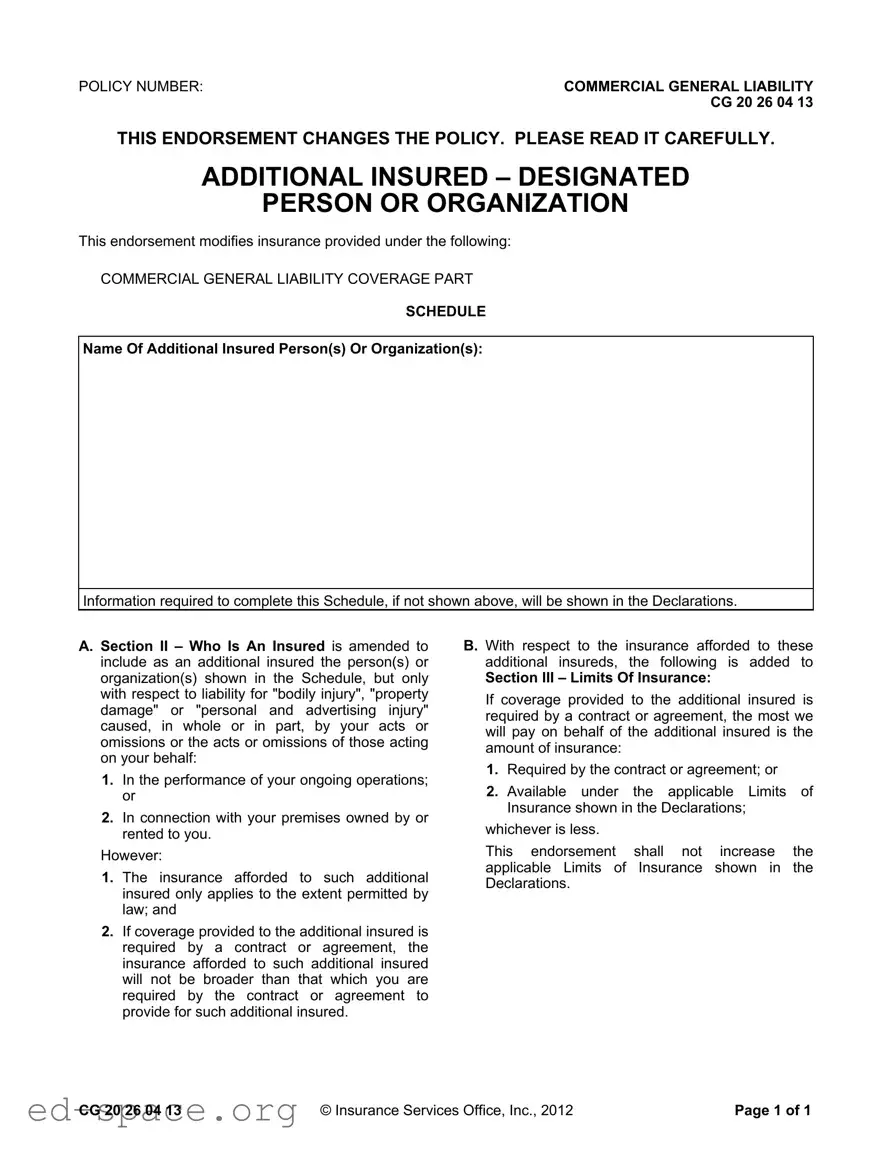
The CG 20 26 04 13 form is an essential endorsement for those involved in commercial general liability insurance. It specifically addresses the inclusion of additional insured parties, which can be crucial for businesses that engage in contracts requiring such coverage. This endorsement modifies the existing insurance policy to extend liability protection to designated individuals or organizations, thereby safeguarding them against claims related to bodily injury, property damage, or personal and advertising injury. The coverage applies only in connection with your ongoing operations or premises owned or rented by you, and it is vital to note that the extent of this coverage is governed by the law and any contractual agreements in place. Furthermore, the limits of insurance for additional insureds are clearly defined, ensuring that the protection offered does not exceed what is stipulated in the contract or what is available under the main policy. Understanding the nuances of the CG 20 26 04 13 form can help businesses mitigate risks and maintain compliance with contractual obligations, making it a critical document in the realm of commercial insurance.

POLICY NUMBER: |
COMMERCIAL GENERAL LIABILITY |
|
CG 20 26 04 13 |
THIS ENDORSEMENT CHANGES THE POLICY. PLEASE READ IT CAREFULLY.
ADDITIONAL INSURED – DESIGNATED
PERSON OR ORGANIZATION
This endorsement modifies insurance provided under the following:
COMMERCIAL GENERAL LIABILITY COVERAGE PART
SCHEDULE
Name Of Additional Insured Person(s) Or Organization(s):
Information required to complete this Schedule, if not shown above, will be shown in the Declarations.
A. Section II – Who Is An Insured is amended to include as an additional insured the person(s) or organization(s) shown in the Schedule, but only with respect to liability for "bodily injury", "property damage" or "personal and advertising injury" caused, in whole or in part, by your acts or omissions or the acts or omissions of those acting on your behalf:
1.In the performance of your ongoing operations; or
2.In connection with your premises owned by or rented to you.
However:
1.The insurance afforded to such additional insured only applies to the extent permitted by law; and
2.If coverage provided to the additional insured is required by a contract or agreement, the insurance afforded to such additional insured will not be broader than that which you are required by the contract or agreement to provide for such additional insured.
B. With respect to the insurance afforded to these additional insureds, the following is added to
Section III – Limits Of Insurance:
If coverage provided to the additional insured is required by a contract or agreement, the most we will pay on behalf of the additional insured is the amount of insurance:
1.Required by the contract or agreement; or
2.Available under the applicable Limits of Insurance shown in the Declarations;
whichever is less.
This endorsement shall not increase the applicable Limits of Insurance shown in the Declarations.
CG 20 26 04 13 |
© Insurance Services Office, Inc., 2012 |
Page 1 of 1 |
| Fact Name | Description |
|---|---|
| Policy Type | This form is an endorsement for a Commercial General Liability (CGL) policy. |
| Additional Insured | The form allows for the addition of specific persons or organizations as additional insureds. |
| Liability Coverage | It covers liability for bodily injury, property damage, and personal and advertising injury. |
| Acts or Omissions | The coverage applies to acts or omissions of the named insured or those acting on their behalf. |
| Ongoing Operations | The endorsement is applicable in relation to ongoing operations performed by the named insured. |
| Premises Coverage | It also provides coverage for premises owned or rented by the named insured. |
| Contractual Limitations | If required by a contract, coverage for additional insureds cannot exceed what is specified in that contract. |
| Limits of Insurance | The form specifies that limits of insurance for additional insureds are subject to the policy's declarations. |
| Governing Law | The governing laws may vary by state, but this endorsement generally follows state insurance regulations. |
| Year of Issue | This endorsement was issued by the Insurance Services Office, Inc. in 2012. |
Filling out the CG 20 26 04 13 form is a straightforward process that requires careful attention to detail. Once completed, this form will help ensure that the appropriate parties are recognized as additional insureds under your commercial general liability policy. Follow these steps to accurately fill out the form.
What is the purpose of the CG 20 26 04 13 form?
The CG 20 26 04 13 form is an endorsement that modifies a Commercial General Liability policy. It adds specific individuals or organizations as additional insureds, providing them with coverage for certain liabilities related to bodily injury, property damage, or personal and advertising injury caused by your actions or those acting on your behalf.
Who can be listed as an additional insured on this form?
You can list any person or organization as an additional insured, as long as their name is included in the schedule section of the form. This is typically done for clients, contractors, or other parties that require coverage under your policy due to a contractual agreement.
What types of liabilities are covered for additional insureds?
The additional insureds are covered for liabilities related to bodily injury, property damage, or personal and advertising injury. This coverage applies if these liabilities arise from your ongoing operations or from premises that you own or rent.
Are there any limitations on the coverage provided to additional insureds?
Yes, the coverage is limited. It only applies to the extent permitted by law. Additionally, if the coverage is required by a contract, it cannot be broader than what the contract specifies. This means that the insurance provided will match the requirements of the contract you have with the additional insured.
What happens if the contract requires a higher limit than what is available in the policy?
If the contract requires a higher limit of insurance than what is available under your policy, the most the insurer will pay on behalf of the additional insured is the lower amount. This is either the limit required by the contract or the limit available under your policy, whichever is less.
Does this endorsement increase the overall limits of my insurance policy?
No, this endorsement does not increase the overall limits of insurance shown in your policy declarations. The limits remain the same, regardless of the additional insured coverage.
How should I complete the schedule section of the form?
In the schedule section, you should clearly list the names of the additional insured persons or organizations. If there is any specific information required that is not already shown, it will need to be included in the declarations of your policy.
Can I add multiple additional insureds to this form?
Yes, you can add multiple additional insureds by listing each one in the schedule section. Ensure that all necessary details are provided to avoid any coverage issues.
Is there a specific format I need to follow when submitting this form?
How often should I review the CG 20 26 04 13 form?
It is a good practice to review this form regularly, especially when entering into new contracts or agreements. Changes in your business operations or new clients may require updates to the additional insureds listed on the form.
Incomplete Information: Failing to fill in all required fields can lead to delays or denials of coverage.
Incorrect Policy Number: Entering the wrong policy number can create confusion and misdirect the application.
Missing Additional Insured Names: Not listing all the necessary additional insured persons or organizations can limit coverage.
Inaccurate Descriptions: Providing vague or incorrect descriptions of the operations can result in coverage disputes.
Ignoring Contract Requirements: Not adhering to specific contract requirements for additional insureds may lead to insufficient coverage.
Failure to Review Limits: Not checking the limits of insurance can result in inadequate coverage for additional insureds.
Neglecting to Sign: Forgetting to sign the form can invalidate the endorsement and the coverage it provides.
Assuming Coverage: Assuming that all liabilities are covered without confirming the specifics can lead to unexpected gaps in protection.
Relying on Old Versions: Using outdated versions of the form can lead to misunderstandings about coverage terms.
Not Seeking Clarification: Failing to ask questions about unclear terms or conditions can result in misinterpretations.
The CG 20 26 04 13 form is an important endorsement that adds additional insured parties to a commercial general liability policy. When working with this form, several other documents may also be needed to ensure comprehensive coverage and compliance. Below is a list of related forms and documents that are often used alongside the CG 20 26 04 13 form.
Understanding these documents can help ensure that all parties are adequately protected and compliant with insurance requirements. Proper documentation is key to navigating the complexities of commercial insurance and safeguarding against potential liabilities.
The CG 20 26 04 13 form is an endorsement that modifies a Commercial General Liability policy to include additional insureds. Understanding similar documents can help clarify its purpose and use. Here are ten documents that share similarities with the CG 20 26 04 13 form:
Each of these documents plays a vital role in protecting various parties involved in business operations. Understanding their similarities can help ensure that appropriate coverage is in place.
When filling out the CG 20 26 04 13 form, it is important to approach the task with care and attention to detail. Below is a list of things you should and shouldn't do to ensure accuracy and compliance.
Taking these steps can help prevent delays and ensure that the form serves its intended purpose effectively.
Understanding the CG 20 26 04 13 form can be challenging, and several misconceptions often arise. Here are seven common misunderstandings about this endorsement:
By clarifying these misconceptions, businesses can better understand their insurance coverage and ensure they are adequately protected.
The CG 20 26 04 13 form is an important document for those involved in commercial general liability insurance. Below are key takeaways regarding its completion and use.