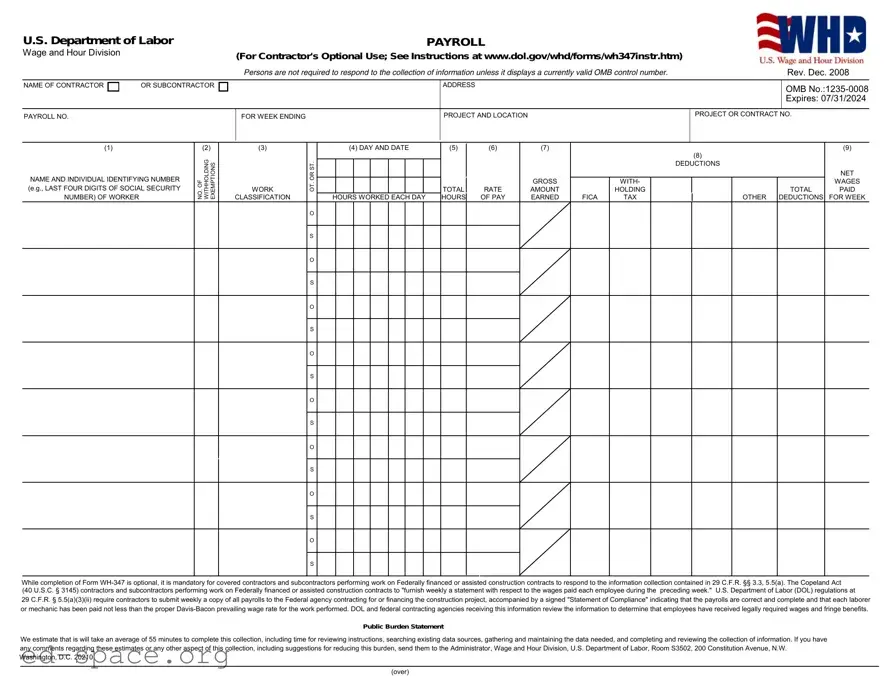
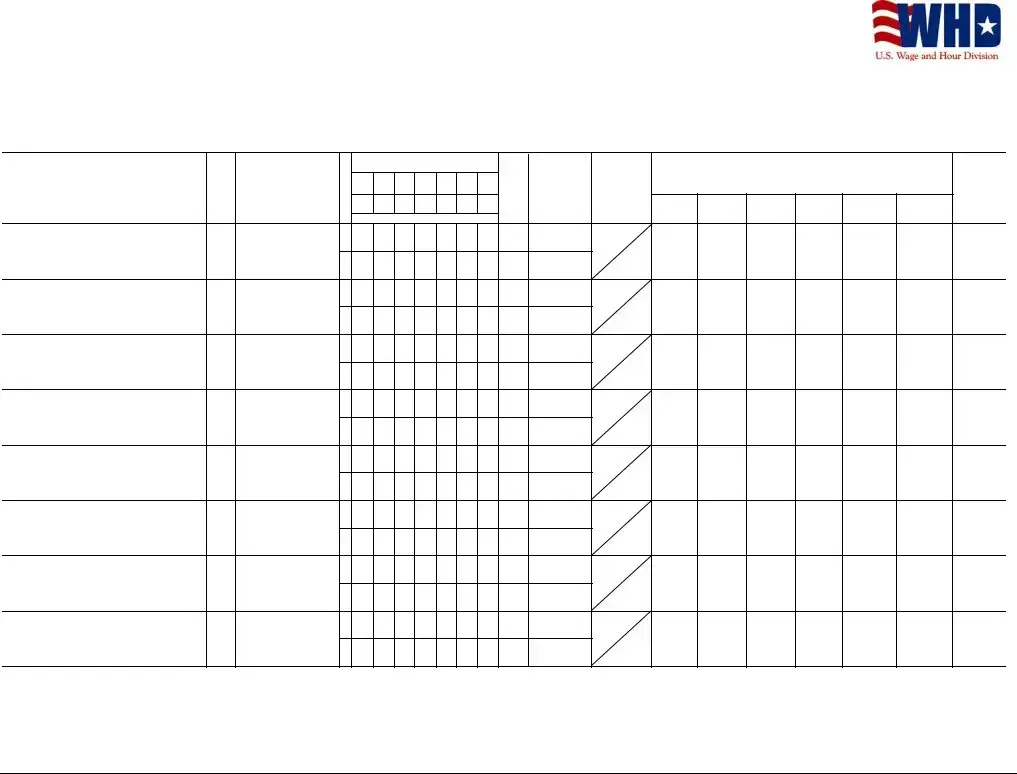
The Certified Payroll form, officially known as Form WH-347, plays a crucial role in ensuring that workers on federally funded construction projects receive fair wages. This form is not just a simple payroll document; it is a comprehensive tool that contractors and subcontractors use to report wages paid to their employees each week. It requires detailed information about each worker, including their name, job classification, hours worked, and wages earned, along with any deductions made. Compliance with this form is mandatory for contractors working on federally financed or assisted projects, as it helps verify adherence to the Davis-Bacon Act, which mandates the payment of prevailing wages. Additionally, the form must be accompanied by a signed "Statement of Compliance," confirming that all workers have been compensated according to the law. The U.S. Department of Labor oversees the collection and review of this information, ensuring that laborers receive their legally entitled wages and benefits. While filling out this form may seem daunting, it typically takes about 55 minutes to complete, including gathering necessary data and reviewing the instructions. Understanding the importance of the Certified Payroll form is essential for contractors to maintain compliance and uphold the rights of their workers.
U.S. Department of Labor |
|
PAYROLL |
|
|
Wage and Hour Division |
|
(For Contractor's Optional Use; See Instructions at www.dol.gov/whd/forms/wh347instr.htm) |
|
|
|
|
Persons are not required to respond to the collection of information unless it displays a currently valid OMB control number. |
Rev. Dec. 2008 |
|
NAME OF CONTRACTOR |
OR SUBCONTRACTOR |
|
ADDRESS |
OMB |
|
|
|
|
|
|
|
|
|
Expires: 07/31/2024 |
|
|
|
|
|
PAYROLL NO. |
|
FOR WEEK ENDING |
PROJECT AND LOCATION |
PROJECT OR CONTRACT NO. |
(1)
NAME AND INDIVIDUAL IDENTIFYING NUMBER (e.g., LAST FOUR DIGITS OF SOCIAL SECURITY NUMBER) OF WORKER
(2)
NO. OF WITHHOLDi NG TXE EMP IONS
(3)
WORK
CLASSIFICATION
(4) DAY AND DATE |
(5) |
(6) |
(7) |
|
|
(8) |
|
(9) |
|
|
|
|
|
|
|
|
|
T. |
|
|
|
|
|
DEDUCTIONS |
|
|
ORS |
|
|
|
|
|
|
|
NET |
|
|
GROSS |
|
WITH- |
|
|
WAGES |
|
OT. |
|
|
|
|
|
|||
TOTAL |
RATE |
AMOUNT |
|
HOLDING |
|
TOTAL |
PAID |
|
HOURS WORKED EACH DAY |
HOURS |
OF PAY |
EARNED |
FICA |
TAX |
OTHER |
DEDUCTIONS |
FOR WEEK |
O |
|
|
|
|
|
|
|
|
S |
|
|
|
|
|
|
|
|
O |
|
|
|
|
|
|
|
|
S |
|
|
|
|
|
|
|
|
O |
|
|
|
|
|
|
|
|
S |
|
|
|
|
|
|
|
|
O |
|
|
|
|
|
|
|
|
S |
|
|
|
|
|
|
|
|
O |
|
|
|
|
|
|
|
|
S |
|
|
|
|
|
|
|
|
O |
|
|
|
|
|
|
|
|
S |
|
|
|
|
|
|
|
|
O |
|
|
|
|
|
|
|
|
S |
|
|
|
|
|
|
|
|
O |
|
|
|
|
|
|
|
|
S |
|
|
|
|
|
|
|
|
While completion of Form
(40 U.S.C. § 3145) contractors and subcontractors performing work on Federally financed or assisted construction contracts to "furnish weekly a statement with respect to the wages paid each employee during the preceding week." U.S. Department of Labor (DOL) regulations at
29 C.F.R. § 5.5(a)(3)(ii) require contractors to submit weekly a copy of all payrolls to the Federal agency contracting for or financing the construction project, accompanied by a signed "Statement of Compliance" indicating that the payrolls are correct and complete and that each laborer or mechanic has been paid not less than the proper
Public Burden Statement
We estimate that is will take an average of 55 minutes to complete this collection, including time for reviewing instructions, searching existing data sources, gathering and maintaining the data needed, and completing and reviewing the collection of information. If you have any comments regarding these estimates or any other aspect of this collection, including suggestions for reducing this burden, send them to the Administrator, Wage and Hour Division, U.S. Department of Labor, Room S3502, 200 Constitution Avenue, N.W. Washington, D.C. 20210
(over)
Date
I,
(Name of Signatory Party) |
|
(Title) |
do hereby state:
(1) That I pay or supervise the payment of the persons employed by
(b)WHERE FRINGE BENEFITS ARE PAID IN CASH
−Each laborer or mechanic listed in the above referenced payroll has been paid, as indicated on the payroll, an amount not less than the sum of the applicable basic hourly wage rate plus the amount of the required fringe benefits as listed in the contract, except as noted in section 4(c) below.
(c)EXCEPTIONS
(Contractor or Subcontractor)
on the
EXCEPTION (CRAFT) |
EXPLANATION |
; that during the payroll period commencing on the
(Building or Work)
day of |
|
, |
|
, and ending the |
|
day of |
|
, |
|
, |
all persons employed on said project have been paid the full weekly wages earned, that no rebates have been or will be made either directly or indirectly to or on behalf of said
from the full
(Contractor or Subcontractor)
weekly wages earned by any person and that no deductions have been made either directly or indirectly from the full wages earned by any person, other than permissible deductions as defined in Regulations, Part
3 (29 C.F.R. Subtitle A), issued by the Secretary of Labor under the Copeland Act, as amended (48 Stat. 948,
63 Stat. 108, 72 Stat. 967; 76 Stat. 357; 40 U.S.C. § 3145), and described below:
(2)That any payrolls otherwise under this contract required to be submitted for the above period are correct and complete; that the wage rates for laborers or mechanics contained therein are not less than the applicable wage rates contained in any wage determination incorporated into the contract; that the classifications set forth therein for each laborer or mechanic conform with the work he performed.
(3)That any apprentices employed in the above period are duly registered in a bona fide apprenticeship program registered with a State apprenticeship agency recognized by the Bureau of Apprenticeship and Training, United States Department of Labor, or if no such recognized agency exists in a State, are registered with the Bureau of Apprenticeship and Training, United States Department of Labor.
(4)That:
(a)WHERE FRINGE BENEFITS ARE PAID TO APPROVED PLANS, FUNDS, OR PROGRAMS
−in addition to the basic hourly wage rates paid to each laborer or mechanic listed in the above referenced payroll, payments of fringe benefits as listed in the contract have been or will be made to appropriate programs for the benefit of such employees, except as noted in section 4(c) below.
REMARKS:
NAME AND TITLE |
SIGNATURE |
|
|
THE WILLFUL FALSIFICATION OF ANY OF THE ABOVE STATEMENTS MAY SUBJECT THE CONTRACTOR OR SUBCONTRACTOR TO CIVIL OR CRIMINAL PROSECUTION. SEE SECTION 1001 OF TITLE 18 AND SECTION 3729 OF TITLE 31 OF THE UNITED STATES CODE.
| Fact Name | Details |
|---|---|
| Form Purpose | The Certified Payroll form is used to report wages paid to employees on federally financed or assisted construction projects. |
| Optional Use | Completion of the form is optional for contractors but mandatory for those working on certain federal contracts. |
| Governing Law | 29 C.F.R. §§ 3.3, 5.5(a) govern the use of the Certified Payroll form. |
| Weekly Reporting | Contractors must submit weekly payroll reports to the federal agency overseeing the project. |
| Employee Information | Each employee's name, identifying number, and work classification must be included in the report. |
| Wage Compliance | The form ensures that employees are paid at least the prevailing wage rates as mandated by the Davis-Bacon Act. |
| Fringe Benefits | Details about fringe benefits paid to employees must also be reported, if applicable. |
| Public Burden Statement | It takes an average of 55 minutes to complete the Certified Payroll form, including all necessary data gathering. |
| Signature Requirement | A signed "Statement of Compliance" must accompany the payroll report, confirming accuracy and compliance. |
| Consequences of Falsification | Willful falsification of the form can lead to civil or criminal prosecution under U.S. law. |
Filling out the Certified Payroll form is an essential process for contractors and subcontractors working on federally financed or assisted construction projects. The form must be completed accurately to ensure compliance with federal regulations. Follow the steps below to fill out the form correctly.
After completing the form, ensure that it is submitted to the appropriate federal agency along with the required Statement of Compliance. This submission should occur weekly to maintain compliance with federal regulations.
What is the Certified Payroll form?
The Certified Payroll form, also known as Form WH-347, is a document used by contractors and subcontractors working on federally financed or assisted construction projects. It reports the wages paid to each worker on a weekly basis. This form ensures compliance with the Davis-Bacon Act, which mandates that workers receive at least the prevailing wage for their work.
Who is required to submit the Certified Payroll form?
Contractors and subcontractors engaged in federally funded construction projects must submit the Certified Payroll form. This requirement applies to those who are covered under the Davis-Bacon Act. Even though the form itself is optional, the information it contains is mandatory for compliance with federal regulations.
How often must the Certified Payroll form be submitted?
The Certified Payroll form must be submitted weekly. Each contractor is required to provide a copy of their payroll to the federal agency overseeing the project. This weekly submission helps ensure that all workers are paid the appropriate wages and benefits as mandated by law.
What information is included in the Certified Payroll form?
The form includes several key pieces of information. This includes the contractor's name and address, the project location, the names of workers, their identifying numbers, work classifications, hours worked, wages earned, and any deductions made. Additionally, it requires a signed statement of compliance confirming that the payroll is accurate and that workers are paid the correct wage rates.
What happens if the Certified Payroll form is not submitted?
If a contractor fails to submit the Certified Payroll form, they may face serious consequences. These can include penalties, fines, or even legal action. The federal agency may also withhold payments for work performed until compliance is achieved. It is crucial to adhere to these requirements to avoid any potential issues.
Are there any exceptions to the information required on the Certified Payroll form?
Yes, there are certain exceptions that may apply. For instance, if a contractor has made permissible deductions, these should be noted on the form. Additionally, if there are any exceptions regarding wage rates or fringe benefits, these must be clearly explained in the remarks section of the form. It is important to accurately report any deviations to remain compliant.
What is the significance of the signed "Statement of Compliance" on the Certified Payroll form?
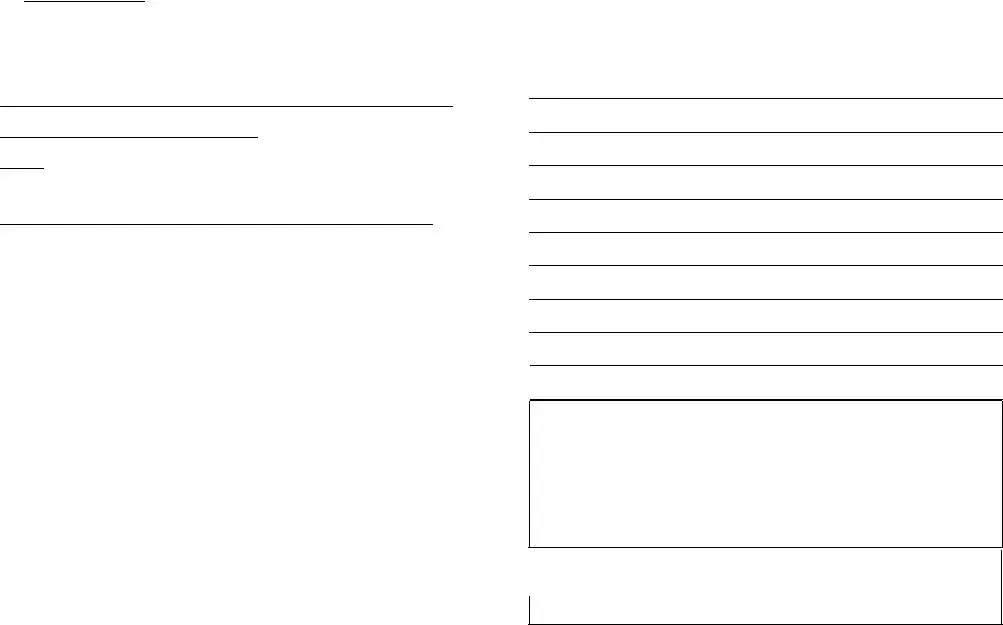
The signed "Statement of Compliance" is a critical part of the Certified Payroll form. By signing this statement, the contractor certifies that all information provided is correct and complete. It also confirms that all workers have been paid at least the prevailing wage. Falsifying this information can lead to severe legal consequences, including civil or criminal prosecution.
Incomplete Information: Failing to fill out all required fields can lead to significant delays. Each section, from the name of the contractor to the wages paid, must be completed accurately. Omitting details can raise red flags during audits.
Incorrect Worker Identification: Using incorrect or outdated identifying numbers for workers can create confusion. It is essential to ensure that the last four digits of the Social Security number or other identifiers are accurate to maintain proper records.
Misclassification of Work: Classifying workers incorrectly can result in underpayment or overpayment of wages. Each worker's classification should align with the work performed, as discrepancies can lead to legal complications.
Failure to Report Deductions: Not reporting deductions accurately can cause issues. All deductions, whether for taxes or other reasons, must be clearly documented to ensure compliance with federal regulations.
Neglecting to Sign the Statement of Compliance: The signature of the signatory party is crucial. Without it, the form is incomplete and cannot be processed. This oversight can lead to serious repercussions for the contractor or subcontractor.
The Certified Payroll form is a crucial document used by contractors and subcontractors working on federally financed or assisted construction projects. It ensures compliance with wage laws and provides transparency regarding employee compensation. Alongside this form, several other documents are commonly utilized to support the payroll process and maintain compliance with federal regulations.
These documents collectively support the integrity of the payroll process and ensure that all parties involved adhere to federal labor laws. Maintaining accurate and complete records is essential for compliance and helps protect the rights of workers on federally funded projects.
When filling out the Certified Payroll form, there are several important guidelines to follow. Here’s a list of what to do and what to avoid:
Following these guidelines will help ensure compliance with federal regulations and avoid potential issues.
Understanding the Certified Payroll form can be challenging, and several misconceptions often arise. Here are four common misunderstandings about this important document:
While it may seem that the form is optional, it is actually mandatory for contractors and subcontractors working on federally financed or assisted construction projects. They must submit the form weekly to ensure compliance with wage laws.
This is not true. Any contractor or subcontractor involved in federally funded projects, regardless of size, is required to complete and submit the Certified Payroll form. Compliance is crucial for all parties involved.
In addition to wages, the form also tracks hours worked, classifications of work, and deductions. It ensures that all employees are paid the correct prevailing wage and that any required fringe benefits are accounted for.
Contractors must submit the Certified Payroll form weekly for each pay period. This ongoing requirement helps maintain transparency and compliance throughout the duration of the project.
Filling out and using the Certified Payroll form is an important process for contractors and subcontractors involved in federally financed or assisted construction projects. Here are some key takeaways to consider: