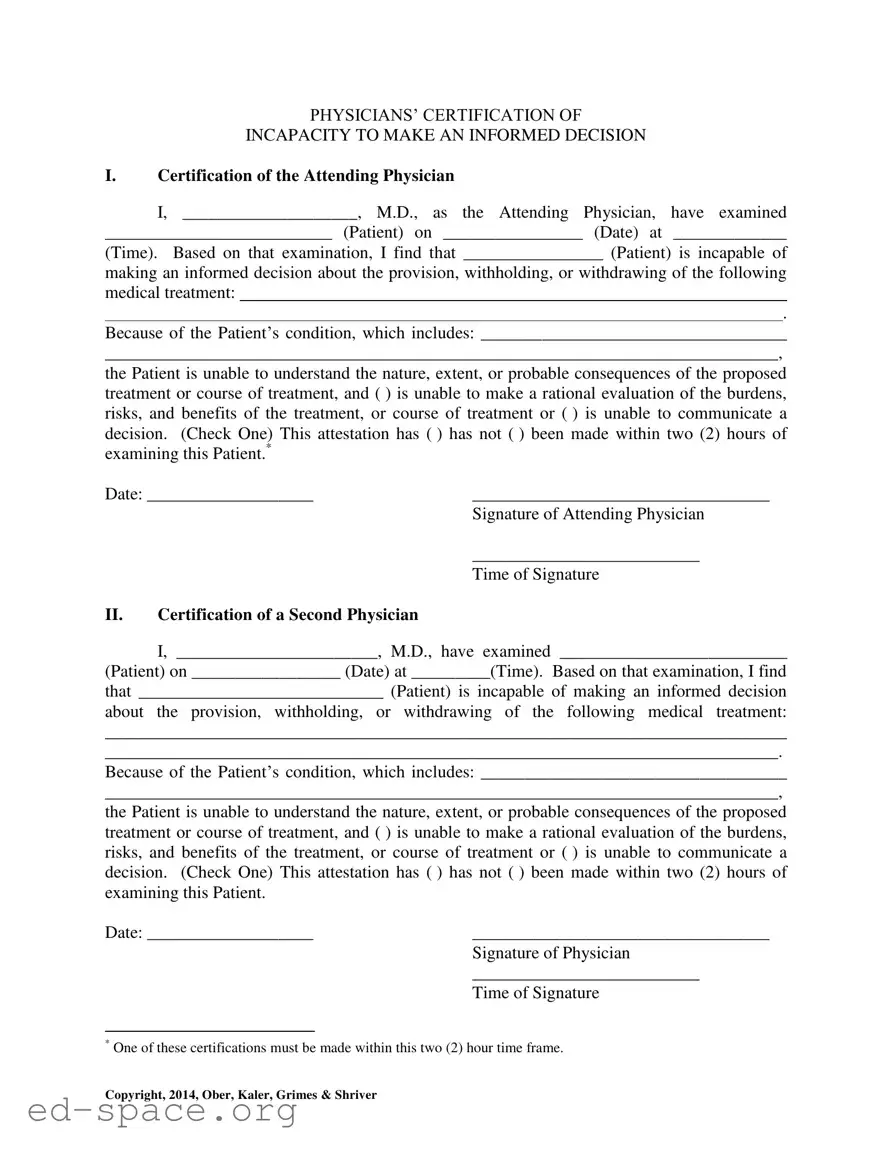
When a patient faces a medical situation that renders them unable to make informed decisions about their care, the Certification of Incapacity form becomes a crucial tool for healthcare providers. This form requires the signatures of at least two physicians who have examined the patient, affirming that the individual lacks the capacity to understand their treatment options or to communicate their wishes effectively. Each physician must detail their findings, specifying the patient’s condition and the reasons behind the incapacity. Important aspects of the form include the need for timely certification, as one of the physicians must complete their assessment within two hours of the examination. By clarifying the patient's inability to evaluate the risks and benefits of proposed treatments, this form serves to protect the patient's rights while ensuring that appropriate medical decisions can be made in their best interest. Understanding the intricacies of this document is essential for both healthcare professionals and families navigating challenging medical scenarios.

PHYSICIANS’ CERTIFICATION OF
INCAPACITY TO MAKE AN INFORMED DECISION
I.Certification of the Attending Physician
I, ____________________, M.D., as the Attending Physician, have examined
__________________________ (Patient) on ________________ (Date) at _____________
(Time). Based on that examination, I find that ________________ (Patient) is incapable of
making an informed decision about the provision, withholding, or withdrawing of the following medical treatment:
.
Because of the Patient’s condition, which includes: ___________________________________
_____________________________________________________________________________,
the Patient is unable to understand the nature, extent, or probable consequences of the proposed treatment or course of treatment, and ( ) is unable to make a rational evaluation of the burdens, risks, and benefits of the treatment, or course of treatment or ( ) is unable to communicate a decision. (Check One) This attestation has ( ) has not ( ) been made within two (2) hours of examining this Patient.*
Date: ___________________ |
__________________________________ |
|
Signature of Attending Physician |
|
__________________________ |
|
Time of Signature |
II.Certification of a Second Physician
I, _______________________, M.D., have examined __________________________
(Patient) on _________________ (Date) at _________(Time). Based on that examination, I find
that ____________________________ (Patient) is incapable of making an informed decision
about the provision, withholding, or withdrawing of the following medical treatment:
______________________________________________________________________________
_____________________________________________________________________________.
Because of the Patient’s condition, which includes: ___________________________________
_____________________________________________________________________________,
the Patient is unable to understand the nature, extent, or probable consequences of the proposed treatment or course of treatment, and ( ) is unable to make a rational evaluation of the burdens, risks, and benefits of the treatment, or course of treatment or ( ) is unable to communicate a decision. (Check One) This attestation has ( ) has not ( ) been made within two (2) hours of examining this Patient.
Date: ___________________ |
__________________________________ |
|
Signature of Physician |
|
__________________________ |
|
Time of Signature |
*One of these certifications must be made within this two (2) hour time frame.
Copyright, 2014, Ober, Kaler, Grimes & Shriver
| Fact Name | Details |
|---|---|
| Purpose | The Certification of Incapacity form is used to confirm a patient's inability to make informed medical decisions. |
| Physician Requirement | Two physicians must examine the patient and provide their certifications on the form. |
| Time Frame | One certification must occur within two hours of the patient's examination. |
| Patient Information | The form requires specific details about the patient, including their name and the date and time of examination. |
| Conditions for Incapacity | Physicians must describe the patient's condition affecting their decision-making capabilities. |
| Legal Implications | In many states, this form is governed by laws related to medical decision-making and patient rights. |
| Signature Requirement | Both physicians must sign and date the form to validate their assessments. |
| Check Boxes | Physicians must check boxes indicating the specific reasons for the patient's incapacity. |
| State Variations | Each state may have its own version of this form, reflecting local laws and regulations. |
Filling out the Certification of Incapacity form requires careful attention to detail. This form is essential for documenting a patient's inability to make informed medical decisions. Follow the steps below to complete the form accurately.
Once both sections are filled out and signed, the form is ready for submission. Ensure all information is accurate to avoid any delays in processing.
What is the purpose of the Certification of Incapacity form?
The Certification of Incapacity form is designed to document a patient's inability to make informed medical decisions. This form requires the signatures of two physicians who have examined the patient. Their evaluations confirm that the patient cannot understand the nature or consequences of proposed medical treatments. This certification is crucial for ensuring that appropriate medical decisions can be made on behalf of the patient when they are unable to do so themselves.
Who needs to complete the Certification of Incapacity form?
Two licensed physicians must complete the Certification of Incapacity form. The first physician, referred to as the attending physician, examines the patient and provides an initial assessment. A second physician must also conduct an independent examination and provide their certification. Both physicians must agree on the patient's incapacity to make informed decisions regarding medical treatment.
What information is required on the form?
The form requires several key pieces of information. Each physician must include their name, the patient's name, the date and time of the examination, and a detailed description of the patient's condition. Additionally, physicians must indicate whether the patient is unable to make a rational evaluation of treatment options or communicate a decision. This information is critical for establishing the patient's incapacity clearly.
Is there a time limit for completing the Certification of Incapacity form?
Yes, there is a specific time frame for completing the form. One of the physicians must certify the patient's incapacity within two hours of their examination. This requirement ensures that the assessment reflects the patient's current condition and that timely medical decisions can be made. Adhering to this time limit is essential for the validity of the certification.
Incomplete Patient Information: Failing to fill in the patient's full name, date of examination, or time of examination can lead to confusion and delays in processing the form.
Missing Signatures: Not signing the form or omitting the signature of the second physician can invalidate the certification.
Incorrect Time Frame: Not adhering to the requirement that one of the certifications must be completed within two hours of examination can render the document ineffective.
Failure to Check Evaluation Options: Not selecting one of the options regarding the patient’s ability to evaluate treatment risks and benefits, or to communicate a decision, can create ambiguity.
Insufficient Details on Patient's Condition: Providing vague or incomplete descriptions of the patient’s condition may lead to misunderstandings about their incapacity.
Neglecting to Include Treatment Information: Omitting specifics about the medical treatment in question can result in an unclear understanding of the decisions being made.
Not Keeping Copies: Failing to retain copies of the completed form for personal records can lead to issues if the document is needed for future reference.
When dealing with matters of incapacity, there are several important forms and documents that may be necessary alongside the Certification of Incapacity form. Each document serves a specific purpose and helps ensure that the rights and needs of the patient are respected and upheld. Below is a list of commonly used forms in this context.
Understanding these documents can help ensure that patients receive the care they need while respecting their rights and wishes. Each form plays a vital role in the process of making informed decisions during challenging times.
Durable Power of Attorney for Health Care: This document allows an individual to appoint someone to make medical decisions on their behalf if they become unable to do so. Like the Certification of Incapacity, it focuses on the patient's ability to understand and communicate their health care preferences.
Advance Health Care Directive: This document combines both a living will and a durable power of attorney for health care. It outlines the types of medical treatment a person does or does not want and appoints someone to make decisions if they cannot. Both documents emphasize the importance of understanding treatment options.
Medical Power of Attorney: Similar to a durable power of attorney, this document specifically grants authority to someone to make health care decisions for another person when they are incapacitated. It shares the same goal of ensuring that a patient's wishes are respected when they cannot express them.
Living Will: A living will details a person's wishes regarding medical treatment in scenarios where they cannot communicate. It is closely related to the Certification of Incapacity, as both address situations where an individual is unable to make informed decisions about their health care.
When filling out the Certification of Incapacity form, attention to detail is crucial. Here are some important dos and don'ts to consider:
Misconceptions about the Certification of Incapacity form can lead to confusion and misinterpretation of its purpose and requirements. Here are ten common misconceptions clarified:
Understanding these misconceptions can help clarify the purpose and proper use of the Certification of Incapacity form, ensuring that patients receive the appropriate care and legal protections.
When filling out and using the Certification of Incapacity form, consider the following key takeaways: