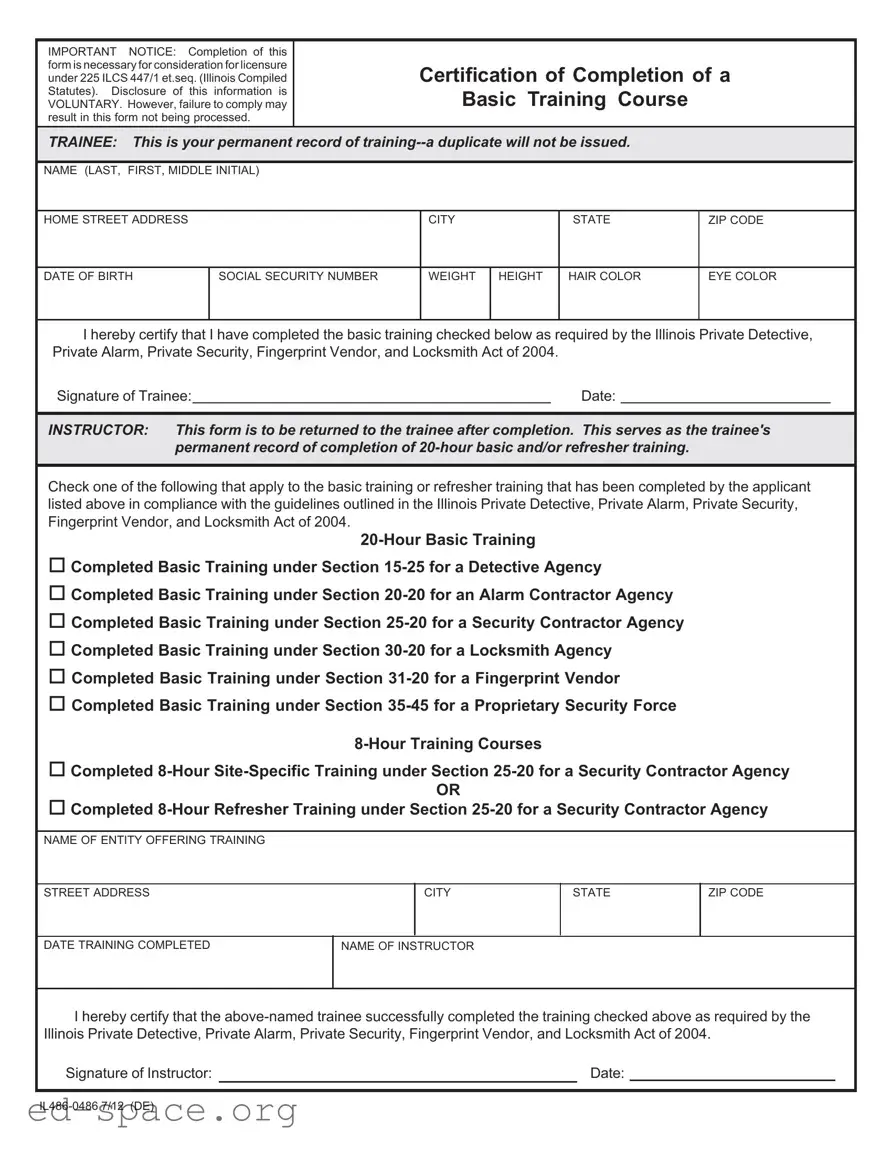
The Certification of Completion Basic Training Course form plays a crucial role in the licensing process for individuals seeking to work in various security-related fields in Illinois. This form serves as the official record of a trainee's completion of required training, which is mandated by the Illinois Private Detective, Private Alarm, Private Security, Fingerprint Vendor, and Locksmith Act of 2004. It collects essential personal information from the trainee, including their name, address, date of birth, and social security number, ensuring that their training records are accurately maintained. The form also requires the trainee to certify their completion of specific training courses, which can range from a 20-hour basic training to 8-hour refresher courses, depending on the type of agency they are associated with. Instructors play a vital role as well, as they must sign the form to confirm the successful completion of the training. Notably, while providing this information is voluntary, failing to submit the completed form may hinder the processing of the trainee's application for licensure. Thus, understanding the importance and requirements of this form is essential for anyone pursuing a career in the private security sector in Illinois.

IMPORTANT NOTICE: Completion of this form is necessary for consideration for licensure under 225 ILCS 447/1 et.seq. (Illinois Compiled Statutes). Disclosure of this information is VOLUNTARY. However, failure to comply may result in this form not being processed.
Certification of Completion of a
Basic Training Course
TRAINEE: This is your permanent record of
NAME (LAST, FIRST, MIDDLE INITIAL)
HOME STREET ADDRESS
CITY
STATE
ZIP CODE
DATE OF BIRTH
SOCIAL SECURITY NUMBER
WEIGHT
HEIGHT
HAIR COLOR
EYE COLOR
I hereby certify that I have completed the basic training checked below as required by the Illinois Private Detective, Private Alarm, Private Security, Fingerprint Vendor, and Locksmith Act of 2004.
Signature of Trainee: |
|
Date: |
|||
|
|
|
|
|
|
INSTRUCTOR: |
This form is to be returned to the trainee after completion. This serves as the trainee's |
||||
|
permanent record of completion of |
||||
|
|
|
|
|
|
Check one of the following that apply to the basic training or refresher training that has been completed by the applicant listed above in compliance with the guidelines outlined in the Illinois Private Detective, Private Alarm, Private Security, Fingerprint Vendor, and Locksmith Act of 2004.
Completed Basic Training under Section
Completed Basic Training under Section
Completed Basic Training under Section
Completed Basic Training under Section
Completed Basic Training under Section
Completed Basic Training under Section
Completed
OR
Completed
NAME OF ENTITY OFFERING TRAINING
STREET ADDRESS
CITY
STATE
ZIP CODE
DATE TRAINING COMPLETED
NAME OF INSTRUCTOR
I hereby certify that the
Signature of Instructor: |
|
Date: |
| Fact Name | Details |
|---|---|
| Governing Law | This form is governed by the Illinois Private Detective, Private Alarm, Private Security, Fingerprint Vendor, and Locksmith Act of 2004. |
| Voluntary Disclosure | Disclosure of personal information on the form is voluntary, but non-compliance may lead to processing issues. |
| Permanent Record | The completed form serves as the trainee's permanent record of training; no duplicates will be issued. |
| Training Duration | The form certifies completion of either a 20-hour basic training course or an 8-hour refresher training course. |
| Instructor's Role | The instructor must sign the form to certify that the trainee has successfully completed the required training. |
After completing the Certification Of Completion Basic Training Course form, the next step involves submitting the form to the appropriate licensing authority for processing. Ensure all information is accurate and complete to avoid delays.
What is the purpose of the Certification Of Completion Basic Training Course form?
This form serves as a permanent record of an individual's completion of a basic training course required for licensure under Illinois law. It ensures that the necessary training has been completed in compliance with the Illinois Private Detective, Private Alarm, Private Security, Fingerprint Vendor, and Locksmith Act of 2004.
Who needs to complete this form?
The form must be completed by trainees who have successfully finished a basic training course in one of the specified areas, such as private detective work, alarm contracting, or security services. It is essential for those seeking licensure in these fields.
What information is required on the form?
Key information includes the trainee's name, address, date of birth, social security number, weight, height, hair color, and eye color. Additionally, the form requires details about the training completed, including the type of training, the name of the training entity, and the instructor's name.
Is the disclosure of information on this form mandatory?
Disclosure of information is voluntary; however, failing to provide the necessary details may lead to the form not being processed. It is in the trainee's best interest to complete the form accurately to avoid delays in licensure.
What happens if I lose my Certification Of Completion form?
A duplicate of the Certification Of Completion form will not be issued. It is crucial to keep this document safe, as it serves as a permanent record of training completion. Consider making a copy for personal records before submitting it.
Who signs the form once the training is completed?
The form must be signed by both the trainee and the instructor. The instructor’s signature certifies that the trainee has successfully completed the training as required by Illinois law.
What types of training can be certified on this form?
The form allows for certification of various types of training, including 20-hour basic training and 8-hour refresher or site-specific training. Each training type corresponds to specific sections of the Illinois Private Detective, Private Alarm, Private Security, Fingerprint Vendor, and Locksmith Act of 2004.
Incomplete Personal Information: Failing to fill out all required fields, such as the trainee's full name, address, and date of birth, can lead to processing delays.
Incorrect Social Security Number: Providing an incorrect or invalid Social Security Number can cause significant issues with licensure processing.
Missing Signature: Forgetting to sign the form can result in the application being rejected, as a signature is necessary to certify completion.
Wrong Training Selection: Selecting the incorrect type of training completed can lead to complications, as the form must accurately reflect the training undertaken.
Omitting Instructor Information: Not providing the name and signature of the instructor can hinder the validation of the training completion.
Neglecting to Include Training Entity Details: Failing to list the name and address of the entity offering the training can create confusion and affect the processing of the form.
Incorrect Dates: Entering the wrong date of training completion can lead to discrepancies in records and may affect licensure eligibility.
Ignoring the Importance of Accuracy: Not double-checking all entries for accuracy can result in errors that may delay the processing of the form.
When completing the Certification of Completion Basic Training Course form, there are several other documents that may be required or helpful in the process. Each of these documents serves a specific purpose and helps ensure that all necessary information is accurately recorded and submitted. Below is a list of these forms and documents.
Having these documents ready can streamline the application process and increase the chances of a successful outcome. Each piece of information contributes to a comprehensive understanding of the applicant’s qualifications and readiness for licensure.
The Certification of Completion Basic Training Course form plays a crucial role in the licensing process for various professions in Illinois. It shares similarities with several other important documents that serve to verify training and completion of educational requirements. Here are four such documents:
When filling out the Certification of Completion Basic Training Course form, there are important practices to follow. Here are five things to do and avoid:
Understanding the Certification Of Completion Basic Training Course form is essential for those seeking licensure in Illinois. However, several misconceptions can lead to confusion. Here are nine common misunderstandings about this form:
Many believe that completing the form is not necessary. In reality, submission of this form is crucial for consideration for licensure under Illinois law.
This form serves as a permanent record of training, and no duplicates will be issued. It is important to keep the original safe.
While the form requests personal details, disclosure is voluntary. However, not providing this information may hinder the processing of the form.
Different sections of the law specify various training requirements. Each training course is tailored to specific roles, such as security contractors or locksmiths.
The instructor’s signature is essential. It certifies that the trainee has completed the required training.
Timely submission of the form is important. Delays can lead to complications in the licensure process.
Refresher training is also recognized. This form applies to both new trainees and those updating their qualifications.
This form is applicable to various professions, including alarm contractors, security personnel, and locksmiths.
The date when training is completed is crucial. It helps establish the timeline for licensure eligibility.
By clarifying these misconceptions, individuals can better navigate the process of obtaining their certification and ensure compliance with Illinois regulations.
Filling out the Certification of Completion Basic Training Course form is an essential step for individuals seeking licensure in Illinois. Here are key takeaways to keep in mind: