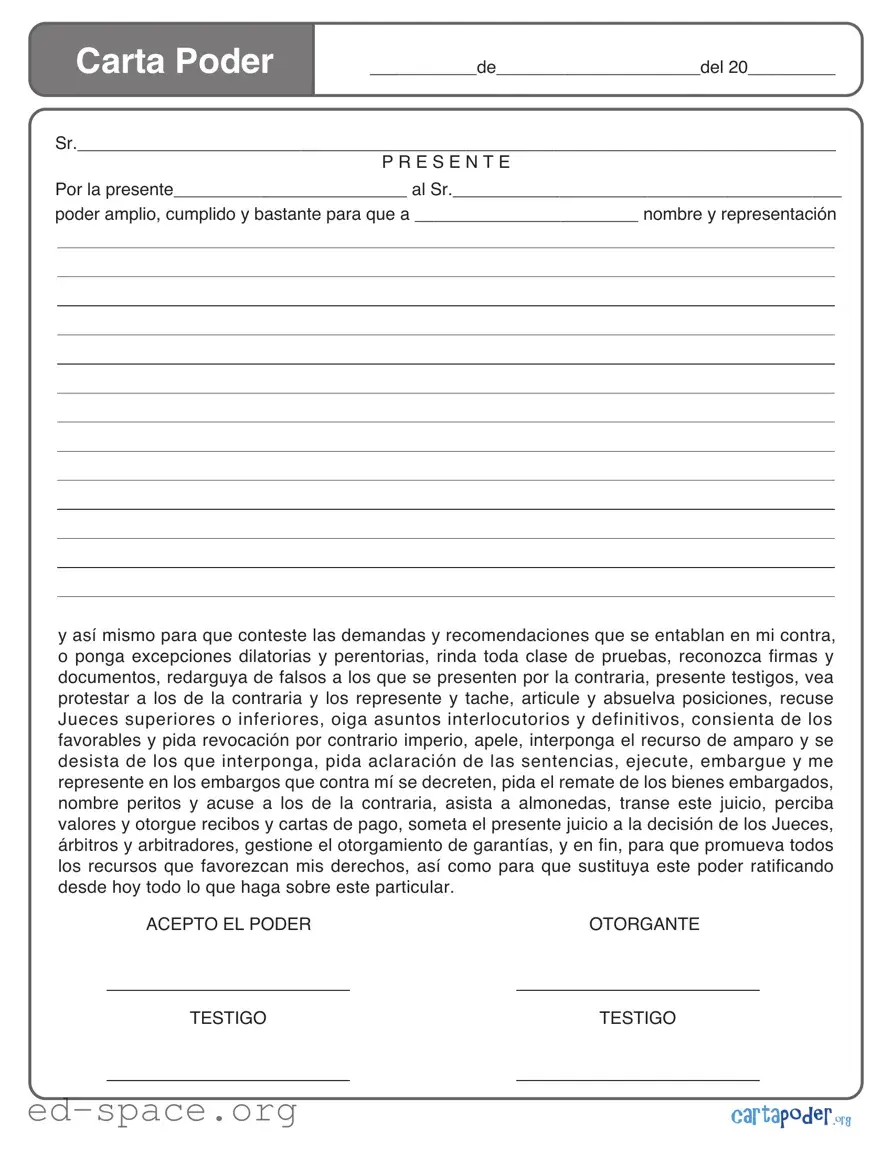
The Carta Poder form serves as a crucial legal document that grants an individual the authority to act on behalf of another person in various legal matters. This form is particularly important in situations where one party cannot be present to manage their legal affairs. It allows the designated representative to perform a wide range of actions, including responding to legal demands, presenting evidence, and even appealing decisions. The document outlines the specific powers granted, which can include the ability to acknowledge signatures, challenge opposing evidence, and manage financial transactions related to legal proceedings. Additionally, the Carta Poder can empower the representative to handle negotiations and make decisions that directly affect the rights and interests of the person granting the power. By clearly defining the scope of authority, this form helps ensure that the interests of the individual are adequately represented in legal settings, providing a structured approach to managing legal responsibilities.
Carta Poder
___________de_____________________del 20_________
Sr.______________________________________________________________________________
P R E S E N T E
Por la presente________________________ al Sr.________________________________________
poder amplio, cumplido y bastante para que a _______________________ nombre y representación
y así mismo para que conteste las demandas y recomendaciones que se entablan en mi contra, o ponga excepciones dilatorias y perentorias, rinda toda clase de pruebas, reconozca firmas y documentos, redarguya de falsos a los que se presenten por la contraria, presente testigos, vea protestar a los de la contraria y los represente y tache, articule y absuelva posiciones, recuse Jueces superiores o inferiores, oiga asuntos interlocutorios y definitivos, consienta de los favorables y pida revocación por contrario imperio, apele, interponga el recurso de amparo y se desista de los que interponga, pida aclaración de las sentencias, ejecute, embargue y me represente en los embargos que contra mí se decreten, pida el remate de los bienes embargados, nombre peritos y acuse a los de la contraria, asista a almonedas, transe este juicio, perciba valores y otorgue recibos y cartas de pago, someta el presente juicio a la decisión de los Jueces, árbitros y arbitradores, gestione el otorgamiento de garantías, y en fin, para que promueva todos los recursos que favorezcan mis derechos, así como para que sustituya este poder ratificando desde hoy todo lo que haga sobre este particular.
ACEPTO EL PODER |
OTORGANTE |
TESTIGO |
|
TESTIGO |
|
|
|
| Fact Name | Description |
|---|---|
| Purpose | The Carta Poder form grants authority to an individual to act on behalf of another in legal matters. |
| Signatories | It requires signatures from the person granting the power and two witnesses to validate the document. |
| Scope of Authority | The form allows the representative to perform a wide range of actions, including filing legal documents, representing in court, and managing financial transactions. |
| State-Specific Forms | Some states may have specific requirements for the Carta Poder form, governed by local laws, such as the California Civil Code. |
| Revocation | The authority granted can be revoked by the person who issued the power at any time, provided proper notice is given. |
| Legal Validity | For the Carta Poder to be legally valid, it must comply with the requirements set forth by the governing laws of the relevant jurisdiction. |
Filling out the Carta Poder form is an important step in granting someone the authority to act on your behalf. After completing the form, you will need to have it signed and witnessed to ensure its validity. Follow these steps to accurately fill out the form.
After filling out the form, it's crucial to have it signed in the presence of witnesses. This ensures that the power of attorney is legally binding and recognized by relevant authorities. Make sure to keep a copy for your records.
What is a Carta Poder?
A Carta Poder is a legal document that grants someone the authority to act on behalf of another person in various legal matters. This document is particularly useful when the principal cannot be present to handle their affairs, allowing the designated representative to perform actions such as responding to legal demands, presenting evidence, and managing court proceedings.
Who can be designated as a representative in a Carta Poder?
Any adult individual can be designated as a representative in a Carta Poder. This person is often referred to as the "attorney-in-fact." It is essential that the chosen representative is trustworthy and capable of handling the responsibilities outlined in the document, as they will be making decisions that affect the principal’s legal rights.
What are the specific powers granted by a Carta Poder?
The Carta Poder grants broad powers to the designated representative. These powers may include responding to legal actions, presenting evidence, recognizing signatures, contesting claims, managing court appearances, and executing necessary legal documents. Essentially, it allows the representative to act in the best interest of the principal across various legal scenarios.
Is a Carta Poder permanent or temporary?
The duration of a Carta Poder can vary based on the principal's intentions. It may be established for a specific period or for a particular legal matter. Once the objectives are fulfilled, or if the principal revokes the power, the Carta Poder becomes ineffective. It is advisable to clearly state the intended duration in the document to avoid any confusion.
How should a Carta Poder be executed?
To execute a Carta Poder, the principal must sign the document in the presence of witnesses. It is crucial that the witnesses are not related to the principal or the representative, ensuring impartiality. In some cases, notarization may be required to enhance the document's validity, depending on local laws and regulations.
Can a Carta Poder be revoked?
Yes, a Carta Poder can be revoked at any time by the principal, provided they are of sound mind. The revocation should be communicated in writing to the representative and any relevant parties involved in the legal matters. It is recommended to keep a record of the revocation for future reference.
Incomplete Information: Failing to fill out all required fields can lead to delays or rejection. Ensure that names, dates, and other critical details are complete.
Incorrect Signatures: The form must be signed by the person granting the power. If the signature does not match the name on the form, it may be considered invalid.
Not Specifying Authority: Clearly state what powers are being granted. Vague language can cause confusion and limit the effectiveness of the power of attorney.
Ignoring Witness Requirements: Some jurisdictions require witnesses to sign the form. Failing to include witnesses can invalidate the document.
Not Keeping Copies: Always retain a copy of the completed form for your records. This ensures you have proof of the granted powers in case of disputes.
The Carta Poder form is a powerful document that allows one person to grant another the authority to act on their behalf in various legal matters. However, there are several other forms and documents that often accompany the Carta Poder, enhancing its effectiveness and ensuring clarity in legal proceedings. Here’s a brief overview of these important documents.
Understanding these documents can significantly improve your ability to navigate legal situations. Each plays a unique role in ensuring that your rights and preferences are respected, particularly when you are unable to advocate for yourself. Always consider consulting a legal professional when dealing with these important forms.
The Carta Poder form is a legal document that grants authority to an individual to act on behalf of another. Several other documents serve similar purposes. Here are seven documents that share similarities with the Carta Poder form:
When filling out the Carta Poder form, it is important to follow certain guidelines to ensure the document is valid and effective. Here are seven things to do and not do:
Misconception 1: The Carta Poder form is only for legal professionals.
This is not true. While it is often used by attorneys, anyone can grant power of attorney to another individual using this form. It allows a person to authorize someone else to act on their behalf in various matters.
Misconception 2: The Carta Poder is permanent and cannot be revoked.
This is incorrect. A Carta Poder can be revoked at any time by the person who granted it. The revocation must be communicated to the person holding the power of attorney and, ideally, documented in writing.
Misconception 3: Only specific actions can be authorized through a Carta Poder.
This is misleading. The Carta Poder can grant broad authority, allowing the agent to perform a wide range of actions on behalf of the principal. These can include legal representation, financial transactions, and more, depending on the language used in the document.
Misconception 4: A Carta Poder does not require witnesses.
This is not accurate. Depending on the jurisdiction, having witnesses may be necessary for the Carta Poder to be valid. It is important to check local laws to ensure compliance with any witness requirements.
Understanding the Carta Poder form is essential for effective legal representation. Here are some key takeaways: