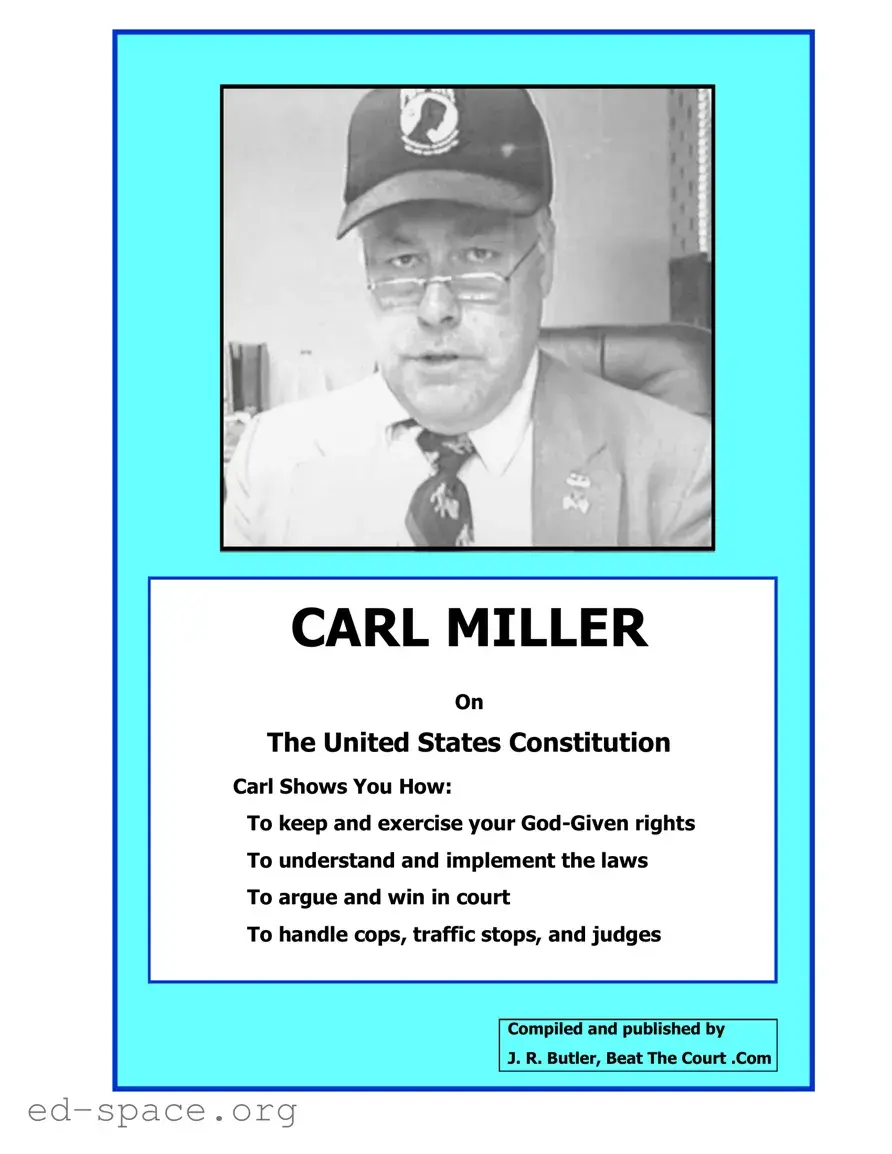
The Carl Miller Constitution Handbook form serves as a comprehensive guide for individuals seeking to understand and exercise their constitutional rights. It outlines essential principles that empower citizens to navigate legal challenges, from traffic stops to court appearances. This handbook emphasizes the importance of knowing one’s rights, which are described as God-given and protected by the Constitution. With over 25 years of research and practical courtroom experience, Carl Miller has developed strategies that have led to a remarkable win rate in legal disputes. The form covers a range of topics, including the right to travel, the right to work, and defenses against unconstitutional acts. Readers will find practical advice on handling interactions with law enforcement and understanding the legal system. The handbook is designed for anyone interested in asserting their rights effectively, whether they are novices or those with prior experience in legal matters. Through this resource, Carl Miller aims to equip individuals with the knowledge and confidence needed to argue their cases successfully and uphold the principles enshrined in the Constitution.

CARL MILLER
On
The United States Constitution
Carl Shows You How:
To keep and exercise your
To handle cops, traffic stops, and judges
1
Compiled and published by
J. R. Butler, Beat The Court .Com

THE BEST OF CARL MILLER
Publishers Note:
For over 25 years I have been doing research on the laws and the Constitution of the United
States. I have watched as people in the “patriot movement” protesting everything from traffic tickets to income taxes have spewed forth their “theories and remedies” and ended up in jail…Or worse,
dead.
Carl‟s research and knowledge sets him apart from the rest. He has learned intimately the
inner workings of the U.S. Constitution and the laws of the country, and has formulated arguments for use in court for almost anything they will try to hammer you for. And has perfected them to the extent that he has an almost 100% win rate in court!
Anyone who is an American, who has any interest in the country and where it‟s going, needs
to read Carl‟s information here. Whether you are just mildly interested, or you want to beat their sox
off in traffic court, tax court, or any other venue, Carl Miller is hands down the best mentor and
teacher you can have.
Make sure you sign up for your FREE subscription to
the LAW DAWG Reporter Newsletter.
We are always looking for more from Carl and others
like him.
http://www.beatthecourt.com/LAWDAWGREPORTER.HTM
2
|
Table of Contents |
Introduction |
4 |
Here’s Carl |
4 |
The Constitution |
5 |
Special Argument developed |
15 |
No Immunity |
19 |
Construed in your favor |
20 |
Miranda |
21 |
Unconstitutional Acts |
23 |
Applying the Constitution |
24 |
Enabling Clause |
25 |
Right To Travel |
26 |
Right To Work |
30 |
Quo Warranto – Dr. Kevorkian |
31 |
Drug Testing at Work |
33 |
Pulling City Franchise |
34 |
Traffic Stops |
35 |
Is Judge Licensed? |
44 |
Radar Speeding Defense |
47 |
Taxes |
48 |
Arguing Jurisdiction |
50 |
Now: Arguments on taxes. |
52 |
Court Cases and Legal Quotes |
58 |
Citizen’s Rule Book |
60 |
|
3 |
Introduction
Carl Miller is an expert on the constitution and the bill of rights. He has studied law for 25 years and has a courtroom
The famous movie “Apocalypse Now” and the
Carl Miller was inducted into the top secret project “Blue Book”, and he considers it an honor to have served in several operations supporting Lt. Col. James “Bo” Gritez, including operation “Eagle Snatch”. Carl is the veteran of hundreds of dangerous parachute jumps, breaking
his legs or ankles six times, shot down 4 times and personally shot twice. Carl has miraculously
escaped death numerous times. Carl credits divine intervention and God‟s providence for preserving
his life to this day so that he may complete the most important mission of his life; that of teaching others the importance of the constitution of the united states and how to use it, and by using it thus preserving it.
Carl has taught hundreds of people, including housewives and truck drivers the fine art of
arguing the constitution and winning in court. Carl says it‟s easy once you know how, and a whole
lot of fun, too.
So Here’s Carl:
“Good evening folks, I want to thank you for inviting me into your home tonight, to talk to you about an extremely important issue to you. I‟m basically here to talk about the United States Constitution and our government, and some of the principles there of. You need to understand most thoroughly so that you can have an effective opportunity to exercise your constitutional rights.
The whole purpose of this is that you understand that these rights come from God. They are God inspired. God is the one who endowed you with these rights, and the constitution merely offers a legitimate program to protect those rights or to secure those rights and the blessings of those rights
for ourselves and on our children for all times. It‟s important that you understand that the constitution God inspired, it‟s important that you understand that a lot of the principles that are in the constitution actually come out of the Holy Bible, and it‟s very important that you understand that this
constitution allows you each to be a king or queen in your own right, as long as you recognize one
principle that you don‟t ever create a situation where you take away the rights of another.. So the
4
whole point of having the constitution is so that all of us can have these rights equally. As long as we respect our neighbor and allow them also to have the rights equally, the protections are going to last forever and the reality is that we are going to get thoroughly into your constitution, and we want you to find a constitution wherever you can, and we are basically going to take you
Now the facts are simple: if you don‟t know your rights, you don‟t have any rights. We have
come a long way with this program to help you. The most important thing I can teach you about this constitution is the importance of reading it you must read the constitution and understand what physically is involved. You must know your rights and timely assert them; that is your burden. If you do not, then a legal term called “latches” incurs in full force. “Latches” is a species of action wherein a party of reasonable intelligence and integrity, having a right to take an action as prescribed by law, and having failed to timely do so loses all right to proceed.
Basically there‟s an argument: “If I violate your rights you may or may not know about it. If you do know about it, you may or may not be able to do something about it. And if you do have the ability to do something about it, you may or may not have the financial wherewithal to go to a finished program. If you do have the financial wherewithal you may not have the intestinal fortitude to go to the finished program. So most of the time your governments and your abusive personalities in government or you corporations pretty much have Carte Blanche to injure you…Because in 99% of the cases most people will not proceed. But every now and then you run into that one hard nut,
and he or she doesn‟t quit until the cows come home. What happens is that person will prevail, and
those are the people who are actually generating better protections and better constitutional rights for you. Those are the ones who are going to the supreme courts and courts of appeals that are pushing, that are spending their life funds to allow you to have the benefit. But if you aren‟t there to catch the benefit then the benefit is lost.
The Constitution
It‟s important that you understand that the constitution is in writing, It‟s important that you understand that it‟s a legal document, that it was ratified by all of the members in congress together, and that document has all the signatures on the document, and it‟s important that you understand
that there was an offer: the government offered to govern.
There was a consideration; the citizens considered how they were to be governed, and government promised that they would govern by constitution. And there was an agreement. The
5
citizens agreed that if government promised that there would be government by constitution they would allow the constitution into force.
Now there‟s a unique situation in force here: It‟s very rare when you find the party of the
first part, which is the congressmen, officers of the government, who are also parties of the second part as representatives of we the people of the republic.
When they signed the document, they signed as officers of the government agreeing to the constitution, and simultaneously as officers and representatives of the people in the Republican form of government. When they signed that document that constituted an
Now, all we ask is that they enforce the contract. If we read something in the constitution, and we have a good reason to believe it is the way it is, then they should honor that. And they should honor it in favor of you, the clearly intended and expressly designated beneficiary.
The first thing you need to understand is Article 6 paragraph 2 of the constitution. This is known as the supremacy clause of the constitution. Basically what it says is “This constitution, and the laws of the United States which shall be made pursuance thereof, and the treaties made or which shall be made under the authority of the United States shall be the supreme law of the land. The judges in every state shall be bound thereby. Anything in the constitution or laws of any state to the contrary are not withstanding in law.
First important case: Marbury v. Madison, 5 U.S. 137 (1803).
This is one of the leading cases in the history of the U.S. The opinion of the court was “Anything that is in conflict is null and void of law; Clearly for a secondary law to come in conflict with the supreme was illogical; for certainly the supreme law would prevail over any other law, and certainly our forefathers had intended that the supreme law would be the basis for all laws, and for any law to come in conflict would be null and void of law. It would bear no power to enforce, it would bear no obligation to obey, it would purport to settle as though it had never existed, for unconstitutionality would date from the enactment of such a law, not from the date so branded by a court of law. No courts are bound to uphold it, and no citizens are bound to obey it. It operates as a mere nullity or a fiction of law, which means it
doesn‟t exist in law.”
Now let me give you an example in today‟s timing as to how effective this is: This argument
is so effective that it literally nullifies the Brady Bill, it nullifies the crime bill that takes away the right of the people to keep and bear arms on these 19 weapons that turn into 159 weapons, it stops the 666 bill that just went through that they‟re trying to take away the 4th Amendment, Because they have no
6
power to pass a law that‟s in conflict with the United States Constitution, and it‟s automatically null
and void of law from its inception; not from the day you go to court and brand it as unconstitutional.
A lot of people think they have got to go to court and brand it unconstitutional. But if you know your arguments and you can show your arguments, most of the time you will win. Every now and then you will run into a
The next thing I‟m going to teach you is about the second amendment. The second
amendment is the one everybody talks about today and the one that probably gets railroaded the most. The next is the fourth amendment and the fifth amendment.
The second amendment is one of the most vital amendments here because our forefathers had such an important understanding of life, liberty and the pursuit of happiness…That was the first amendment…That they turned around and realized that without the right to protect that first right, they didn‟t have that right. So the second amendment they instituted the right of the people to keep and carry arms, and that right shall not be infringed. Now they started out by saying “A well regulated
militia being necessary for the maintenance of a free state. Now that is a true statement. But the most
important part about that second amendment is where it says “The right of the people” and the
Supreme Court has ruled in hundreds of cases that whenever it says “the right of the people” it means
the right each, of every single citizen to possess the right equally. Now a lot of guys like to hand out
this minloa “Well, that‟s a collective right, you have got to be a member of the militia”, that‟s all B.S. You don‟t have to be a member of the militia…All you have to do is be an American. You have the
right. The right to keep and carry arms, and that right shall not be infringed.
Now note after “infringed” there is no sub paragraph a, b, c, d, e, which would stipulate what would be an acceptable infringement. So all infringement is forbidden. I ask them “what is it that you don‟t understand about the work infringement?” Because that‟s what it says when you look it up in Black‟s Law dictionary.
When you want to talk to these people in court you want to have Black‟s Law Dictionary. You would be absolutely amazed what‟s in Black‟s Law Dictionary. These are the exact words that you need to be able to definitively define the work game problem we are having with these people today. They keep changing the words. But guess what? The words in this book are the words that were written when we were in the constitution when it was signed. And the definitions that are in this book
are enforceable in a court of law. You can bring this book into court and pull it open and say “this is the one, judge”. And the have to listen. And that‟s the way it is.
7
So, for sure if you are going to be in this, go down to a book store or Amazon.Com and get a
copy of Black‟s Law Dictionary. You need that to be in this because it‟s like defining the map of how to get from A to B. You have to have this book so you can pull it out and say “Hey, don‟t trample my rights.”
Another good book on the constitution you can pick up is “The American Constitution” put
out by West Publishing co. This goes into a whole lot of widened arguments as to your constitution.
Now after I‟m finished talking to you you‟re going to have a new concept of the constitution and how it works. You‟re going to understand that it‟s what you say it is. If you have got an honest right…I‟ll give you an example…
Now the first amendment basically talks about the right of life, liberty and the pursuit of
happiness. But isn‟t the right to work part of the right to life, liberty, and the pursuit of happiness? You‟ve got a right to work, right? To contract your labor, your skill and your time and life as you see fit, right? That‟s a first amendment right. Another first amendment right would be the right to travel freely and unencumbered. No state can require you to have a license to travel freely and unencumbered and we will go into that and show you how that is taken care of.
The bottom line is you need to learn as much as you absolutely possibly can in the shortest
possible time about your constitution, because I‟m telling you right now as we speak they‟re trying to
curtail that constitution and take away rights that you have that have been given to you by your
forefathers. There‟s only two things that are going to stop that. The first thing is that if we all get together, get ahold of the constitution and start shaking it. “Whoa, horsie, we‟re not letting you take away that constitution. This is America, we‟ve got an American Flag on the pole out front. Last time I checked this is America and we have got a constitution here and you ain‟t touching that constitution.
The second way we can do it is if necessary and proper our armed militia can come together and decide to tell these people that are giving aid and comfort to the enemies of our country by breaking our laws that you have broken the law of Title 18 U.S. Code section 2381, which says “When in the presence of two witnesses to the same overt act or in an open court of law if you fail to timely move to protect and defend the constitution of the United States and honor your oath of office you are subject to the charge of capital felony treason, and upon conviction you will be taken by the posse to the nearest busy intersection and at high noon hung by the
neck until dead…The body to remain in state till dusk as an example to anyone who takes his
oath of office lightly. You see, without that oath of office this constitution is worthless. That‟s why we have you take that oath of office, so we know that you will honor that oath of office,
8
and that you will keep our constitution. The bottom line here is that you have to know to be able to exercise your constitution.
The most important part of your constitution are in the first ten amendments. Obviously the right of the people to keep and carry arms shall not be infringed. And that right shall not be infringed. You must claim your right if you want to have it. You have to be willing to do that. And if they are going to take your right, then you have to be willing to challenge them whatever the cost. The bottom line is that any law that comes in conflict with that, what do we talk about in Article 6 paragraph 2? If any law should come in conflict with the supreme law it‟s null and void of law, it bears no power to enforce, no obligation to obey, and it purports to settle as if it never existed. The unconstitutionality dates from the enactment of such law. If any portion of a bill is unconstitutional the entire bill is
unconstitutional. Why? Repugnancy…It‟s repugnant to the constitution. Now, other cases involved
are your rights to due process…Like under your 4th, 5th, and 6th amendments. The right of people to be secure in their houses, person, papers, and affects against unreasonable search and seizure shall not be violated. No warrant shall issue but upon probable cause supported by oath or affirmation, and particularly describing the place to be searched and the person or things to be seized. Obviously that
would imply that he‟d gone before a judge and said this is the guy, he did it, this was the crime, and this is the evidence we are looking for, judge. We‟d like to get a warrant and we swear that what we told you is the God‟s truth. Then they can come over and search until hell freezes over.
Now it‟s important to jump to the 9th amendment. Enumeration in this constitution of certain rights shall not be construed to deny or disparage others retained by the people. This means congress has no authority to add on to the constitution in such a way that would take away rights previously guaranteed.
10th amendment…the powers not delegated to the United States by the constitution nor prohibited by it are reserved to the states respectively or to the people. The constitution is a contract designed to limit government. When you get into your police powers you start understanding your police powers
You will hear this all the time: “Well, we have police powers. Broad and sweeping police powers”. Black‟s Law Dictionary says “Police powers: The law of eminent domain in a state or
political domain to enact laws for the common good and welfare, and to curb crime, and in great big
black letters it says “Within constitutional limitations…See 10th amendment”.
Do they have powers to take away rights guaranteed by the constitution? Obviously they don‟t. The 9th amendment put a clear limit on that.
9
5th amendment. No person shall be held to answer for a capital, or otherwise infamous crime, unless on a presentment or indictment of a Grand Jury, except in cases arising in the land or naval forces, or in the Militia, when in actual service in time of War or public danger; nor shall any person be subject for the same offense to be twice put in jeopardy of life or limb; nor shall be compelled in any criminal case to be a witness against himself, nor be deprived of life, liberty, or property, without due process of law; nor shall private property be taken for public use, without just compensation.
Due process: You have a right to due process of the law. If they don‟t give you due process,
Title 5 U. S. Code section 556 (d) is clear and specific and says if they deny you due process of the law all jurisdiction ceases automatically. If they deny you due process at any time, and you can prove
it, you can force a showdown…You can say “Well, they might have had jurisdiction at one time,
judge, but they lost it when they denied me due process.
6th amendment: In all criminal prosecutions the accused shall enjoy the right to a speedy and public trial by an impartial jury of the state and district where the crime shall have been committed, and to be informed of the nature and the cause of the action and accusation. To be confronted with the witnesses against him. To have compulsory process to obtain witnesses in your favor, and to have
assistance of counsel in your defense…Or you can stand as your own counsel. You are the one who
best knows your case. You are the best person to present the facts on your case because you are the person who knows your case the best.
7th amendment: In Suits at common law, where the value in controversy shall exceed twenty dollars, the right of trial by jury shall be preserved, and no fact tried by a jury, shall be otherwise
The bottom line to this constitution is that it‟s all in writing, it clearly represents a contract. I‟m asking you to learn your contract, so that you can understand the rights you have under that
constitution.
It is also important that you understand that this constitution is supposed to be
enforced…From Am Jur vol. 16, constitutional law section, sec. 97…”That a constitution should
receive a liberal interpretation in favor of the citizen is especially true with respect to those provisions which were designed to safeguard the liberty and security of the citizen in regard to both person and property. (see note 31, Bryer’s v United States 273 U.S. 28. In other words it‟s supposed to be liberally enforced in favor of the citizen for the protections of their rights and property. Any
10
| Fact Name | Description | Governing Law(s) |
|---|---|---|
| Author | The Carl Miller Constitution Handbook is compiled and published by J. R. Butler, associated with Beat The Court .Com. | N/A |
| Expertise | Carl Miller has over 25 years of experience studying the U.S. Constitution and has a courtroom win rate exceeding 90%. | N/A |
| Focus Areas | The handbook covers various topics, including the right to travel, traffic stops, and tax arguments. | U.S. Constitution, relevant state laws on traffic and taxation |
| Target Audience | The content is designed for Americans interested in understanding their constitutional rights and how to effectively assert them. | N/A |
Filling out the Carl Miller Constitution Handbook form requires careful attention to detail and a clear understanding of the information requested. Once you have completed the form, you will be equipped with valuable insights and resources regarding your constitutional rights and how to effectively advocate for them. The following steps will guide you through the process of filling out the form accurately.
What is the Carl Miller Constitution Handbook form?
The Carl Miller Constitution Handbook form is a resource designed to help individuals understand and exercise their constitutional rights. It provides guidance on various legal matters, including how to handle interactions with law enforcement, navigate court proceedings, and assert your rights effectively.
Who is Carl Miller?
Carl Miller is an expert on the U.S. Constitution with over 25 years of experience studying law. He has a remarkable courtroom win rate and prefers to represent himself in court. His unique insights and strategies have helped many people successfully argue their cases.
How can the handbook help me in court?
The handbook offers practical advice and strategies for arguing cases in court. It covers various topics, from traffic violations to tax disputes, and provides arguments that can be used effectively in legal settings. By understanding the content, you can better prepare yourself for court appearances.
What topics are covered in the handbook?
The handbook covers a wide range of topics, including the Constitution, rights to travel and work, handling traffic stops, and understanding taxes. It also includes special arguments and insights into how to challenge unconstitutional acts. Each section is designed to empower you with knowledge.
Is this handbook suitable for everyone?
Yes, the handbook is suitable for anyone interested in learning about their rights under the Constitution. Whether you are a student, a working professional, or someone facing legal issues, the information is accessible and can be beneficial for all. It aims to educate and inform individuals from all walks of life.
Can I use the handbook to represent myself in court?
Absolutely! The handbook is designed to empower individuals to represent themselves. Many people have successfully used the strategies outlined in the handbook to argue their cases in court. It provides the tools and knowledge needed to navigate the legal system confidently.
How do I get a copy of the handbook?
You can obtain a copy of the Carl Miller Constitution Handbook through the official website, where it may be available for download or purchase. Make sure to check for any updates or additional resources that may enhance your understanding of the Constitution.
What is the LAW DAWG Reporter Newsletter?
The LAW DAWG Reporter Newsletter is a free subscription service that provides ongoing information and updates related to legal rights and the Constitution. By signing up, you can stay informed about new developments, resources, and insights from Carl Miller and others in the field.
How can I ensure I understand my rights?
Understanding your rights requires active engagement with the material. Read the Constitution, study the handbook, and practice asserting your rights in various scenarios. The more you familiarize yourself with the content, the better equipped you will be to defend your rights when necessary.
Incomplete Information: One common mistake is failing to provide all the necessary details. Omitting information can lead to delays or rejections of the form.
Incorrect Personal Information: People often make errors in their names, addresses, or contact details. Double-checking this information is crucial to ensure that communications reach the right person.
Ignoring Instructions: Each section of the form comes with specific instructions. Skipping over these can result in misunderstandings or incorrect submissions.
Not Signing the Form: A signature is often required to validate the form. Forgetting to sign can render the entire submission invalid.
Submitting Late: There are deadlines associated with the form. Late submissions may be rejected outright, so it’s essential to be aware of these dates.
Using Incorrect Payment Methods: If a fee is required, using the wrong payment method can lead to complications. Always check what forms of payment are accepted.
Neglecting to Keep Copies: Failing to make copies of the completed form can be problematic. Keeping a record of what was submitted is important for future reference.
Overlooking Required Attachments: Some sections may require additional documents. Not including these can lead to delays or rejection of the form.
Rushing the Process: Taking time to carefully fill out the form is crucial. Rushing can lead to mistakes that could have been easily avoided.
The Carl Miller Constitution Handbook serves as an invaluable resource for individuals seeking to understand their rights under the U.S. Constitution. To complement this handbook, several other forms and documents are often utilized. Each of these documents plays a crucial role in helping individuals navigate legal matters and assert their rights effectively.
By familiarizing oneself with these documents, individuals can enhance their understanding of their rights and responsibilities. Each form serves a specific purpose, and together, they create a comprehensive toolkit for navigating the complexities of the legal system. Empowerment through knowledge is key, and utilizing these resources can make a significant difference in asserting one's constitutional rights.
When filling out the Carl Miller Constitution Handbook form, there are several important guidelines to follow. Adhering to these can ensure a smoother process and better outcomes.
Conversely, there are also things to avoid while filling out the form:
Here are nine common misconceptions about the Carl Miller Constitution Handbook form, along with clarifications for each:
While the handbook provides valuable insights and strategies, it does not guarantee success. Legal outcomes depend on various factors, including the specifics of each case.
Carl Miller is not an attorney; he represents himself and teaches others how to do the same. His expertise comes from years of study and practical experience.
The content is relevant for anyone interested in understanding their constitutional rights, not just those involved in criminal cases.
Understanding the material is essential, but practical application and preparation are equally important for success in legal situations.
The purpose is to empower individuals to understand their rights and responsibilities within the legal framework, not to incite rebellion against the government.
It encourages respectful and informed interactions with law enforcement, emphasizing the importance of knowing one's rights without escalating situations.
While many principles are universal, some laws and regulations may vary by state. Users should verify local laws and practices.
The material is designed for everyone, regardless of their legal background. It aims to make constitutional knowledge accessible to all.
While his methods are effective, individual circumstances, the legal system, and the specific case will ultimately influence the outcome.
Filling out and using the Carl Miller Constitution Handbook form can be a transformative experience for individuals seeking to understand and exercise their rights. Here are some key takeaways to consider:
By following these takeaways, individuals can better equip themselves to understand and utilize their constitutional rights effectively.