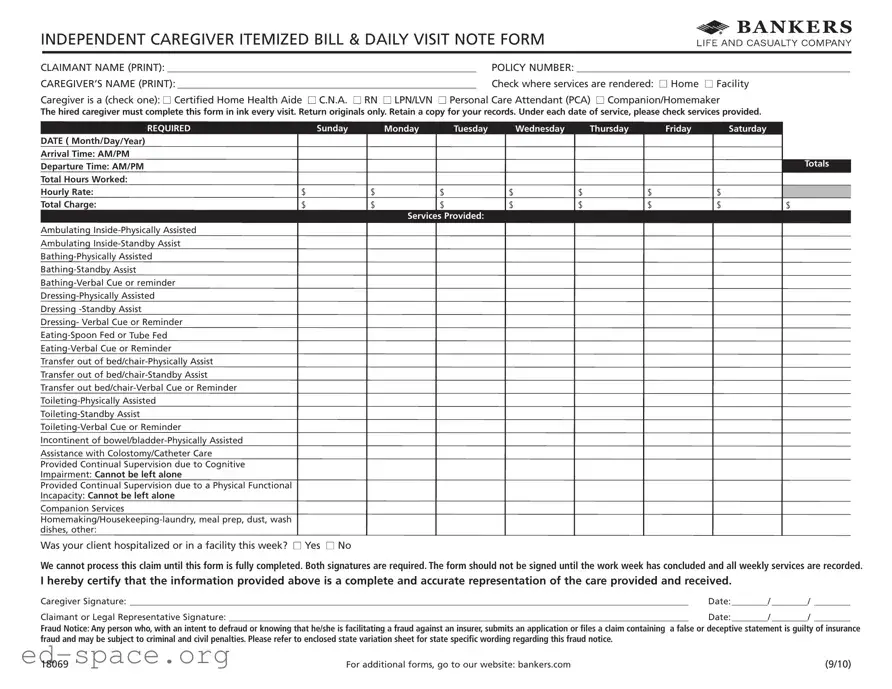
For families and individuals relying on caregiving services, maintaining clear and accurate records is essential. The Caregiver Daily Log form serves as a vital tool for documenting the daily activities and services provided by caregivers. This form captures essential information such as the caregiver's name, the claimant's details, and the policy number, ensuring that all parties involved have a clear understanding of the care being administered. Caregivers are required to complete the form in ink for every visit, detailing the arrival and departure times, total hours worked, and the corresponding charges. Various services rendered, including assistance with bathing, dressing, eating, and toileting, are meticulously itemized, allowing for a comprehensive overview of the care provided. Additionally, the form includes sections for noting any hospitalization or facility stays during the week. Both the caregiver and the claimant must sign the document to certify its accuracy, reinforcing the importance of transparency in caregiving arrangements. This structured approach not only facilitates the claims process but also fosters trust and accountability between caregivers and those they serve.
INDEPENDENT CAREGIVER ITEMIZED BILL & DAILY VISIT NOTE FORM
CLAIMANT NAME (PRINT): _____________________________________________________________ |
POLICY NUMBER: ______________________________________________________ |
CAREGIVER’S NAME (PRINT): ___________________________________________________________ |
Check where services are rendered: n Home n Facility |
Caregiver is a (check one): n Certified Home Health Aide n C.N.A. n RN n LPN/LVN n Personal Care Attendant (PCA) n Companion/Homemaker
The hired caregiver must complete this form in ink every visit. Return originals only. Retain a copy for your records. Under each date of service, please check services provided.
REQUIRED
DATE ( Month/Day/Year)
Arrival Time: AM/PM
Departure Time: AM/PM
Total Hours Worked:
Hourly Rate:
Total Charge:
Sunday |
Monday |
Tuesday |
Wednesday |
Thursday |
Friday |
Saturday |
|
|
|
|
|
|
|
Totals |
$ |
$ |
$ |
$ |
$ |
$ |
$ |
|
$ |
$ |
$ |
$ |
$ |
$ |
$ |
$ |
|
|
Services Provided: |
|
|
|
|
|
Ambulating
Assistance with Colostomy/Catheter Care Provided Continual Supervision due to Cognitive Impairment: Cannot be left alone Provided Continual Supervision due to a Physical Functional Incapacity: Cannot be left alone
Companion Services
meal prep, dust, wash |
Was your client hospitalized or in a facility this week? n Yes n No
We cannot process this claim until this form is fully completed. Both signatures are required. The form should not be signed until the work week has concluded and all weekly services are recorded.
I hereby certify that the information provided above is a complete and accurate representation of the care provided and received.
Caregiver Signature: ____________________________________________________________________________________________________________________________ |
Date: ________/ ________/ |
________ |
Claimant or Legal Representative Signature: ______________________________________________________________________________________________________ |
Date: ________/ ________/ |
________ |
Fraud Notice: Any person who, with an intent to defraud or knowing that he/she is facilitating a fraud against an insurer, submits an application or files a claim containing a false or deceptive statement is guilty of insurance fraud and may be subject to criminal and civil penalties. Please refer to enclosed state variation sheet for state specific wording regarding this fraud notice.
18069 |
For additional forms, go to our website: bankers.com |
(9/10) |
| Fact Name | Details |
|---|---|
| Purpose | The Caregiver Daily Log form is used to document services provided by caregivers to clients. |
| Completion Requirement | Caregivers must complete the form in ink after each visit, ensuring accuracy and completeness. |
| Signatures | Both the caregiver and the claimant or legal representative must sign the form for it to be valid. |
| Service Documentation | Caregivers are required to check off the services provided during each visit under the specified date. |
| Hourly Rate | The form includes a section for documenting the hourly rate and total charges for the services rendered. |
| State-Specific Regulations | Each state may have specific laws governing the use of this form. Refer to the enclosed state variation sheet for details. |
| Fraud Notice | The form contains a fraud notice, warning against submitting false information, which could lead to penalties. |
| Retention of Copies | Caregivers should retain a copy of the completed form for their records after submitting the original. |
Filling out the Caregiver Daily Log form is an important step in documenting the care provided. This ensures that all services rendered are accurately recorded for billing and compliance purposes. Follow these steps to complete the form correctly.
Once you have completed the form, make sure to keep a copy for your records. Return the original form as instructed to ensure timely processing of your claim.
What is the purpose of the Caregiver Daily Log form?
The Caregiver Daily Log form is designed to document the services provided by a caregiver during each visit. It helps ensure that all care activities are recorded accurately and can be used for billing purposes. By keeping track of arrival and departure times, total hours worked, and specific services rendered, this form provides a clear record that can be referenced by both the caregiver and the claimant. It is essential for ensuring proper payment and compliance with insurance requirements.
Who needs to fill out the Caregiver Daily Log form?
The caregiver who provides services must complete the form. This includes various types of caregivers, such as Certified Home Health Aides, CNAs, RNs, LPNs, Personal Care Attendants, and Companions. Each caregiver should fill out the form in ink for each visit. It is important to return the original form while keeping a copy for personal records. This helps maintain transparency and accountability in the care provided.
What information is required on the form?
The form requires several key pieces of information. First, the caregiver must include the claimant's name and policy number. Next, they need to indicate the services rendered, arrival and departure times, total hours worked, and the hourly rate. Additionally, caregivers must check off the specific services provided during the visit. Finally, both the caregiver and the claimant or legal representative must sign the form to certify that the information is accurate and complete.
What happens if the form is not completed correctly?
If the Caregiver Daily Log form is not filled out completely or accurately, the claim may not be processed. It is crucial that all sections are completed, including signatures from both parties. Missing information can lead to delays in payment or even denial of the claim. Therefore, caregivers should double-check their entries before submitting the form to ensure that all required details are included.
Neglecting to Use Ink: The form must be filled out in ink. Using pencil or other writing instruments can lead to forms being rejected or lost.
Inaccurate Dates: Each entry should have the correct date. Missing or incorrect dates can delay processing or cause claims to be denied.
Omitting Arrival and Departure Times: Failing to fill in the arrival and departure times can create confusion about the hours worked, affecting payment.
Forgetting Total Hours Worked: It’s crucial to calculate and enter the total hours worked for each day. Missing this can lead to underpayment or complications in claims.
Not Checking Services Provided: Each service rendered must be checked off. Leaving this section incomplete can result in processing delays.
Failure to Obtain Required Signatures: Both the caregiver and the claimant must sign the form. Without these signatures, the form cannot be processed.
Submitting Without Retaining a Copy: Always keep a copy of the completed form for personal records. This can be invaluable if any issues arise during the claims process.
The Caregiver Daily Log form is essential for documenting the services provided by caregivers. However, several other forms and documents often accompany this log to ensure comprehensive care management and proper billing. Below is a list of these related documents, each serving a specific purpose in the caregiving process.
Each of these documents plays a crucial role in ensuring that caregiving is effective, transparent, and compliant with relevant regulations. Properly completing and maintaining these forms can significantly enhance the quality of care provided and protect all parties involved.
Filling out the Caregiver Daily Log form accurately is essential for ensuring that all services provided are documented correctly. Here are some important do's and don'ts to keep in mind while completing this form:
By following these guidelines, you can help ensure that the Caregiver Daily Log form is completed correctly, facilitating a smoother claims process.
Here are ten common misconceptions about the Caregiver Daily Log form, along with clarifications to help you understand its purpose and requirements.
Understanding these misconceptions can help ensure that caregivers complete the Caregiver Daily Log form accurately and efficiently, facilitating smoother claims processing.
When filling out the Caregiver Daily Log form, consider the following key takeaways: