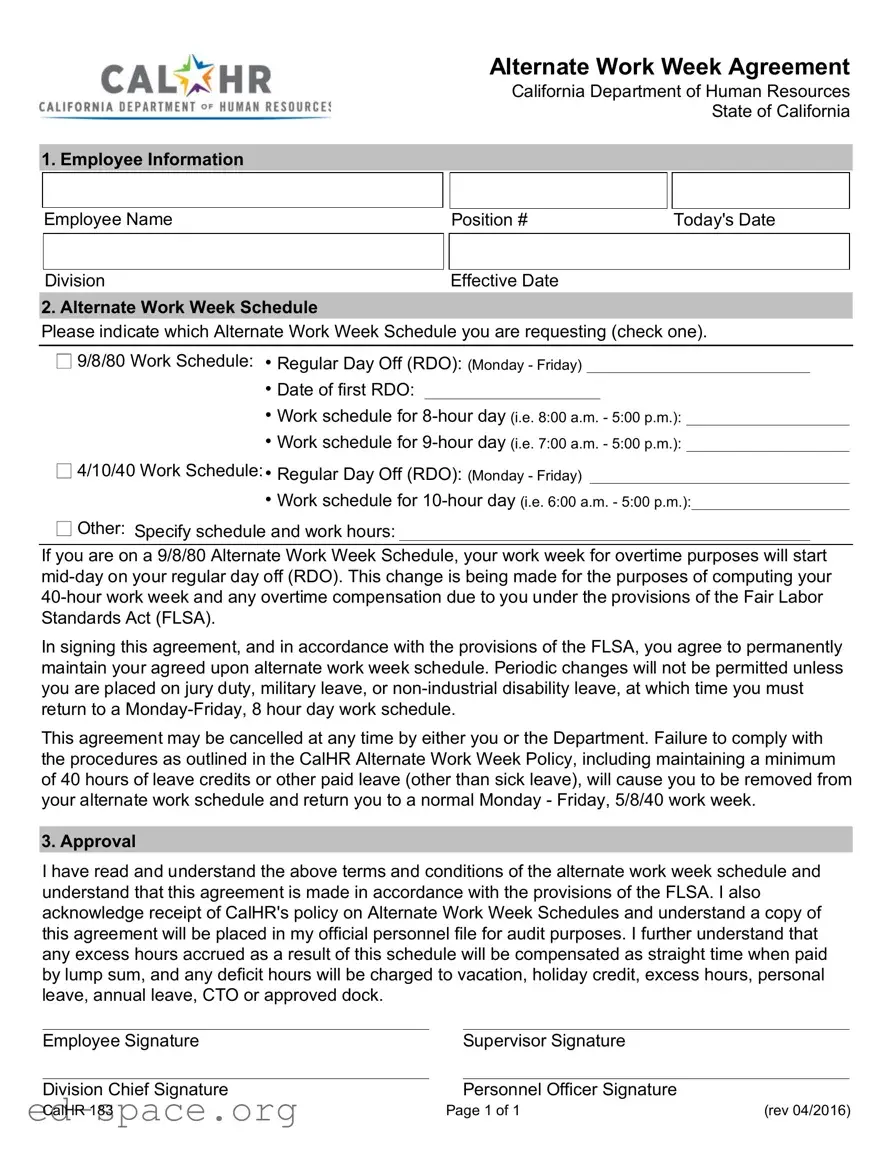
The California Work Week Agreement form is a crucial document for employees seeking to establish an alternate work schedule that diverges from the traditional Monday through Friday, 8-hour workday. This form allows employees to choose from various schedules, including the 9/8/80 and 4/10/40 arrangements, each offering flexibility in hours worked and days off. For instance, under the 9/8/80 schedule, employees can work eight days over a two-week period, with one regular day off, while the 4/10/40 schedule allows for four 10-hour days, also with a regular day off. The form requires essential employee information, such as name, division, and position number, alongside the desired work schedule. Importantly, it outlines the implications for overtime calculations under the Fair Labor Standards Act (FLSA), ensuring that employees understand how their alternate schedule affects their pay and work hours. Employees must agree to maintain their chosen schedule permanently, with limited exceptions for situations like jury duty or military leave. The agreement can be canceled at any time by either party, but noncompliance with the outlined procedures may result in reverting to the standard workweek. Signatures from the employee, division chief, supervisor, and personnel officer confirm understanding and acceptance of the terms, reinforcing the seriousness of this commitment while providing a structured framework for work-life balance.
Alternate Work Week Agreement
California Department of Human Resources
State of California
1. Employee Information
Employee Name
Division
2. Alternate Work Week Schedule
Position # |
Today's Date |
Effective Date
Please indicate which Alternate Work Week Schedule you are requesting (check one).
9/8/80 Work Schedule: • Regular Day Off (RDO): (Monday - Friday)
•Date of first RDO:
•Work schedule for
•Work schedule for
4/10/40 Work Schedule: • Regular Day Off (RDO): (Monday - Friday)
•Work schedule for
Other: Specify schedule and work hours:
If you are on a 9/8/80 Alternate Work Week Schedule, your work week for overtime purposes will start
In signing this agreement, and in accordance with the provisions of the FLSA, you agree to permanently maintain your agreed upon alternate work week schedule. Periodic changes will not be permitted unless you are placed on jury duty, military leave, or
This agreement may be cancelled at any time by either you or the Department. Failure to comply with the procedures as outlined in the CalHR Alternate Work Week Policy, including maintaining a minimum of 40 hours of leave credits or other paid leave (other than sick leave), will cause you to be removed from your alternate work schedule and return you to a normal Monday - Friday, 5/8/40 work week.
3. Approval
I have read and understand the above terms and conditions of the alternate work week schedule and understand that this agreement is made in accordance with the provisions of the FLSA. I also acknowledge receipt of CalHR's policy on Alternate Work Week Schedules and understand a copy of this agreement will be placed in my official personnel file for audit purposes. I further understand that any excess hours accrued as a result of this schedule will be compensated as straight time when paid by lump sum, and any deficit hours will be charged to vacation, holiday credit, excess hours, personal leave, annual leave, CTO or approved dock.
Employee Signature
Division Chief Signature
Supervisor Signature
Personnel Officer Signature
CalHR 183 |
Page 1 of 1 |
(rev 04/2016) |
| Fact Name | Details |
|---|---|
| Purpose | The California Alternate Work Week Agreement allows employees to request a modified work schedule, such as a 9/8/80 or 4/10/40 schedule, providing flexibility in their work hours. |
| Governing Law | This agreement is governed by the Fair Labor Standards Act (FLSA), which outlines the rules for overtime compensation and work hours. |
| Employee Agreement | By signing the agreement, employees commit to maintaining their chosen alternate work schedule and acknowledge that changes are limited to specific circumstances, such as jury duty or military leave. |
| Cancellation Policy | Either the employee or the Department can cancel the agreement at any time, allowing for flexibility in work arrangements. |
| Compliance Requirements | Employees must maintain at least 40 hours of leave credits or other paid leave, excluding sick leave, to remain on their alternate work schedule. Non-compliance will result in a return to a standard work week. |
Completing the California Work Week Agreement form is a straightforward process that requires careful attention to detail. This form is essential for establishing an alternate work schedule, which can provide flexibility in your work hours. Follow the steps below to ensure that you fill out the form correctly.
What is the California Work Week Agreement form?
The California Work Week Agreement form is a document that allows employees to request an alternate work schedule. This agreement can enable employees to work longer hours on certain days in exchange for a shorter work week. Options typically include a 9/8/80 schedule or a 4/10/40 schedule, depending on the employee's preference and departmental approval.
What are the different types of alternate work week schedules available?
Employees can choose between a 9/8/80 schedule, which allows for eight-hour days over nine days with one regular day off, or a 4/10/40 schedule, which consists of four ten-hour days followed by three days off. Employees may also specify other schedules, but these must be clearly outlined in the form.
How does the alternate work week affect overtime calculations?
For those on a 9/8/80 schedule, the work week for overtime purposes begins mid-day on the regular day off. This adjustment is important for calculating overtime compensation under the Fair Labor Standards Act (FLSA). Employees should be aware that any hours worked beyond the agreed schedule may qualify for overtime pay.
Can I change my alternate work week schedule after it has been approved?
Once the alternate work week schedule is established, changes are generally not permitted unless specific circumstances arise, such as jury duty, military leave, or non-industrial disability leave. In those cases, the employee must revert to a standard Monday-Friday, eight-hour workday.
What happens if I do not maintain the required leave credits?
Employees are required to maintain a minimum of 40 hours of leave credits or other paid leave, excluding sick leave. Failure to do so may result in removal from the alternate work schedule, reverting the employee back to a standard Monday-Friday, five-day work week.
Is the agreement permanent?
While the agreement is intended to be permanent, it can be canceled at any time by either the employee or the department. It is essential to communicate any intentions to cancel the agreement to ensure proper processing.
Will a copy of the agreement be kept on file?
Yes, a copy of the signed agreement will be placed in the employee's official personnel file. This is done for audit purposes and to ensure compliance with the terms of the agreement.
What should I do if I have excess or deficit hours?
Any excess hours accrued due to the alternate work week schedule will be compensated at straight time when paid in a lump sum. Conversely, any deficit hours will be charged against vacation, holiday credit, personal leave, or other approved leave options.
Who needs to sign the California Work Week Agreement form?
The form must be signed by the employee, the division chief, the supervisor, and the personnel officer. All signatures are necessary to validate the agreement and confirm that all parties understand the terms and conditions outlined.
Where can I find more information about the Alternate Work Week Policy?
Employees should refer to the California Department of Human Resources (CalHR) policy on Alternate Work Week Schedules for comprehensive details. This policy provides essential information regarding eligibility, procedures, and compliance requirements related to alternate work week agreements.
Neglecting to Provide Complete Employee Information: One common mistake is not filling out all required fields, such as the employee's name, division, and position number. Incomplete information can delay the processing of the agreement.
Failing to Specify the Correct Work Schedule: It's crucial to check the appropriate box for the desired alternate work week schedule. Not selecting a schedule or choosing the wrong one can lead to confusion about work hours and responsibilities.
Ignoring the Regular Day Off (RDO): Many people overlook the importance of clearly indicating their Regular Day Off. This oversight can result in scheduling conflicts and misunderstandings about work expectations.
Overlooking the Terms of Agreement: Employees often sign the agreement without fully understanding the terms and conditions outlined. This can lead to unintentional violations of the agreement, which may impact their work schedule.
Not Keeping Track of Leave Credits: It’s essential to maintain a minimum of 40 hours of leave credits or other paid leave. Failing to do so can result in being removed from the alternate work schedule and reverted back to a standard work week.
The California Work Week Agreement form is an essential document for employees who wish to adopt an alternate work schedule. However, several other forms and documents are often used in conjunction with this agreement to ensure compliance with state policies and to facilitate smooth transitions to new work schedules. Below is a list of these related documents.
Utilizing these documents alongside the California Work Week Agreement form can help employees navigate their work arrangements more effectively. It is essential to understand the role each document plays in maintaining compliance and fostering a productive work environment.
When filling out the California Work Week Agreement form, it is essential to follow specific guidelines to ensure accuracy and compliance. Here are four key dos and don'ts to consider:
Following these guidelines will help ensure a smooth process in establishing your alternate work week schedule.
This is not true. Participation in the Alternate Work Week Agreement is voluntary. Employees can choose whether or not to opt into this schedule based on their personal and professional needs.
In reality, once an employee agrees to an alternate work schedule, they must maintain it unless specific circumstances arise, such as jury duty or military leave. Changes are not permitted on a whim.
While employees on an alternate work schedule may be eligible for overtime, it is calculated differently. For those on a 9/8/80 schedule, the work week for overtime purposes starts mid-day on their regular day off.
Sick leave does not count towards the minimum 40 hours of leave credits required to maintain the alternate work schedule. Employees must ensure they have enough paid leave to remain eligible.
While the agreement is intended to be maintained, it can be canceled by either the employee or the department at any time. This flexibility is important for accommodating changing circumstances.
Each department has the discretion to implement the Alternate Work Week Agreement based on their operational needs. Therefore, schedules may vary significantly between departments.
Employees on alternate work schedules do not receive additional pay for longer hours unless they exceed the established overtime threshold. Compensation for excess hours is typically at straight time.
The Alternate Work Week Agreement is available to various positions across different divisions, as long as the employee meets the eligibility criteria set by their department.
Here are some key takeaways regarding the California Work Week Agreement form: