The California Statutory Will form is designed to simplify the process of creating a legally binding will for residents of California. This straightforward document allows individuals to outline their wishes regarding the distribution of their assets after death. It includes sections for specific gifts, such as personal residences, automobiles, and cash, enabling individuals to designate beneficiaries clearly. The form also addresses the appointment of guardians for minor children and custodians for assets intended for beneficiaries under 25 years old. Additionally, it provides a space for nominating an executor to manage the estate. To ensure validity, the will must be signed and dated by the maker in the presence of two witnesses, who also sign the document. By adhering to the instructions outlined in the form, individuals can create a will that reflects their intentions while complying with California probate laws.

California Statutory Will
California Probate Code, Section 6240
INSTRUCTIONS
1.READ THE WILL. Read the whole Will first. If you do not understand something, ask a lawyer to explain it to you.
2.FILL IN THE BLANKS. Fill in the blanks. Follow the instructions in the form carefully. Do not add any words to the Will (except for filling in blanks) or cross out any words.
3.DATE AND SIGN THE WILL AND HAVE TWO WITNESSES SIGN IT. Date and sign the Will and have two witnesses sign it. You and the witnesses should read and follow the Notice to Witnesses found at the end of this Will.
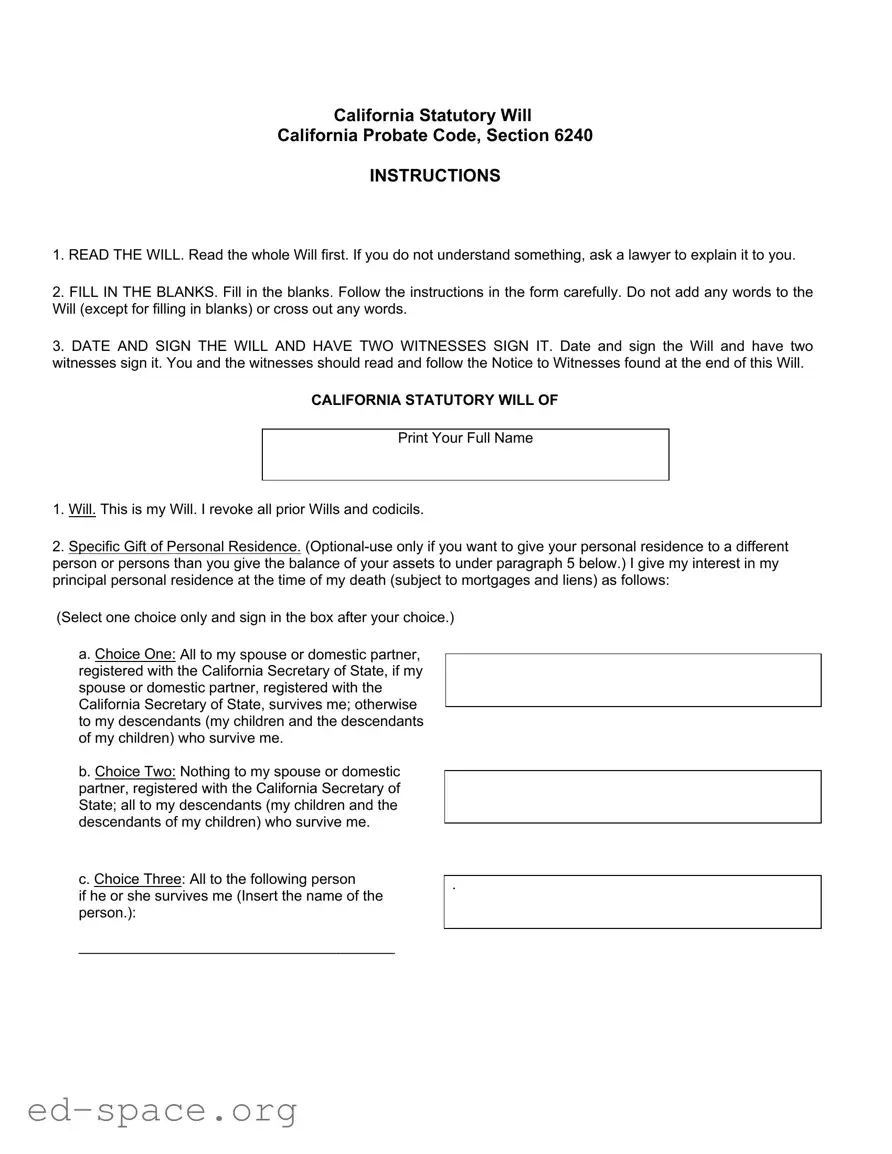
CALIFORNIA STATUTORY WILL OF
Print Your Full Name
1.Will. This is my Will. I revoke all prior Wills and codicils.
2.Specific Gift of Personal Residence.
(Select one choice only and sign in the box after your choice.)
a. Choice One: All to my spouse or domestic partner, registered with the California Secretary of State, if my spouse or domestic partner, registered with the California Secretary of State, survives me; otherwise to my descendants (my children and the descendants of my children) who survive me.
b. Choice Two: Nothing to my spouse or domestic partner, registered with the California Secretary of State; all to my descendants (my children and the descendants of my children) who survive me.
c. Choice Three: All to the following person
if he or she survives me (Insert the name of the person.):
.
_______________________________________

d. Choice Four: Equally among the following persons who survive me (Insert the names of two or more persons.):
______________________________________
______________________________________
______________________________________
______________________________________
3.Specific Gift of Automobiles, Household and Personal Effects.
(Select one choice only and sign in the box after your choice.)
a. Choice One: All to my spouse or domestic partner, registered with the California Secretary of State, if my spouse or domestic partner, registered with the California Secretary of State, survives me; otherwise to my descendants (my children and the descendants of my children) who survive me.
b. Choice Two: Nothing to my spouse or domestic partner, registered with the California Secretary of State; all to my descendants (my children and the descendants of my children) who survive me.
c. Choice Three: All to the following person if he or she survives me (Insert the name of the person.):
______________________________________
d. Choice Four: Equally among the following persons who survive me (Insert the names of two or more persons.):
_______________________________________
_______________________________________
_______________________________________
_______________________________________

4.Specific Gifts of Cash. (Optional) I make the following cash gifts to the persons named below who survive me, or to the named charity, and I sign my name in the box after each gift. If I do not sign in the box, I do not make a gift. (Sign in the box after each gift you make.)
Name of Person or Charity to receive gift |
Amount of Cash Gift |
(name one only – please print) |
__________________________________________ |
|
Sign your name in this box to make this gift |
|
|
Name of Person or Charity to receive gift |
Amount of Cash Gift |
(name one only – please print) |
__________________________________________ |
|
Sign your name in this box to make this gift |
|
|
Name of Person or Charity to receive gift |
Amount of Cash Gift |
(name one only – please print) |
__________________________________________ |
|
Sign your name in this box to make this gift |
|
|
Name of Person or Charity to receive gift |
Amount of Cash Gift |
(name one only – please print) |
__________________________________________ |
|
Sign your name in this box to make this gift |
|
|
Name of Person or Charity to receive gift |
Amount of Cash Gift |
(name one only – please print) |
___________________________________________ |
|
Sign your name in this box to make this gift |
|
|
5.Balance of My Assets. Except for the specific gifts made in paragraphs 2, 3 and 4 above, I give the balance of my assets as follows:
(Select one choice only and sign in the box after your choice. If I sign in more than one box or if I do not sign in any box, the court will distribute my assets as if I did not make a Will.)
a. Choice One: All to my spouse or domestic partner, registered with the California Secretary of State, if my spouse or domestic partner, registered with the California Secretary of State, survives me; otherwise to my descendants (my children and the descendants of my children) who survive me.
b. Choice Two: Nothing to my spouse or domestic partner, registered with the California Secretary of State; all to my descendants (my children and the descendants of my children) who survive me.
c. Choice Three: All to the following person if he or she survives me (Insert the name of the person.):
_______________________________________
d. Choice Four: Equally among the following persons who survive me (Insert the names of two or more persons.):
_______________________________________
_______________________________________
_______________________________________
_______________________________________
6.Guardian of the Child's Person. If I have a child under age 18 and the child does not have a living parent at my death, I nominate the individual named below as First Choice as guardian of the person of that child (to raise the child). If the First Choice does not serve, then I nominate the Second Choice, and then the Third Choice, to serve. Only an individual (not a bank or trust company) may serve.
Name of First Choice for Guardian of the Person
Name of Second Choice for Guardian of the Person
Name of Third Choice for Guardian of the Person
7.Special Provision for Property of Persons Under Age 25.
Name of First Choice for Custodian of Assets
Name of Second Choice for Custodian of Assets
Name of Third Choice for Custodian of Assets

Insert any age from 18 to 25 as the age for the person to receive the property: (If you do not choose an age, age 18 will apply.)
8.Executor. I nominate the individual or bank or trust company named below as First Choice as executor. If the First Choice does not serve, then I nominate the Second Choice, and then the Third Choice, to serve.
Name of First Choice for Executor
Name of Second Choice for Executor
Name of Third Choice for Executor
9.Bond. My signature in this box means a bond is not required for any person named as executor. A bond may be required if I do not sign in this box:
No bond shall be required.
(Notice: You must sign this Will in the presence of two (2) adult witnesses. The witnesses must sign their names in your presence and in each other's presence. You must first read to them the following sentence.)
This is my Will: I ask the persons who sign below to be my witnesses.
Signed on_______________________ at __________________________, California.
(date)(city)
Signature of Maker of Will
(Notice to Witnesses: Two (2) adults must sign as witnesses. Each witness must read the following clause before signing. The witnesses should not receive assets under this Will.)
Each of us declares under penalty of perjury under the laws of the State of California that the following is true and correct:
a. On the date written below the maker of this Will declared to us that this instrument was the maker's Will and requested us to act as witnesses to it;

b. We understand this is the maker's Will;
c. The maker signed this Will in our presence, all of us being present at the same time;
d. We now, at the maker's request, and in the maker's and each other's presence, sign below as witnesses; e. We believe the maker is of sound mind and memory;
f. We believe that this Will was not procured by duress, menace, fraud or undue influence; g. The maker is age 18 or older; and
h. Each of us is now age 18 or older, is a competent witness, and resides at the address set forth after his or her name.
Dated: _________________, _______________________
Signature of witness
Print name here:
____________________________
Residence address:
_____________________________
_____________________________
Signature of witness
Print name here:
________________________________
Residence address
________________________________
________________________________
AT LEAST TWO WITNESSES MUST SIGN NOTARIZATION ALONE IS NOT SUFFICIENT
| Fact Name | Details |
|---|---|
| Governing Law | California Statutory Will is governed by California Probate Code, Section 6240. |
| Reading the Will | It is essential to read the entire Will before making any decisions. If there are uncertainties, consulting a lawyer is advised. |
| Filling in Blanks | Only fill in the blanks provided in the form. Adding or crossing out words is not permitted. |
| Witness Requirements | The Will must be signed in the presence of two witnesses, who also need to sign the document. |
| Specific Gifts | Specific gifts can be made for personal residence, automobiles, household items, and cash gifts to named individuals or charities. |
| Balance of Assets | Any remaining assets after specific gifts will be distributed according to the choices selected in the Will. |
| Guardian Nomination | If a child under 18 is involved, a guardian can be nominated. The form allows for multiple choices. |
| Custodian Provision | For beneficiaries under age 25, a custodian can be appointed to manage assets until the chosen age is reached. |
Filling out the California Will form is an important step in ensuring your wishes are clearly stated and respected. After completing the form, it will need to be signed and witnessed to be legally valid. Follow the steps carefully to ensure everything is filled out correctly.
What is a California Will form?
A California Will form is a legal document that allows individuals to outline how their assets and property should be distributed after their death. It ensures that your wishes are followed regarding who receives your belongings, including specific gifts and the appointment of guardians for any minor children.
How do I complete the California Will form?
To complete the California Will form, start by reading the entire document carefully. Fill in the blanks as instructed, without adding or crossing out any words. Once you've completed the form, you must date and sign it in the presence of two witnesses, who also need to sign the document. Make sure you and your witnesses follow the Notice to Witnesses section at the end of the Will.
Can I change my Will after I have completed it?
Yes, you can change your Will at any time. To do this, you should create a new Will that revokes the previous one or add a codicil, which is a document that amends your existing Will. It is important to follow the same signing and witnessing requirements to ensure that your changes are valid.
What happens if I don’t have a Will?
If you die without a Will, your assets will be distributed according to California's intestacy laws. This means that the state will decide how your property is divided, which may not align with your wishes. Having a Will allows you to control the distribution of your assets and appoint guardians for your children.
Who can be a witness to my Will?
In California, any two adults can serve as witnesses to your Will, as long as they are not beneficiaries of the Will. It's essential that they sign the document in your presence and in each other's presence. Their signatures confirm that they witnessed you signing the Will.
What is the role of an executor in a Will?
The executor is the person or entity responsible for managing your estate after your death. This includes paying debts, distributing assets according to your Will, and handling any necessary legal proceedings. You can nominate an individual or a bank or trust company as your executor in the Will.
Do I need a lawyer to create a California Will?
While you can complete a California Will form without a lawyer, it is advisable to consult one, especially if your estate is complex or if you have specific concerns. A lawyer can help ensure that your Will is valid and that your wishes are clearly stated, reducing the chance of disputes after your death.
What should I do with my completed Will?
Once your Will is completed and signed, keep it in a safe place, such as a safe deposit box or a fireproof safe at home. Inform your executor and trusted family members where to find it. Regularly review your Will to ensure it still reflects your wishes, especially after significant life events like marriage, divorce, or the birth of a child.
Not Reading the Entire Will: Many individuals skip reading the full Will before filling it out. Understanding the document is crucial. If any part is unclear, consulting a lawyer is advisable.
Failing to Fill in All Blanks: It's important to complete all required fields. Leaving blanks can lead to confusion or misinterpretation of intentions.
Adding Extra Words or Cross-Outs: The form should only have the necessary information filled in. Adding words or crossing out sections can invalidate the Will.
Not Dating and Signing Properly: The Will must be dated and signed by the maker. Additionally, two witnesses must also sign. Omitting any of these steps can render the Will invalid.
Choosing Multiple Options: When selecting beneficiaries or distributions, only one choice should be marked. Selecting more than one option can complicate the distribution of assets.
Neglecting to Consider Guardianship: For individuals with minor children, failing to name guardians can leave the decision to the court, which may not align with personal wishes.
Not Following Witness Instructions: Witnesses must be adults who do not stand to inherit from the Will. Ignoring this requirement can lead to challenges in the Will's validity.
When creating a California Will, several additional forms and documents can be beneficial for ensuring that your wishes are clearly outlined and legally recognized. Below is a list of commonly used documents that complement the California Will form.
Utilizing these documents alongside your California Will can provide a comprehensive plan for your estate. Each form plays a vital role in ensuring your wishes are respected and can help ease the burden on your loved ones during a difficult time.
When filling out the California Will form, it’s crucial to approach the process with care. Here’s a list of things to do and avoid:
Here are some common misconceptions about the California Will form:
Here are some important points to remember when filling out and using the California Will form:
Following these steps can help ensure that your Will is valid and reflects your intentions. Taking the time to complete the form correctly can save complications later on.