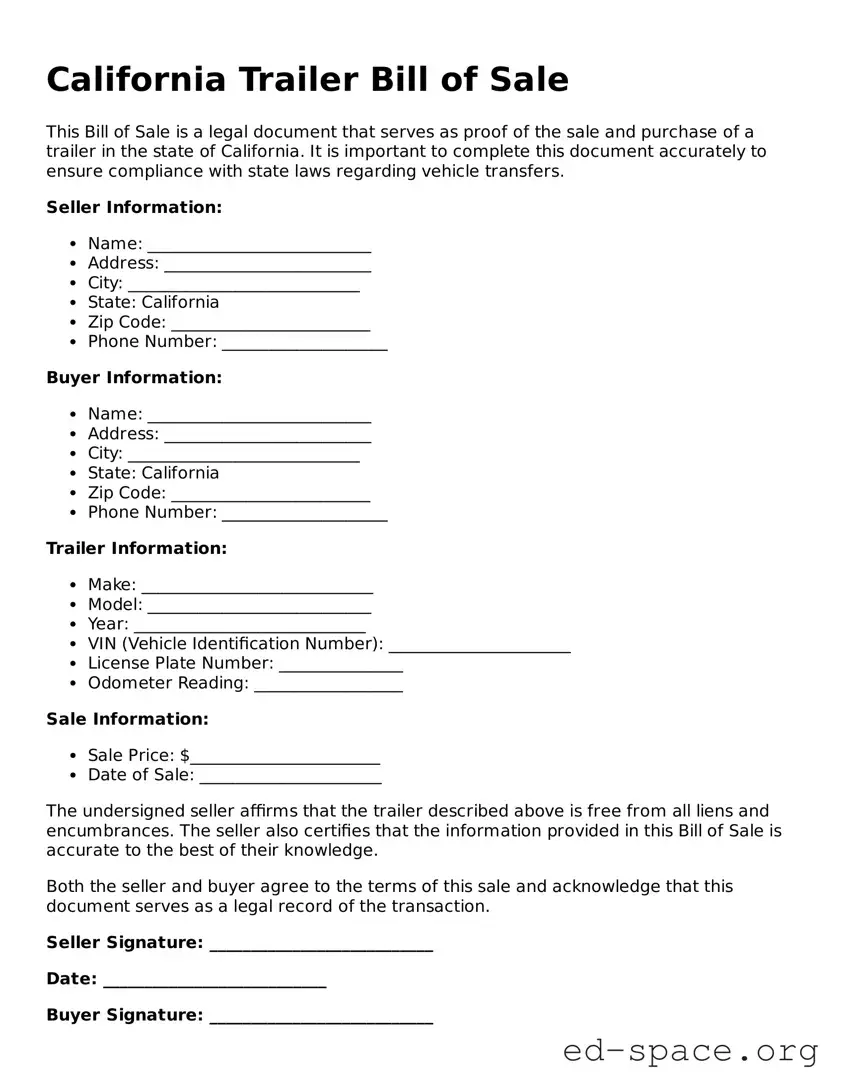
The California Trailer Bill of Sale form serves as a crucial document in the process of transferring ownership of a trailer from one party to another. This form is essential for both buyers and sellers, as it provides a clear record of the transaction and helps to protect the interests of both parties involved. Typically, the form includes important details such as the names and addresses of the buyer and seller, the trailer's identification number, make, model, year, and purchase price. Additionally, the form often requires the seller's signature, which confirms their consent to the sale, and may also include a section for the buyer's signature to acknowledge the receipt of the trailer. By completing this form, individuals can ensure that the transfer of ownership is documented properly, which is particularly important for registration purposes with the California Department of Motor Vehicles (DMV). Understanding the components and significance of the Trailer Bill of Sale can help streamline the buying and selling process, making it more efficient and legally sound.
California Trailer Bill of Sale
This Bill of Sale is a legal document that serves as proof of the sale and purchase of a trailer in the state of California. It is important to complete this document accurately to ensure compliance with state laws regarding vehicle transfers.
Seller Information:
Buyer Information:
Trailer Information:
Sale Information:
The undersigned seller affirms that the trailer described above is free from all liens and encumbrances. The seller also certifies that the information provided in this Bill of Sale is accurate to the best of their knowledge.
Both the seller and buyer agree to the terms of this sale and acknowledge that this document serves as a legal record of the transaction.
Seller Signature: ___________________________
Date: ___________________________
Buyer Signature: ___________________________
Date: ___________________________
For any questions regarding this document or the process of transferring ownership of a trailer in California, please consult with a legal advisor or the California Department of Motor Vehicles.
| Fact Name | Description |
|---|---|
| Purpose | The California Trailer Bill of Sale form is used to document the sale of a trailer between a seller and a buyer. |
| Governing Law | This form is governed by the California Vehicle Code, specifically sections relating to the sale and transfer of vehicles and trailers. |
| Required Information | The form requires details such as the names and addresses of both the buyer and seller, the trailer's identification number, and the sale price. |
| Signature Requirement | Both the seller and the buyer must sign the form to make it legally binding. |
| Use for Registration | The completed bill of sale can be used to register the trailer with the California Department of Motor Vehicles (DMV). |
| Record Keeping | It is advisable for both parties to keep a copy of the signed bill of sale for their records. |
| Notarization | While notarization is not required, it can provide an additional layer of security for the transaction. |
| Tax Implications | The sale may be subject to sales tax, which the buyer is typically responsible for paying at the time of registration. |
| Condition Disclosure | The seller should disclose the condition of the trailer, including any known defects, to avoid future disputes. |
| Transfer of Ownership | Once the bill of sale is completed and signed, ownership of the trailer is officially transferred from the seller to the buyer. |
After obtaining the California Trailer Bill of Sale form, the next steps involve accurately filling it out to ensure a smooth transaction. This document will serve as proof of ownership transfer and should be completed with care. Follow the steps below to fill out the form correctly.
What is a California Trailer Bill of Sale form?
The California Trailer Bill of Sale form is a legal document used to record the sale of a trailer in the state of California. This form provides essential details about the transaction, including the buyer and seller’s information, the trailer’s specifications, and the sale price. It serves as proof of ownership transfer and can be used for registration purposes with the Department of Motor Vehicles (DMV).
Who needs to complete a Bill of Sale for a trailer?
Both the seller and the buyer of the trailer need to complete the Bill of Sale. The seller must provide accurate information about the trailer and confirm the sale, while the buyer needs to acknowledge the purchase and accept the terms of the sale. This document is crucial for both parties to protect their interests in the transaction.
What information is required on the form?
The form typically requires the following information: the names and addresses of both the seller and buyer, a detailed description of the trailer (including make, model, year, and Vehicle Identification Number), the sale price, and the date of the transaction. Additionally, both parties may need to sign the document to validate the sale.
Is a Bill of Sale legally required in California?
While a Bill of Sale is not legally required for every trailer sale in California, it is highly recommended. Having a Bill of Sale can help resolve disputes regarding ownership and provides proof of the transaction. Furthermore, the DMV may require it when registering the trailer in the new owner’s name.
Can I create my own Bill of Sale?
Yes, you can create your own Bill of Sale for a trailer as long as it includes all necessary information. However, using a standardized form can simplify the process and ensure that all required details are included. Various templates are available online, or you can consult with a legal professional for guidance.
What if the trailer has a lien on it?
If there is a lien on the trailer, the seller must disclose this information to the buyer. The lienholder may need to be involved in the sale process to release the lien. It is crucial for the buyer to ensure that the lien is cleared before completing the purchase to avoid potential legal complications.
How do I register the trailer after purchase?
After completing the Bill of Sale, the buyer must visit the DMV to register the trailer in their name. They will need to provide the completed Bill of Sale, proof of ownership, and any other required documents, such as a title if applicable. Fees may apply, and the buyer should check the DMV website for specific requirements.
What should I do if I lose the Bill of Sale?
If you lose the Bill of Sale, it may be difficult to prove ownership of the trailer. If possible, contact the seller to obtain a duplicate. If that is not an option, you may need to file a statement of facts with the DMV explaining the situation. Keeping a copy of all important documents is always a good practice to avoid such issues.
Can I use the Bill of Sale for tax purposes?
Yes, the Bill of Sale can be used for tax purposes, particularly when reporting the purchase of the trailer. It serves as documentation of the transaction and may be required when filing taxes or applying for any applicable tax deductions. Always consult with a tax professional for specific advice related to your situation.
Not including the VIN (Vehicle Identification Number). The VIN is crucial for identifying the trailer. Without it, the sale may not be valid.
Failing to provide accurate buyer and seller information. Ensure names, addresses, and contact details are correct to avoid complications later.
Omitting the purchase price. This detail is necessary for both parties and for tax purposes. Be clear and precise about the amount.
Not signing the form. Both the buyer and seller must sign the document. Without signatures, the sale is incomplete.
Ignoring the date of sale. Including the date is important for record-keeping and may affect the transfer of ownership.
Not keeping a copy of the completed form. Always retain a copy for your records. This can help resolve disputes or questions in the future.
When buying or selling a trailer in California, several documents may be needed alongside the Trailer Bill of Sale form. These documents help ensure a smooth transaction and proper registration. Here’s a list of commonly used forms and documents:
Having these documents ready can facilitate the sale or purchase of a trailer in California. Proper documentation not only protects both parties but also ensures compliance with state regulations.
When filling out the California Trailer Bill of Sale form, it’s important to follow certain guidelines to ensure the process goes smoothly. Here are six things to keep in mind:
Following these guidelines will help ensure that your trailer sale is documented properly and legally recognized in California.
The California Trailer Bill of Sale form is often misunderstood. Here are eight common misconceptions about this document, along with clarifications for each.
This is incorrect. The Trailer Bill of Sale is required for both new and used trailers to establish ownership transfer.
A verbal agreement does not provide the legal protection that a written bill of sale does. The form serves as a formal record of the transaction.
Whether you buy from a private seller or a dealership, a bill of sale is important for documenting the transaction.
This is false. Including the trailer's Vehicle Identification Number (VIN) is crucial for accurate identification and registration.
Both the buyer and the seller should sign the bill of sale to validate the transaction and protect both parties.
This is misleading. While the form itself does not need to be filed, it is essential for the buyer to keep it for registration and future reference.
In fact, the bill of sale is a legally binding document that can be used in court to prove ownership and the terms of the sale.
This is incorrect. Each state, including California, has specific requirements that must be followed for the bill of sale to be valid.
When filling out and using the California Trailer Bill of Sale form, it is important to keep the following key points in mind: