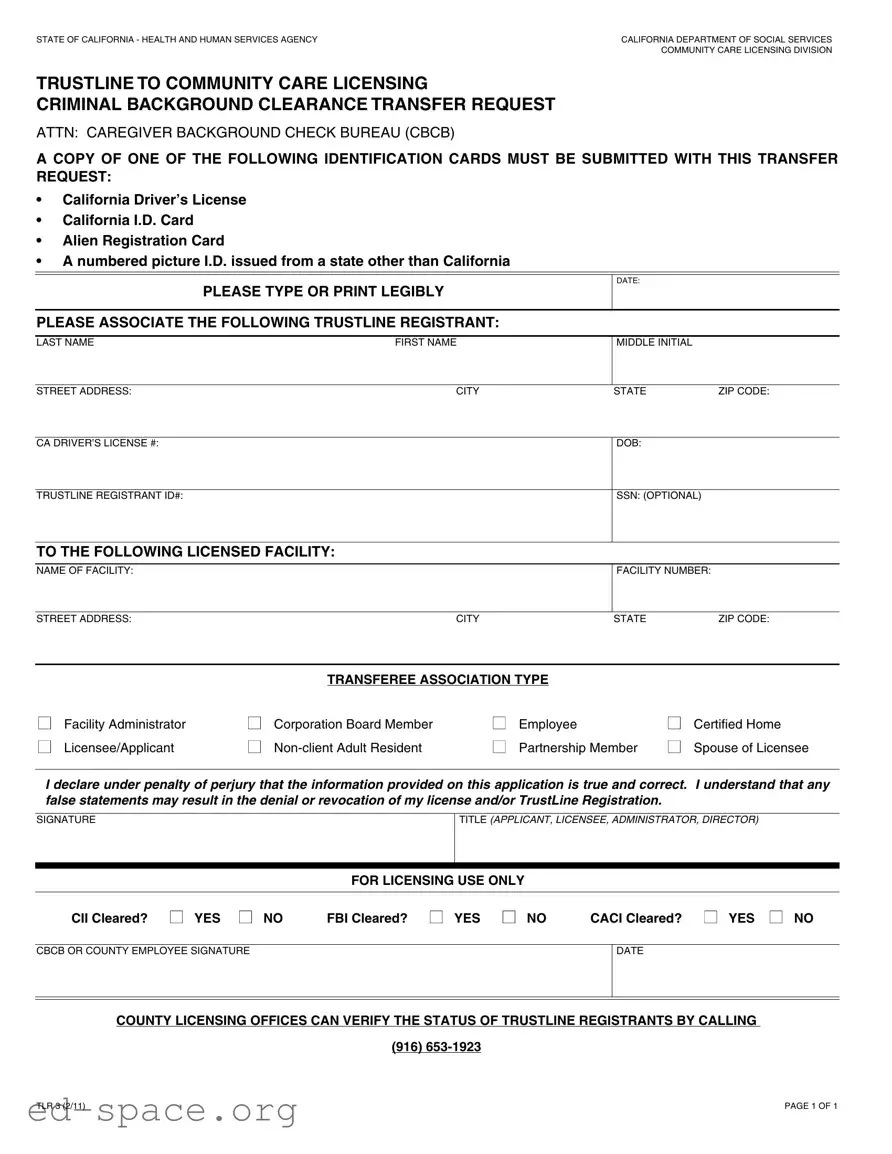
The California TLR 3 form plays a crucial role in the process of transferring criminal background clearances for caregivers in licensed facilities. This form is essential for ensuring that individuals working with vulnerable populations, such as children or the elderly, have undergone the necessary background checks. To initiate a transfer request, caregivers must provide a valid identification card, which can include a California driver's license, an I.D. card, or even an alien registration card. Key information required on the form includes the caregiver's name, address, and TrustLine registrant ID, along with details about the facility to which they are being transferred. The form also prompts the applicant to declare their association type with the licensed facility, whether as an employee, administrator, or board member, among others. Importantly, the applicant must affirm the truthfulness of their information under penalty of perjury, highlighting the seriousness of the process. Once submitted, the form undergoes verification by county licensing offices, ensuring that all background checks are cleared before the caregiver can assume their role in the facility. This structured approach not only safeguards the well-being of those in care but also reinforces the integrity of the caregiving profession in California.

STATE OF CALIFORNIA - HEALTH AND HUMAN SERVICES AGENCY |
CALIFORNIA DEPARTMENT OF SOCIAL SERVICES |
|
COMMUNITY CARE LICENSING DIVISION |
TRUSTLINE TO COMMUNITY CARE LICENSING
CRIMINAL BACKGROUND CLEARANCE TRANSFER REQUEST
ATTN: CAREGIVER BACKGROUND CHECK BUREAU (CBCB)
A COPY OF ONE OF THE FOLLOWING IDENTIFICATION CARDS MUST BE SUBMITTED WITH THIS TRANSFER REQUEST:
•California Driver’s License
•California I.D. Card
•Alien Registration Card
•A numbered picture I.D. issued from a state other than California
PLEASE TYPE OR PRINT LEGIBLY
DATE:
PLEASE ASSOCIATE THE FOLLOWING TRUSTLINE REGISTRANT:
LAST NAME |
FIRST NAME |
MIDDLE INITIAL
STREET ADDRESS: |
CITY |
STATE |
ZIP CODE: |
CA DRIVER’S LICENSE #:
DOB:
TRUSTLINE REGISTRANT ID#:
SSN: (OPTIONAL)
TO THE FOLLOWING LICENSED FACILITY:
NAME OF FACILITY:
FACILITY NUMBER:
STREET ADDRESS: |
CITY |
STATE |
ZIP CODE: |
TRANSFEREE ASSOCIATION TYPE
■
■
Facility Administrator
Licensee/Applicant
■
■
Corporation Board Member
■
■
Employee
Partnership Member
■
■
Certified Home
Spouse of Licensee
I declare under penalty of perjury that the information provided on this application is true and correct. I understand that any false statements may result in the denial or revocation of my license and/or TrustLine Registration.
SIGNATURE
TITLE (APPLICANT, LICENSEE, ADMINISTRATOR, DIRECTOR)
FOR LICENSING USE ONLY
CII Cleared? ■ YES ■ NO |
FBI Cleared? ■ YES ■ NO |
CACI Cleared? ■ YES ■ NO |
CBCB OR COUNTY EMPLOYEE SIGNATURE
DATE
COUNTY LICENSING OFFICES CAN VERIFY THE STATUS OF TRUSTLINE REGISTRANTS BY CALLING
(916)
TLR 3 (2/11) |
PAGE 1 OF 1 |
| Fact Name | Description |
|---|---|
| Purpose | The California TLR 3 form is used for transferring a criminal background clearance request for caregivers within licensed facilities. |
| Identification Requirements | A copy of an identification card, such as a California Driver’s License or a state-issued picture ID, must be submitted with the form. |
| Governing Law | This form is governed by California Health and Safety Code, specifically related to community care licensing. |
| Submission Process | The completed form must be sent to the Caregiver Background Check Bureau for processing. |
Completing the California TLR 3 form is a straightforward process that requires attention to detail. Once you have filled out the form, it will be submitted to the appropriate licensing authority for processing. Ensure that all information is accurate and legible to avoid any delays.
What is the purpose of the California TLR 3 form?
The California TLR 3 form is used to request the transfer of a criminal background clearance for individuals associated with licensed facilities. This form is essential for caregivers seeking to work in various community care settings, ensuring that they meet the necessary background check requirements. By submitting this form, caregivers can facilitate their transition between different licensed facilities while maintaining compliance with state regulations.
Who needs to submit the TLR 3 form?
What identification is required when submitting the TLR 3 form?
What information must be provided on the TLR 3 form?
What happens if the information on the TLR 3 form is false?
Failing to provide a copy of an identification card. It is essential to include one of the accepted forms of ID, such as a California Driver’s License or an Alien Registration Card.
Not typing or printing legibly. Illegible handwriting can lead to misunderstandings and delays in processing the form.
Omitting personal information. Ensure that all required fields, such as last name, first name, and date of birth, are filled out completely.
Incorrectly identifying the licensed facility. Double-check the facility name and number to ensure accuracy, as this information is critical for processing.
Choosing the wrong transferee association type. It is important to select the correct option that accurately reflects the relationship to the licensed facility.
Not signing the form. A signature is required to validate the information provided and confirm the declaration of truthfulness.
Leaving out the date on the form. Including the date helps to establish the timeline of the request and is necessary for processing.
Providing an incorrect TrustLine Registrant ID. This ID must match the registrant’s official records to avoid confusion.
Forgetting to include the Social Security Number if applicable. While optional, providing this can assist in verifying identity.
Neglecting to read the declaration statement thoroughly. Understanding the implications of false statements is crucial to avoid potential penalties.
The California TLR 3 form is essential for transferring criminal background clearance for caregivers. Along with this form, several other documents may be required to ensure a smooth process. Below is a list of commonly used forms and documents that complement the TLR 3.
These documents work together to facilitate the background clearance process and ensure compliance with California regulations. Having them ready can help streamline the transfer and registration process for caregivers and facilities alike.
The California TLR 3 form is important for transferring criminal background clearance requests for caregivers. It shares similarities with other documents used in similar contexts. Here are four documents that are comparable to the TLR 3 form:
When filling out the California TLR 3 form, it’s essential to approach the task with care. Here’s a helpful list of what you should and shouldn’t do to ensure your application is processed smoothly.
By following these guidelines, you can enhance the chances of a successful transfer request and avoid common pitfalls in the process.
Understanding the California TLR 3 form is essential for those involved in community care licensing. However, several misconceptions can lead to confusion. Here are four common misunderstandings:
This is not true. The TLR 3 form is designed for transferring existing TrustLine registrants to new licensed facilities. It is used when a caregiver changes their employment or association with a different facility.
In fact, a copy of an identification card is required. Acceptable forms include a California Driver’s License, California I.D. Card, or other specified forms of ID. This helps verify the identity of the registrant.
A signature is mandatory on the TLR 3 form. It certifies that the information provided is accurate and complete. Failing to sign the form can lead to delays or denial of the transfer request.
This is misleading. The TrustLine registration may be put on hold during the transfer until the necessary background checks are completed. It is crucial to ensure that all requirements are met to avoid any interruptions in service.
When filling out and using the California TLR 3 form, it is essential to follow specific guidelines to ensure a smooth process. Here are key takeaways to keep in mind:
These takeaways will help you navigate the process of completing the California TLR 3 form effectively. Always double-check your information before submission to avoid unnecessary complications.