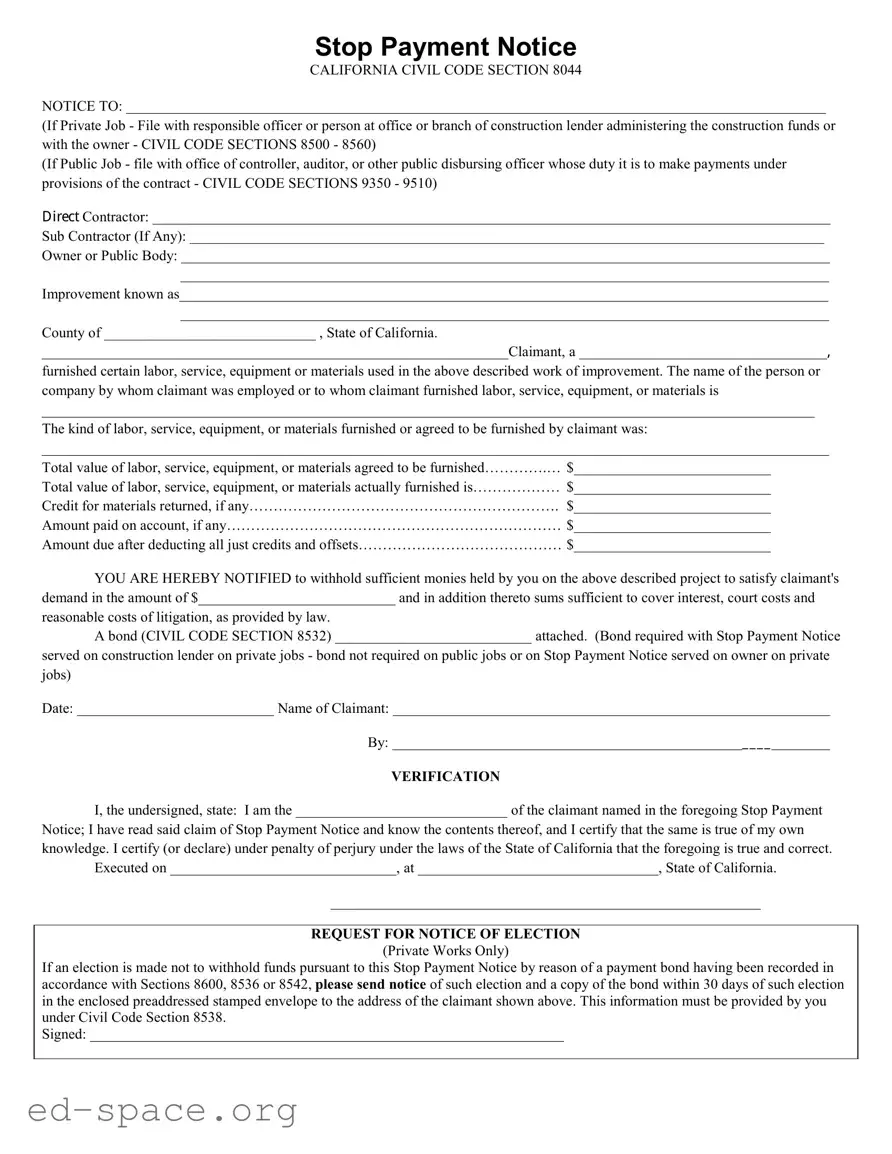
The California Stop Payment form is an essential tool for contractors, subcontractors, and suppliers in the construction industry. This form allows them to formally request that a construction lender or project owner withhold payment for labor, services, equipment, or materials provided on a specific project. It serves as a notice to ensure that the claimant receives the funds they are owed, especially when there are disputes regarding payment. The form requires detailed information, including the names of the involved parties, the nature of the work performed, and the amounts due. It also outlines the necessary steps for filing, depending on whether the project is private or public. Importantly, the form includes a verification section where the claimant certifies the accuracy of the information provided under penalty of perjury. Additionally, for private projects, a request for notice of election is included, allowing claimants to stay informed about any decisions made regarding fund withholding. Understanding this form is crucial for anyone involved in construction projects in California, as it helps protect their financial interests.

Stop Payment Notice
CALIFORNIA CIVIL CODE SECTION 8044
NOTICE TO: ________________________________________________________________________________________________
(If Private Job - File with responsible officer or person at office or branch of construction lender administering the construction funds or with the owner - CIVIL CODE SECTIONS 8500 - 8560)
(If Public Job - file with office of controller, auditor, or other public disbursing officer whose duty it is to make payments under provisions of the contract - CIVIL CODE SECTIONS 9350 - 9510)
'LUHFW Contractor: _____________________________________________________________________________________________
Sub Contractor (If Any): _______________________________________________________________________________________
Owner or Public Body: _________________________________________________________________________________________
_________________________________________________________________________________________
Improvement known as_________________________________________________________________________________________
_________________________________________________________________________________________
County of _____________________________ , State of California.
________________________________________________________________Claimant, a __________________________________
furnished certain labor, service, equipment or materials used in the above described work of improvement. The name of the person or company by whom claimant was employed or to whom claimant furnished labor, service, equipment, or materials is
__________________________________________________________________________________________________________
The kind of labor, service, equipment, or materials furnished or agreed to be furnished by claimant was:
____________________________________________________________________________________________________________
Total value of labor, service, equipment, or materials agreed to be furnished………….… $___________________________
Total value of labor, service, equipment, or materials actually furnished is……………… $___________________________
Credit for materials returned, if any………………………………………………………. $___________________________
Amount paid on account, if any…………………………………………………………… $___________________________
Amount due after deducting all just credits and offsets…………………………………… $___________________________
YOU ARE HEREBY NOTIFIED to withhold sufficient monies held by you on the above described project to satisfy claimant's demand in the amount of $___________________________ and in addition thereto sums sufficient to cover interest, court costs and
reasonable costs of litigation, as provided by law.
A bond (CIVIL CODE SECTION 8532) ___________________________ attached. (Bond required with Stop Payment Notice
served on construction lender on private jobs - bond not required on public jobs or on Stop Payment Notice served on owner on private jobs)
Date: ___________________________ Name of Claimant: ____________________________________________________________
By: ________________________________________________BBBB ________
VERIFICATION
I, the undersigned, state: I am the _____________________________ of the claimant named in the foregoing Stop Payment
Notice; I have read said claim of Stop Payment Notice and know the contents thereof, and I certify that the same is true of my own knowledge. I certify (or declare) under penalty of perjury under the laws of the State of California that the foregoing is true and correct.
Executed on _______________________________, at _________________________________, State of California.
___________________________________________________________
REQUEST FOR NOTICE OF ELECTION
(Private Works Only)
If an election is made not to withhold funds pursuant to this Stop Payment Notice by reason of a payment bond having been recorded in accordance with Sections 8600, 8536 or 8542, please send notice of such election and a copy of the bond within 30 days of such election in the enclosed preaddressed stamped envelope to the address of the claimant shown above. This information must be provided by you under Civil Code Section 8538.
Signed: _________________________________________________________________
| Fact Name | Description |
|---|---|
| Governing Law | The Stop Payment Notice is governed by California Civil Code Sections 8044 and 8500-8560 for private jobs, and Sections 9350-9510 for public jobs. |
| Filing Requirements | For private jobs, the notice must be filed with the responsible officer of the construction lender or the owner. For public jobs, it should be filed with the office of the controller or auditor. |
| Bond Requirement | A bond is required when serving a Stop Payment Notice on a construction lender for private jobs, but it is not required for public jobs or when serving the owner. |
| Verification | The claimant must verify the accuracy of the Stop Payment Notice under penalty of perjury, confirming that the information is true to their knowledge. |
After gathering all necessary information, follow these steps to complete the California Stop Payment form. Ensure that all details are accurate before submission.
What is the purpose of the California Stop Payment form?
The California Stop Payment form serves as a formal notification to construction lenders, property owners, or public disbursing officers. Its primary aim is to inform these parties that a claimant has not received full payment for labor, services, equipment, or materials provided on a construction project. By filing this notice, the claimant seeks to ensure that sufficient funds are withheld from the project to cover the amount owed, including any additional costs related to interest or litigation. This mechanism helps protect the rights of those who contribute to construction projects, ensuring they receive the compensation they deserve.
Who should file the California Stop Payment form?
Any contractor, subcontractor, or supplier who has provided labor, services, equipment, or materials for a construction project can file the California Stop Payment form. If the project is private, the notice must be filed with the construction lender or the property owner. For public projects, it should be submitted to the appropriate public disbursing officer, such as the office of the controller or auditor. It’s crucial for the claimant to ensure they file the notice with the correct party to protect their rights effectively.
What information is required on the California Stop Payment form?
When filling out the California Stop Payment form, several key pieces of information must be included. Claimants need to provide details about the project, including the names of the contractor, subcontractor (if applicable), and the owner or public body involved. Additionally, the form requires a description of the improvement, the total value of labor or materials provided, any credits for returned materials, and the amount due after deductions. This information is vital for the recipient to understand the basis of the claim and the amount being requested.
What happens after the California Stop Payment form is filed?
Once the California Stop Payment form is filed, the recipient is legally obligated to withhold sufficient funds from the project to cover the claimant's demand. This includes not only the amount owed but also any potential costs related to interest and litigation. The party receiving the notice must respond appropriately, either by withholding the funds or by providing a notice of election not to withhold if a payment bond is in place. This process helps ensure that all parties involved are aware of the financial obligations tied to the construction project, fostering transparency and accountability.
Incomplete Information: Failing to fill out all required fields can lead to delays or rejection. Ensure that all sections, including the names of the contractor, subcontractor, and owner, are fully completed.
Incorrect Amounts: Entering incorrect values for labor, services, or materials can create confusion. Double-check the total amounts due and any credits or offsets to ensure accuracy.
Missing Signatures: Not signing the form can render it invalid. Make sure the claimant or authorized representative signs and dates the document before submission.
Wrong Filing Location: Submitting the notice to the incorrect office can lead to complications. Know whether the job is private or public and file with the appropriate authority as specified in the California Civil Code.
Failure to Attach Required Bond: For private jobs, a bond must accompany the stop payment notice. Neglecting to include this can result in the notice being dismissed.
The California Stop Payment form is an important document used in the construction industry to notify parties involved in a project about withheld payments. It serves to protect the rights of those who have provided labor, services, or materials. Several other forms and documents may accompany this form to ensure compliance with legal requirements and to facilitate the payment process. Below is a list of these related documents.
Understanding these documents can help individuals navigate the complexities of construction payments and protect their rights effectively. Each form plays a vital role in ensuring that all parties are informed and that payments are processed appropriately.
The California Stop Payment form shares similarities with several other documents that serve to protect the rights of parties involved in financial transactions, particularly in construction and labor contexts. Below are four such documents, each with a brief explanation of how they relate to the Stop Payment form.
When filling out the California Stop Payment form, it is essential to approach the task with care and attention to detail. Here are some dos and don'ts to guide you through the process:
By following these guidelines, you can increase the likelihood that your Stop Payment Notice will be processed smoothly and effectively.
Understanding the California Stop Payment form can be challenging, and several misconceptions often arise. Here are five common misunderstandings clarified:
This is not true. While the form is commonly used for private jobs, it is also applicable to public jobs. Different filing procedures exist for each type, so it’s essential to know where to file based on the project type.
This misconception overlooks the fact that a bond is only required for private jobs when served on a construction lender. For public jobs or when served on the owner for private jobs, a bond is not necessary.
While filing the notice does provide a legal claim to the funds, it does not guarantee immediate payment. The process may still require further legal action or negotiation.
In reality, you can file a Stop Payment Notice after partial payment has been made. However, it’s crucial to file it before the final payment is issued to protect your rights.
This is misleading. Subcontractors, suppliers, and laborers can also use the Stop Payment Notice to secure their claims. Anyone who has provided labor or materials for the project can file this notice.
When dealing with the California Stop Payment form, understanding its purpose and proper usage is crucial for anyone involved in construction projects. Here are some key takeaways to keep in mind:
By understanding these key elements, individuals can navigate the complexities of the Stop Payment form more effectively, ensuring their rights are protected in construction-related financial disputes.