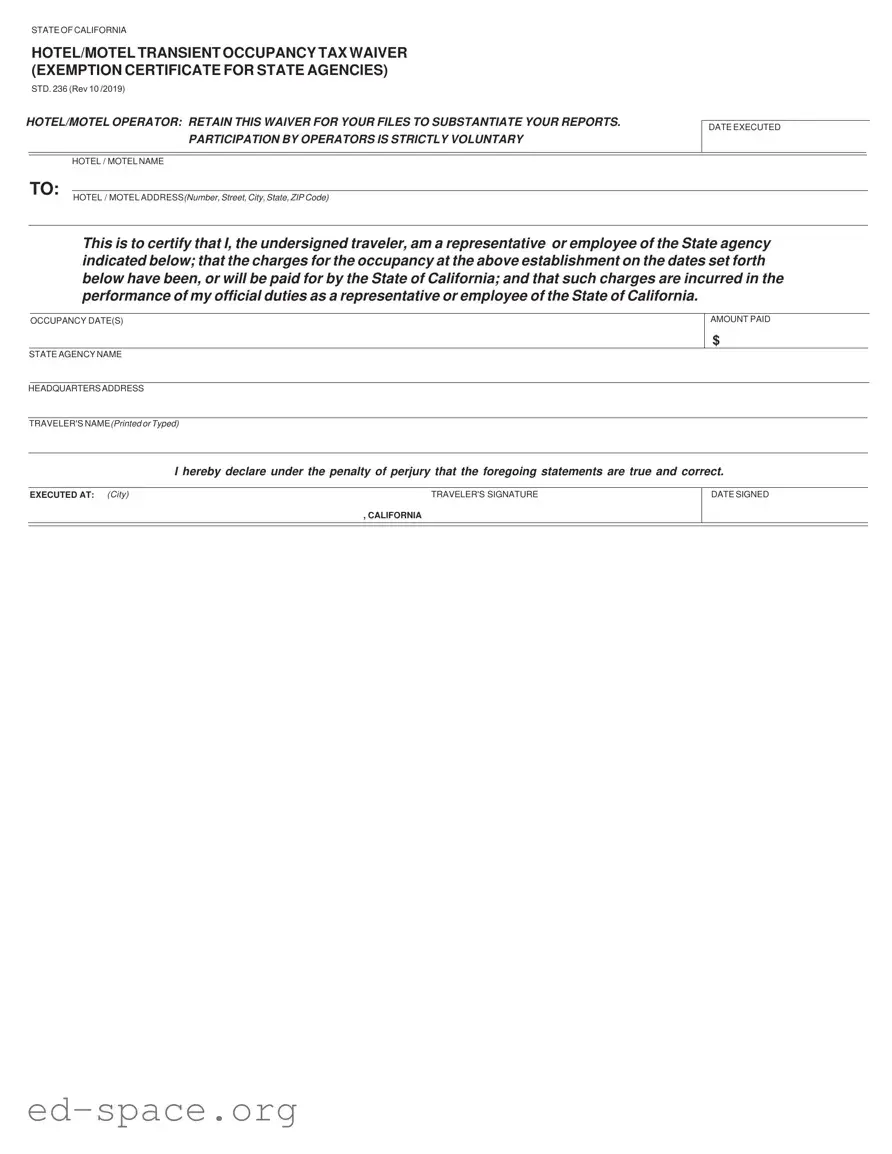
The California Std 236 form serves as an essential tool for state employees and agencies when it comes to managing transient occupancy taxes for hotel and motel stays. Designed specifically for state agency representatives, this form allows for a waiver of the transient occupancy tax, ensuring that state funds are used efficiently during official travel. The form captures crucial information, including the hotel or motel name and address, the dates of occupancy, and the name of the state agency responsible for payment. Travelers must certify that their stay is related to their official duties, and by signing the form, they affirm the accuracy of the provided details under penalty of perjury. This process not only streamlines tax exemption claims but also helps hotel and motel operators maintain accurate records for their reports. Participation in this program is voluntary for operators, yet retaining the waiver is critical for substantiating tax exemption claims. Overall, the Std 236 form reflects California's commitment to facilitating efficient travel for state employees while ensuring compliance with tax regulations.
STATE OF CALIFORNIA
HOTEL/MOTEL TRANSIENT OCCUPANCY TAX WAIVER (EXEMPTION CERTIFICATE FOR STATE AGENCIES)
STD. 236 (Rev 10 /2019)
HOTEL/MOTEL OPERATOR: RETAIN THIS WAIVER FOR YOUR FILES TO SUBSTANTIATE YOUR REPORTS. |
|
|
|
DATE EXECUTED |
|
||
|
|
|
|
|
PARTICIPATION BY OPERATORS IS STRICTLY VOLUNTARY |
|
|
|
|
|
|
|
|
|
|
|
HOTEL / MOTEL NAME |
|
|
TO:
HOTEL / MOTEL ADDRESS(Number, Street, City, State, ZIP Code)
This is to certify that I, the undersigned traveler, am a representative or employee of the State agency indicated below; that the charges for the occupancy at the above establishment on the dates set forth below have been, or will be paid for by the State of California; and that such charges are incurred in the performance of my official duties as a representative or employee of the State of California.
OCCUPANCY DATE(S)
STATE AGENCY NAME
AMOUNT PAID
$
HEADQUARTERS ADDRESS
TRAVELER'S NAME(Printed or Typed)
I hereby declare under the penalty of perjury that the foregoing statements are true and correct.
EXECUTED AT: (City) |
TRAVELER'S SIGNATURE |
DATE SIGNED
, CALIFORNIA
| Fact Name | Details |
|---|---|
| Form Purpose | This form is used to waive the transient occupancy tax for state agencies when they stay at hotels or motels in California. |
| Governing Law | The use of this form is governed by California Revenue and Taxation Code Section 7280. |
| Voluntary Participation | Participation by hotel and motel operators in accepting this waiver is strictly voluntary. |
| Retention Requirement | Hotel and motel operators must retain this waiver for their records to substantiate their tax reports. |
| Execution Date | The form must include the date it was executed by the traveler. |
| Traveler Declaration | The traveler must declare under penalty of perjury that the information provided is true and correct. |
| Signature Requirement | The traveler is required to sign and date the form to validate the waiver. |
Completing the California Std 236 form is a straightforward process that requires specific information about your stay and your role as a representative of a State agency. Once you fill out this form, it will serve as a certification for your hotel or motel stay, indicating that the charges will be covered by the State of California. Follow the steps below to ensure that all necessary information is accurately provided.
What is the California Std 236 form?
The California Std 236 form, also known as the Hotel/Motel Transient Occupancy Tax Waiver, is a certificate used by state agency employees when they stay at hotels or motels for official business. This form allows the traveler to certify that their lodging expenses will be covered by the State of California, thus exempting them from paying the transient occupancy tax typically charged by hotels and motels.
Who is eligible to use the Std 236 form?
Only employees or representatives of state agencies in California can use the Std 236 form. To qualify, the traveler must be on official state business, and the hotel or motel charges must be paid for by the state agency. It’s important for travelers to ensure they are acting within the scope of their duties to utilize this waiver correctly.
How should the form be filled out?
The form must be completed by the state employee or representative staying at the hotel or motel. Key information includes the hotel or motel name and address, the dates of occupancy, the name of the state agency, and the amount paid for the stay. The traveler must also sign the form, declaring that the information provided is true and correct under penalty of perjury. Proper completion is essential for the waiver to be valid.
What should hotel or motel operators do with the Std 236 form?
Hotel and motel operators should retain the completed Std 236 form in their records. This documentation is important as it substantiates the operator’s reports regarding transient occupancy tax exemptions. Keeping this form on file helps ensure compliance with state regulations and can be useful in case of audits or inquiries.
Is participation in using the Std 236 form mandatory for hotel/motel operators?
No, participation by hotel and motel operators in accepting the Std 236 form is strictly voluntary. Operators can choose whether or not to accept the tax waiver. However, if they do accept it, they must follow the proper procedures for retaining the form as part of their financial records.
Omitting Required Information: One common mistake is failing to fill in all the necessary fields. Each section of the California Std 236 form is essential for validating the tax waiver. Incomplete forms may lead to delays or rejection of the application.
Incorrect Dates: Travelers sometimes enter the wrong occupancy dates. This can create confusion and may result in the form being deemed invalid. It is crucial to double-check the dates to ensure they align with the stay at the hotel or motel.
Not Including the Correct State Agency Name: Filling in the name of the state agency inaccurately is another frequent error. It is important to ensure that the agency name matches exactly as it is registered. Any discrepancies can lead to complications in processing the waiver.
Signature Issues: Some individuals forget to sign the form or may not sign in the designated area. A missing signature can invalidate the entire waiver. Always ensure that the signature is provided and that it matches the printed name.
Failure to Retain Copies: After submitting the form, travelers often neglect to keep a copy for their records. Retaining a copy is vital for personal documentation and may be necessary for future reference or audits.
The California Std 236 form serves as a waiver for the transient occupancy tax for state agency employees staying at hotels or motels. This form is often accompanied by several other documents that help substantiate the travel and lodging arrangements made by state employees. Below is a list of related forms and documents commonly used in conjunction with the Std 236 form.
Each of these documents plays a crucial role in ensuring transparency, accountability, and compliance with state travel regulations. Together, they facilitate a smooth process for state employees as they fulfill their official duties while traveling.
The California Std 236 form serves as a waiver for transient occupancy tax for state agencies. It has similarities with several other documents commonly used in various contexts. Here are four documents that share characteristics with the California Std 236 form:
When filling out the California Std 236 form, it's important to ensure accuracy and compliance. Here are five essential do's and don'ts to guide you through the process.
Understanding the California Std 236 form can be crucial for both hotel operators and state employees. However, several misconceptions often arise about this document. Here’s a breakdown of eight common misunderstandings:
Clearing up these misconceptions can help ensure that both hotel operators and state employees navigate the process smoothly. Always refer to the most current guidelines to stay informed.
Filling out the California Std 236 form correctly is essential for ensuring compliance and avoiding unnecessary taxes. Here are some key takeaways: