In California, managing the estate of a deceased loved one can often feel overwhelming, especially when it comes to navigating the legal requirements. For those dealing with smaller estates, the California Small Estate Affidavit offers a streamlined way to transfer assets without the lengthy and costly process of probate. This form is designed for estates valued at $166,250 or less, making it an invaluable tool for families and individuals looking to settle affairs quickly and efficiently. By using this affidavit, heirs can claim personal property, bank accounts, and other assets directly, provided they meet certain eligibility criteria. The process requires the completion of the affidavit, which must include information about the deceased, a description of the assets, and confirmation that no probate proceedings are pending. Additionally, it’s important to note that all interested parties must agree to the use of this affidavit, ensuring that the transfer of assets is both fair and transparent. Understanding how to properly complete and submit this form can significantly ease the burden during a challenging time, allowing loved ones to focus on healing and remembrance.
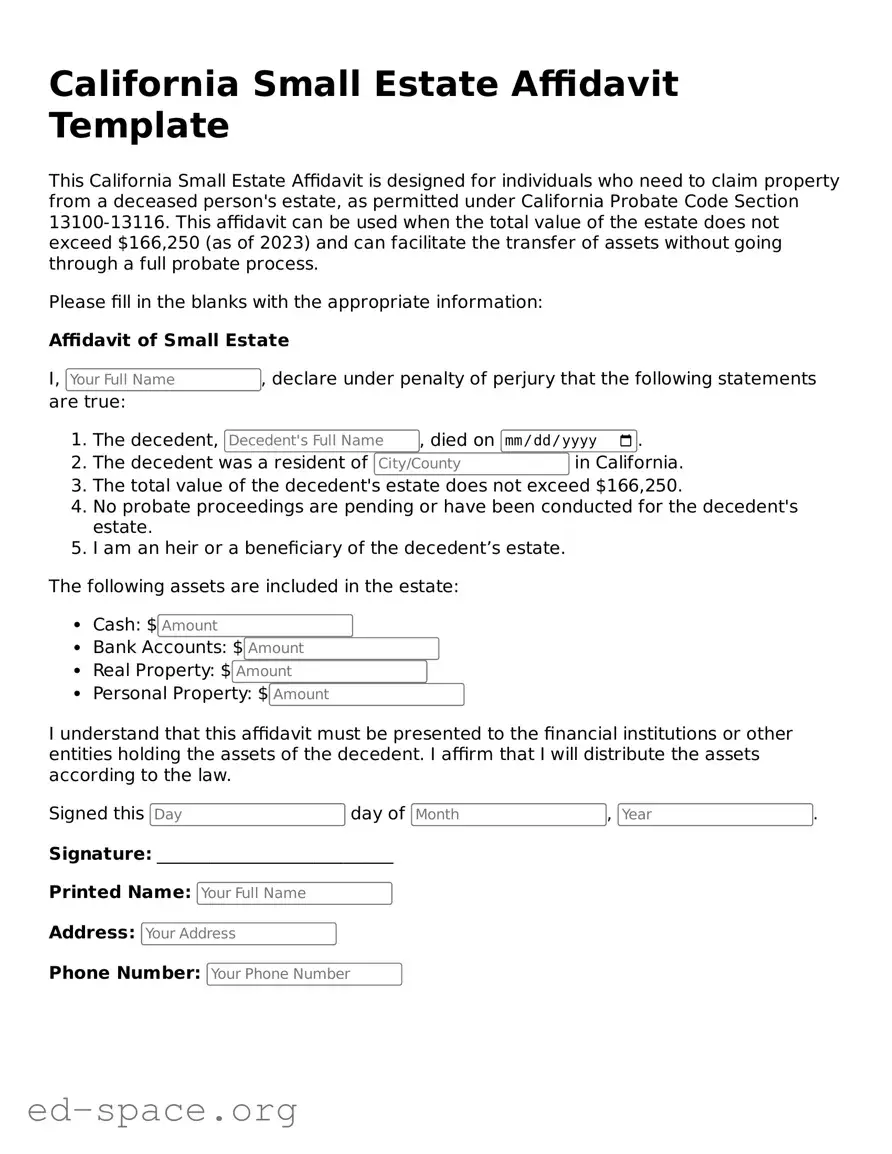
California Small Estate Affidavit Template
This California Small Estate Affidavit is designed for individuals who need to claim property from a deceased person's estate, as permitted under California Probate Code Section 13100-13116. This affidavit can be used when the total value of the estate does not exceed $166,250 (as of 2023) and can facilitate the transfer of assets without going through a full probate process.
Please fill in the blanks with the appropriate information:
Affidavit of Small Estate
I, , declare under penalty of perjury that the following statements are true:
The following assets are included in the estate:
I understand that this affidavit must be presented to the financial institutions or other entities holding the assets of the decedent. I affirm that I will distribute the assets according to the law.
Signed this day of , .
Signature: ___________________________
Printed Name:
Address:
Phone Number:
| Fact Name | Description |
|---|---|
| Purpose | The California Small Estate Affidavit allows heirs to claim assets of a deceased person without going through probate, provided the estate meets certain criteria. |
| Eligibility | The total value of the estate must be $166,250 or less, excluding certain assets like real property. |
| Governing Law | The form is governed by California Probate Code Section 13000 et seq. |
| Required Information | Affidavit must include details such as the decedent's name, date of death, and a list of assets. |
| Signatures | The affidavit must be signed by the claimant and typically requires notarization to validate the document. |
| Filing Location | The completed affidavit is presented to the financial institution or entity holding the assets, rather than filed with the court. |
| Limitations | This affidavit cannot be used for estates that include real property or if the decedent had a will that dictates otherwise. |
Once you have the California Small Estate Affidavit form ready, you will need to fill it out carefully. This form is used to claim assets of a deceased person when the total value is below a certain threshold. Follow these steps to complete the form accurately.
After completing the form, you will need to file it with the appropriate court or institution to begin the process of claiming the assets. Be sure to keep copies of all documents for your records.
What is a California Small Estate Affidavit?
The California Small Estate Affidavit is a legal document that allows individuals to claim assets of a deceased person without going through the lengthy probate process. This form is typically used when the total value of the deceased's assets is below a specific threshold, which is currently set at $166,250 as of January 2023. It streamlines the transfer of property and helps beneficiaries access the deceased's assets more quickly.
Who can use the Small Estate Affidavit?
Any individual who is a beneficiary or heir of the deceased can use the Small Estate Affidavit, provided they meet certain criteria. The individual must be entitled to inherit under California law, and they must not be the executor of a probate estate. Additionally, the deceased must have been a resident of California at the time of death.
What types of assets can be claimed using the Small Estate Affidavit?
Assets that can be claimed include bank accounts, personal property, and vehicles. However, real estate cannot be transferred using this affidavit. It's important to note that the total value of all assets must not exceed the established threshold to qualify for this process.
How do I complete the Small Estate Affidavit?
To complete the Small Estate Affidavit, you will need to fill out the appropriate form, which can be obtained from a local courthouse or online. The form requires information about the deceased, the claimant, and the assets being claimed. Ensure that you provide accurate details and sign the affidavit in front of a notary public to validate it.
What happens after I submit the Small Estate Affidavit?
Once the Small Estate Affidavit is submitted to the appropriate financial institutions or asset holders, they will review the document. If everything is in order, they will release the assets to the claimant. This process can take some time, depending on the institution's policies and procedures.
Is there a deadline for filing a Small Estate Affidavit?
There is no strict deadline for filing a Small Estate Affidavit. However, it is advisable to file it as soon as possible after the death of the individual. Delays can complicate matters, especially if there are other potential heirs or creditors involved.
Can I use the Small Estate Affidavit if there is a will?
Yes, you can use the Small Estate Affidavit even if there is a will. However, if the will names an executor, that person may need to initiate the probate process instead. If the will is not being probated and the total value of the estate qualifies, the Small Estate Affidavit can be a suitable option.
What if there are disputes among heirs regarding the Small Estate Affidavit?
If disputes arise among heirs, it may complicate the use of the Small Estate Affidavit. It’s advisable to communicate openly with all parties involved. In some cases, seeking legal advice or mediation may be necessary to resolve conflicts before proceeding with the affidavit.
Incorrectly estimating the value of the estate: One common mistake is undervaluing or overvaluing the assets. The total value must not exceed the threshold set by California law, which is currently $166,250. Failing to accurately assess the value can lead to complications in the probate process.
Not including all relevant assets: People often forget to list certain assets. This can include bank accounts, vehicles, or personal property. It’s crucial to ensure that all assets owned by the deceased are included to avoid potential legal issues later.
Inaccurate information about heirs: Mistakes can occur when identifying heirs. It’s essential to provide correct names and addresses. Misidentifying heirs can delay the process and may lead to disputes among family members.
Failing to sign the affidavit: A simple yet significant error is neglecting to sign the affidavit. Without a signature, the form is not valid. This oversight can cause unnecessary delays in settling the estate.
The California Small Estate Affidavit is a useful tool for individuals looking to settle the estate of a deceased person without going through a lengthy probate process. However, several other forms and documents may be necessary to ensure a smooth transition of assets. Below is a list of commonly used documents that complement the Small Estate Affidavit.
Gathering these documents can significantly ease the process of settling an estate. Each plays a vital role in ensuring that the wishes of the deceased are honored and that the beneficiaries receive their rightful inheritance without unnecessary complications.
The Small Estate Affidavit is a legal document used to simplify the process of settling a deceased person's estate when the estate's value falls below a certain threshold. Several other documents serve similar purposes in estate management and probate processes. Below is a list of seven documents that share similarities with the Small Estate Affidavit:
Filling out the California Small Estate Affidavit form requires careful attention to detail. Here are some important dos and don'ts to keep in mind:
When it comes to the California Small Estate Affidavit, many people hold misconceptions that can lead to confusion and missteps. Understanding the truth behind these myths can help ensure a smoother process for settling small estates. Here are six common misconceptions:
By dispelling these misconceptions, individuals can approach the Small Estate Affidavit process with greater clarity and confidence. Proper understanding leads to better decision-making, ultimately easing the burden during what can be a challenging time.
When dealing with the California Small Estate Affidavit form, it's important to understand the key aspects to ensure a smooth process. Here are some essential takeaways: