In the realm of estate planning, the California Self-Proving Affidavit plays a crucial role in simplifying the probate process for individuals and their families. This legal document serves as a powerful tool, allowing a will to be validated without the need for witnesses to testify in court. When executed correctly, it provides a layer of assurance that the testator— the person who created the will— was of sound mind and acted voluntarily. This affidavit must be signed by the testator and at least two witnesses, all of whom must affirm their identities and the circumstances surrounding the will's creation. By incorporating this form into estate planning, individuals can save their loved ones time, stress, and potential disputes during what is often a challenging period. Understanding the nuances of this affidavit not only empowers individuals to make informed decisions but also fosters peace of mind, knowing that their wishes will be honored in a legally recognized manner.
California Self-Proving Affidavit
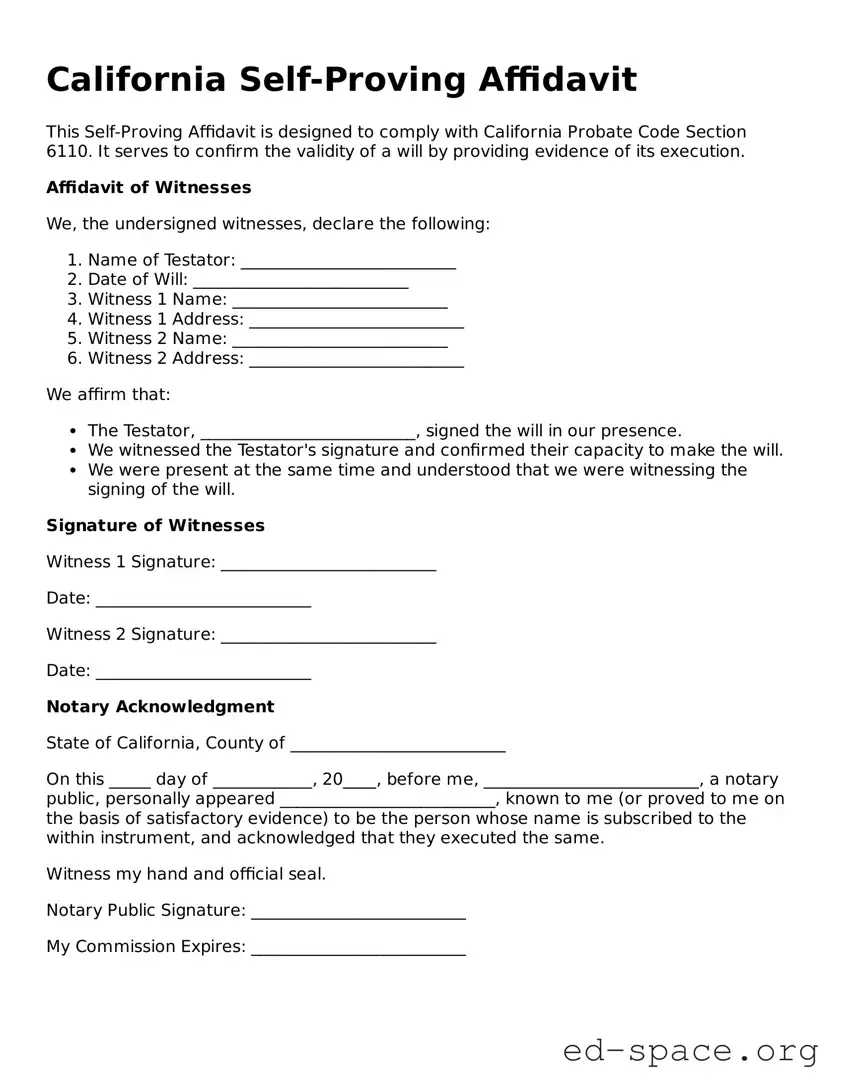
This Self-Proving Affidavit is designed to comply with California Probate Code Section 6110. It serves to confirm the validity of a will by providing evidence of its execution.
Affidavit of Witnesses
We, the undersigned witnesses, declare the following:
We affirm that:
Signature of Witnesses
Witness 1 Signature: __________________________
Date: __________________________
Witness 2 Signature: __________________________
Date: __________________________
Notary Acknowledgment
State of California, County of __________________________
On this _____ day of ____________, 20____, before me, __________________________, a notary public, personally appeared __________________________, known to me (or proved to me on the basis of satisfactory evidence) to be the person whose name is subscribed to the within instrument, and acknowledged that they executed the same.
Witness my hand and official seal.
Notary Public Signature: __________________________
My Commission Expires: __________________________
| Fact Name | Description |
|---|---|
| Purpose | The California Self-Proving Affidavit allows a will to be validated without the need for witnesses to testify in court, simplifying the probate process. |
| Governing Law | This form is governed by California Probate Code Section 6110, which outlines the requirements for a valid will and self-proving affidavits. |
| Signatories | The affidavit must be signed by the testator (the person making the will) and at least two witnesses, all of whom must be present at the same time. |
| Effectiveness | Once completed and notarized, the self-proving affidavit can expedite the probate process by eliminating the need for witness testimony regarding the will's validity. |
Once you have gathered the necessary information and documents, you are ready to fill out the California Self-Proving Affidavit form. This form will require specific details about the will and the witnesses. After completing the form, it will be ready for signing and notarization.
What is a California Self-Proving Affidavit?
A California Self-Proving Affidavit is a legal document that allows a will to be validated without the need for witnesses to testify in court. This affidavit is typically signed by the testator (the person who created the will) and witnesses, affirming that they witnessed the signing of the will and that the testator was of sound mind at the time of signing. It simplifies the probate process by providing a clear statement of the will's authenticity.
Why should I use a Self-Proving Affidavit?
Using a Self-Proving Affidavit can significantly streamline the probate process. When a will includes this affidavit, the court can accept it without requiring the witnesses to appear and testify. This can save time and reduce potential disputes among heirs, as the affidavit serves as strong evidence of the will's validity.
Who can sign the Self-Proving Affidavit?
The Self-Proving Affidavit must be signed by the testator and at least two witnesses. The witnesses should be individuals who are not beneficiaries of the will to avoid any conflicts of interest. It is essential that all parties involved understand the significance of the document they are signing.
How do I complete a Self-Proving Affidavit?
To complete a Self-Proving Affidavit, you need to fill out the form with the necessary information, including the names of the testator and witnesses, the date of signing, and a statement confirming that the testator was of sound mind. After filling out the form, all parties must sign it in the presence of a notary public to ensure its legal validity.
Is a Self-Proving Affidavit required in California?
No, a Self-Proving Affidavit is not required in California. However, it is highly recommended. While a will can still be valid without this affidavit, including one can make the probate process easier and more efficient, reducing the likelihood of challenges to the will's validity.
What happens if I don’t have a Self-Proving Affidavit?
If a will does not include a Self-Proving Affidavit, the court may require the witnesses to testify about the will's authenticity during probate. This can lead to delays, additional costs, and potential disputes among heirs. Without the affidavit, proving the will's validity may be more complicated.
Can I revoke a Self-Proving Affidavit?
A Self-Proving Affidavit can be revoked if the testator decides to change their will. When a new will is created, it should include a new Self-Proving Affidavit. It is important to ensure that any previous wills are properly revoked to avoid confusion during probate.
Where should I store my Self-Proving Affidavit?
It is advisable to store the Self-Proving Affidavit along with the original will in a safe place, such as a safe deposit box or a fireproof safe at home. Inform trusted family members or an attorney about its location. This ensures that the document is accessible when needed during the probate process.
Not including all required signatures. Ensure that both the testator and witnesses sign the affidavit.
Failing to date the document. A missing date can lead to confusion about when the affidavit was executed.
Using incorrect witness information. Witnesses must be of legal age and competent to testify.
Not providing a clear statement of the testator's intent. The affidavit should clearly indicate the testator's wishes regarding their will.
Overlooking state-specific requirements. Each state has unique laws; ensure compliance with California’s specific rules.
Neglecting to notarize the affidavit. Notarization may be required to validate the document in certain situations.
Using outdated forms. Always use the most current version of the Self-Proving Affidavit form.
Failing to keep copies. Retain copies of the signed affidavit for your records and for the estate’s executor.
Not reviewing for errors. Typos or unclear language can lead to misunderstandings and legal issues.
Assuming the affidavit is unnecessary. Understand the importance of this document in simplifying the probate process.
The California Self-Proving Affidavit form is often used in conjunction with several other documents to ensure the validity and proper execution of a will. Below is a list of related forms and documents that may be utilized alongside the Self-Proving Affidavit.
These documents work together to ensure that an individual's estate planning is comprehensive and legally sound. Proper execution and understanding of each document are essential for effective estate management.
The Self-Proving Affidavit is an important legal document that helps streamline the probate process by affirming the validity of a will. There are several other documents that serve similar purposes in estate planning and legal proceedings. Below is a list of seven documents that share similarities with the Self-Proving Affidavit:
When filling out the California Self-Proving Affidavit form, it's essential to follow certain guidelines to ensure accuracy and compliance. Here’s a straightforward list of what you should and shouldn’t do:
Following these guidelines can help prevent delays and ensure that your affidavit is valid. Take the time to review your work before submission.
Understanding the California Self-Proving Affidavit form is essential for anyone involved in estate planning or the probate process. However, several misconceptions often arise regarding this important document. Here are seven common misunderstandings:
Many people believe that a Self-Proving Affidavit is required for all wills in California. In reality, while it can simplify the probate process, it is not mandatory. A will can still be valid without this affidavit, although it may require additional proof of the testator's intent.
Some think that only holographic or handwritten wills can include a Self-Proving Affidavit. In fact, this affidavit can be used with any valid will, whether it is handwritten or typed, as long as it meets the legal requirements.
While it is true that a notary public must witness the signing of the Self-Proving Affidavit, many people mistakenly believe that the will itself must also be notarized. In California, the will can be valid without notarization if it is properly witnessed.
It is a common belief that all witnesses must sign the Self-Proving Affidavit simultaneously. However, California law allows witnesses to sign at different times, as long as the affidavit is executed correctly.
Many assume that the Self-Proving Affidavit only serves a purpose during the probate process. In reality, it can also help establish the validity of a will in various situations, such as when a dispute arises among heirs or beneficiaries.
Some individuals think that once a Self-Proving Affidavit is signed, it is set in stone. However, it can be amended or revoked if necessary, as long as the changes comply with legal requirements.
There is a misconception that only wealthy individuals need a Self-Proving Affidavit. In truth, anyone who wants to ensure their wishes are honored after their passing can benefit from this document, regardless of their financial status.
By addressing these misconceptions, individuals can better navigate the complexities of estate planning and ensure that their intentions are clearly documented and legally recognized.
When dealing with the California Self-Proving Affidavit form, understanding its purpose and proper use is essential. Here are some key takeaways:
Using the Self-Proving Affidavit can save time and resources, ensuring that your wishes are honored after your passing.