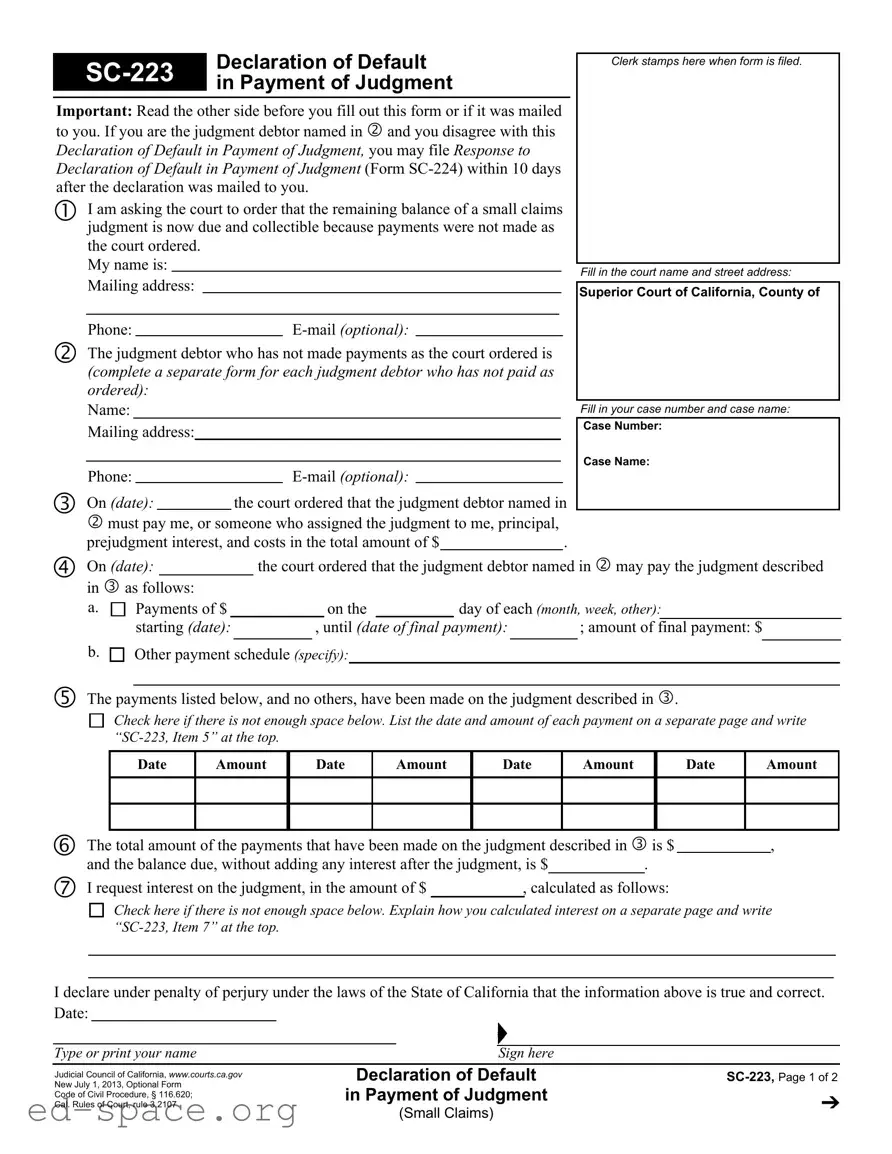
The California SC-223 form, known as the Declaration of Default in Payment of Judgment, serves a crucial role in the small claims process. When a judgment debtor fails to adhere to a court-ordered payment schedule, this form allows the judgment creditor to formally request that the remaining balance of the judgment be declared due and collectible. The form requires specific information, including the names and addresses of both parties, the case number, and details about the payment history. It outlines the total amount due, any interest calculated, and the dates of missed payments. Importantly, if the judgment debtor disagrees with the declaration, they have a limited window of 10 days to file a response using Form SC-224. This process not only ensures that creditors have a pathway to enforce their rights but also provides debtors with an opportunity to contest claims they believe to be inaccurate. Completing the SC-223 accurately is essential for a smooth resolution, as it sets in motion the court's review and potential hearings related to the payment default.
Declaration of Default |
Clerk stamps here when form is filed. |
||
|
|
||
in Payment of Judgment |
|
||
|
|
|
|
Important: Read the other side before you fill out this form or if it was mailed to you. If you are the judgment debtor named in and you disagree with this Declaration of Default in Payment of Judgment, you may file Response to Declaration of Default in Payment of Judgment (Form
I am asking the court to order that the remaining balance of a small claims judgment is now due and collectible because payments were not made as the court ordered.
My name is: |
|
|
|
|
|
|
|
|
|
|
|
|
|
|
|
Fill in the court name and street address: |
|||
Mailing address: |
|
|
|
|
|
|
|||
|
|
|
|
|
|
|
|||
|
|
|
|
|
|
Superior Court of California, County of |
|||
|
|
|
|
|
|
|
|
|
|
|
|
|
|
|
|
|
|
||
Phone: |
|
|
|
|
|||||
The judgment debtor who has not made payments as the court ordered is (complete a separate form for each judgment debtor who has not paid as ordered):
|
Name: |
|
|
|
|
|
|
|
|
Fill in your case number and case name: |
||
|
Mailing address: |
|
|
|
|
|
|
|
Case Number: |
|||
|
|
|
|
|
|
|
|
|
||||
|
|
|
|
|
|
|
|
|
|
|
|
Case Name: |
|
Phone: |
|
|
|
|
|
|
|||||
|
|
|
|
|
|
|||||||
On (date): |
|
|
the court ordered that the judgment debtor named in |
|
||||||||
|
must pay me, or someone who assigned the judgment to me, principal, |
|
|
|
||||||||
|
prejudgment interest, and costs in the total amount of $ |
|
|
. |
|
|||||||
On (date): the court ordered that the judgment debtor named in may pay the judgment described
in as follows:
a. Payments of $ starting (date):
b. Other payment schedule (specify):
The payments listed below, and no others, have been made on the judgment described in .
Check here if there is not enough space below. List the date and amount of each payment on a separate page and write
Date |
Amount |
Date |
Amount |
Date |
Amount |
Date |
Amount |
|
|
|
|
|
|
|
|
|
|
|
|
|
|
|
|
|
|
|
|
|
|
|
|
The total amount of the payments that have been made on the judgment described in is $ |
, |
|||||
and the balance due, without adding any interest after the judgment, is $ |
|
. |
|
|
||
I request interest on the judgment, in the amount of $ |
, calculated as follows: |
|
|
|||
|
|
|
|
|
|
|
Check here if there is not enough space below. Explain how you calculated interest on a separate page and write
I declare under penalty of perjury under the laws of the State of California that the information above is true and correct. Date:
Type or print your nameSign here
Judicial Council of California, www.courts.ca.gov |
Declaration of Default |
|
|
|
|
New July 1, 2013, Optional Form |
in Payment of Judgment |
|
Code of Civil Procedure, § 116.620; |
|
|
|
|
|
Cal. Rules of Court, rule 3.2107 |
(Small Claims) |
|
|
|

Default in Payments on Small Claims Judgment
General Information
If the court ordered that another plaintiff or defendant (judgment debtor) may pay a small claims judgment in payments, and that judgment debtor has not made the payments as ordered, you can ask the court to order that the full balance of the judgment is due and collectible. Here’s how:
•Read this form.
•Fill out page 1 of Form
•File your completed form(s) with the small claims court clerk.
The court will mail all other plaintiffs and defendants in the case copies of the Declaration and a blank Form
The judgment debtor will have 10 days to file a Response. Then the court will mail all plaintiffs and defendants in the case:
•A decision, or
•A notice to go to a hearing.
If the court ordered that you may make payments on a judgment, and another plaintiff, defendant, or person to whom the judgment has been assigned (judgment creditor) has filed Form
•Read this form and the Declaration.
•If you agree with the court ordering that the amounts claimed in the Declaration are now due in full, you do not need to do anything.
•If you do not agree with the Declaration or with the court ordering that the amounts it claims are now due in full, file a Response within 10 calendar days after the court clerk mailed the Declaration to you. (This date is on the Clerk’s Certificate of Mailing.)
To file your Response:
•Fill out Form
•Have your Response served on the judgment creditor and all other plaintiffs and defendants in your case. (See Form
•File your Response and Proof of Service with the small claims court clerk.
Answers to Common Questions
When is the judgment due?
Unless the court orders otherwise, small claims judgments are due immediately. If the judgment is not paid in full within 30 days, the judgment creditor (person to whom the money is owed) can take legal steps to collect any unpaid amount. (Collection may be postponed if an appeal or a request to vacate (cancel) or correct the judgment is filed.)
When can the judgment debtor make payments? A plaintiff or defendant who was ordered to pay a small claims judgment (judgment debtor) can ask the court for permission to make payments. If the court agrees, the plaintiff or defendant who is owed money (the judgment creditor) cannot take any other steps to collect the money as long as the payments are made on time. If payments are not made on time, the judgment creditor can ask the court to order that the remaining balance of the judgment is due and collectible.
Is interest added after the judgment?
Interest (10 percent per year) is usually added to the unpaid amount of the judgment from the date the judgment is entered until it is paid in full. Interest can only be charged on the unpaid amount of the judgment (the
principal); interest cannot be charged on any unpaid interest. If a partial payment is received, the money is applied first to unpaid interest and then to unpaid principal.
When the court allows payments, the court often does not order any interest, as long as all payments are made in full and on time. Unless the judgment creditor asks for interest to be included in the order allowing payments, the judgment creditor may lose any claims for interest. But if the judgment debtor does not make full payments on time, interest on the missed payment or the entire unpaid balance might become due and collectible.
How do I calculate interest?
If you are asking for interest or disagreeing with a request for interest, you need to explain your interest calculation. Interest, at the rate of 10 percent per year (.0274 percent per day), may be added to the full unpaid balance of the judgment or only to payments that were not made on time. To calculate interest, show the unpaid principal balance, the dates and number of days you want the court to allow interest on that amount, and the total interest for that period. If payments were made, you will need to make separate calculations for the reduced principal balance after each payment.
|
Need help? |
|
|
For free help, contact your county’s small claims advisor: |
|
|
[local info here] |
|
|
Or go to www.courts.ca.gov/smallclaims/advisor |
|
|
|
|
New July 1, 2013 |
Declaration of Default in Payment of Judgment |
|
|
|
(Small Claims)
| Fact Name | Fact Description |
|---|---|
| Form Title | SC-223 Declaration of Default in Payment of Judgment |
| Governing Law | California Code of Civil Procedure, § 116.620; Cal. Rules of Court, rule 3.2107 |
| Purpose | This form is used to request the court to declare that the remaining balance of a small claims judgment is due because payments were not made as ordered. |
| Response Deadline | The judgment debtor has 10 days to file a Response to the Declaration after it is mailed. |
| Payment Information | Judgment creditors must list payments made on the judgment and can request interest on the unpaid balance. |
| Interest Rate | Interest is typically calculated at 10 percent per year on the unpaid amount from the date the judgment is entered. |
| Form Filing | Completed forms must be filed with the small claims court clerk to initiate the process. |
| Additional Forms | If the judgment debtor disagrees, they must file Form SC-224, Response to Declaration of Default in Payment of Judgment. |
Filling out the California SC-223 form is a straightforward process that allows you to declare a default in payment of a small claims judgment. Once you have completed the form, you will need to file it with the small claims court clerk. The court will then notify all parties involved about the declaration, and they will have the opportunity to respond.
What is the purpose of the California SC-223 form?
The California SC-223 form, known as the Declaration of Default in Payment of Judgment, is used by a judgment creditor to request the court to declare that the full balance of a small claims judgment is now due and collectible. This situation arises when the judgment debtor fails to make the payments as ordered by the court. By filing this form, the creditor can initiate legal proceedings to collect the remaining balance, which may include principal, interest, and costs associated with the judgment.
What happens after I file the SC-223 form?
Once the SC-223 form is filed with the small claims court clerk, the court will mail copies of the Declaration to all other plaintiffs and defendants involved in the case. This includes a blank Form SC-224, which the judgment debtor can use to respond. The judgment debtor has 10 days from the date the Declaration was mailed to file a response. Following this period, the court will either issue a decision or notify the parties of a scheduled hearing regarding the matter.
Can a judgment debtor request to make payments on the judgment?
Yes, a judgment debtor can request the court's permission to make payments on a small claims judgment. If the court grants this request, the judgment creditor must refrain from taking further collection actions as long as the debtor adheres to the agreed payment schedule. However, if the debtor fails to make payments on time, the creditor can then file the SC-223 form to seek the full balance due and collectible.
How is interest calculated on a judgment?
Interest on a small claims judgment is typically calculated at a rate of 10 percent per year, accruing from the date the judgment is entered until it is fully paid. The interest is applied only to the unpaid principal amount. If partial payments are made, those payments first cover any accrued interest before being applied to the principal. If the court allows payments, it may not include interest as long as the debtor makes all payments on time. However, if payments are missed, the creditor may reclaim interest on the unpaid balance.
Failing to read the instructions on the back of the form before filling it out. Understanding the requirements is essential for proper completion.
Not including all required information about the judgment debtor. Each debtor must be listed on a separate form.
Incorrectly filling out the case number or case name. This information must match the court records.
Leaving out the total amount of payments made. Ensure this figure is accurate and clearly stated.
Not specifying the payment schedule correctly. Clearly outline the amount and dates of payments.
Failing to calculate interest accurately. If interest is requested, provide a clear explanation of how it was calculated.
Not signing the form. A signature is required to validate the declaration.
Submitting the form after the deadline. Ensure it is filed within the required time frame to avoid delays.
Not providing contact information, such as phone number or email. This information helps the court and other parties to communicate.
Neglecting to include additional pages when necessary. If there is not enough space for payments or interest calculations, attach separate pages as instructed.
The California SC-223 form is used to declare a default in payment of a small claims judgment. Alongside this form, several other documents may be necessary to support your case or respond to the declaration. Below is a list of these forms, each with a brief description.
Understanding these forms and their purposes can greatly assist in navigating the small claims process. Properly completing and submitting the necessary documents ensures that your case is handled efficiently and fairly.
The California SC-223 form, known as the Declaration of Default in Payment of Judgment, has similarities with several other legal documents related to small claims and judgments. Below are five documents that share characteristics with the SC-223 form:
When filling out the California SC-223 form, it is essential to follow specific guidelines to ensure your submission is accurate and effective. Below is a list of things you should and shouldn't do.
Understanding the California SC-223 form is crucial for both judgment creditors and debtors. However, several misconceptions often arise regarding its purpose and use. Below is a list of eight common misunderstandings.
Clarifying these misconceptions can help both creditors and debtors navigate the legal process more effectively. Understanding the SC-223 form and its implications is essential for ensuring that rights and responsibilities are upheld.
Here are key takeaways regarding the California SC-223 form: