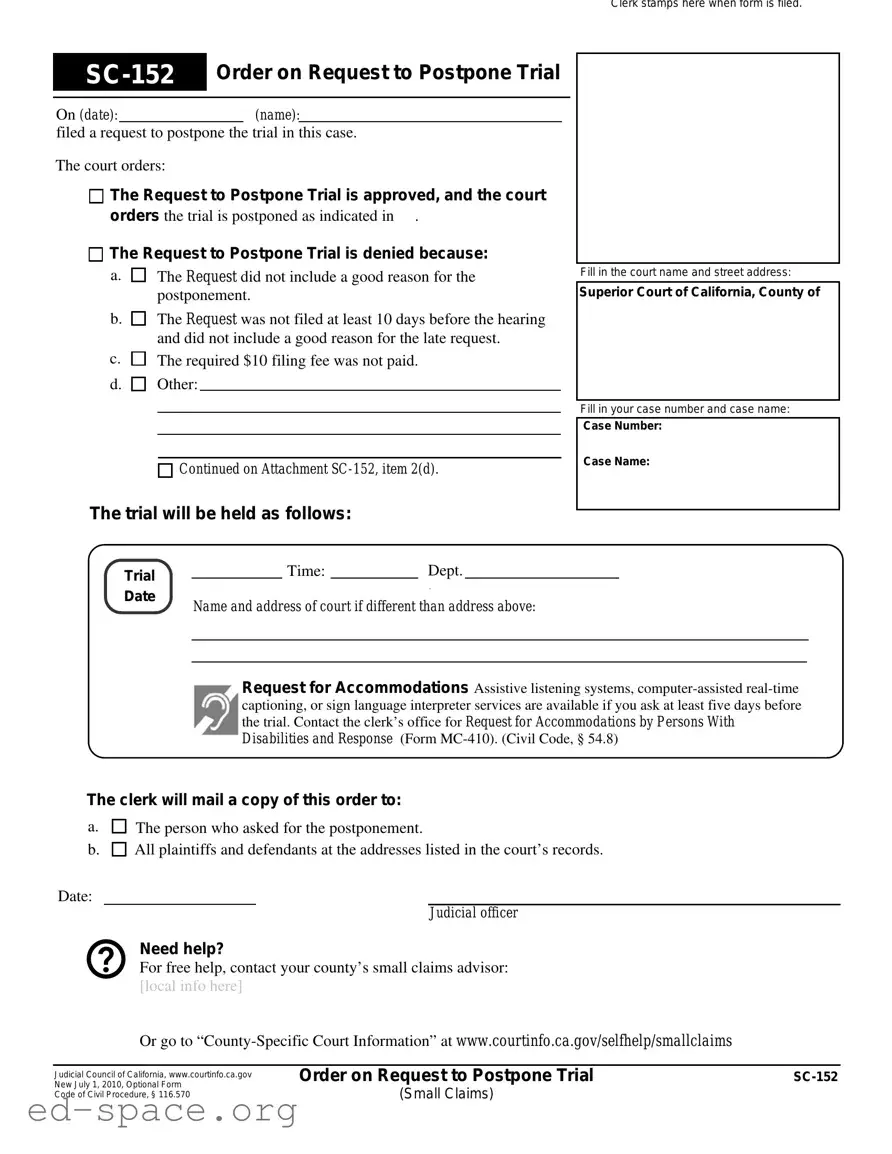
The California SC-152 form, known as the Order on Request to Postpone Trial, plays a crucial role in the small claims process. It is utilized when a party seeks to delay a scheduled trial date. The form addresses several key aspects, including the approval or denial of the postponement request. A request may be approved if the court finds sufficient justification, while denial can occur for various reasons, such as lack of a valid reason, failure to submit the request at least ten days prior to the hearing, or non-payment of the required filing fee. Additionally, the form outlines the new trial date and time if the request is granted. It also provides information on accommodations for individuals with disabilities, ensuring accessibility in court proceedings. The court clerk is responsible for mailing a copy of the order to all relevant parties, including the individual who requested the postponement. This form is essential for maintaining the integrity of the trial schedule while accommodating the needs of the involved parties.
Order on Request to Postpone Trial |
|||||
|
|
|
|
|
|
On (date): |
|
|
(name): |
||
|
|
|
|
|
|
filed a request to postpone the trial in this case.
The court orders:
| The Request to Postpone Trial is approved, and the court orders the trial is postponed as indicated in ¡.
~ The Request to Postpone Trial is denied because:
a. The Request did not include a good reason for the postponement.
b. The Request was not filed at least 10 days before the hearing and did not include a good reason for the late request.
c. The required $10 filing fee was not paid.
d. Other:
Continued on Attachment
¡The trial will be held as follows:
Clerk stamps here when form is filed.
Fill in the court name and street address:
Superior Court of California, County of
Fill in your case number and case name:
Case Number:
Case Name:
HearingTrial î Date
Time:Dept.
:
Name and address of court if different than address above:
Request for Accommodations Assistive listening systems,
¢The clerk will mail a copy of this order to:
a.
The person who asked for the postponement.
b.
Date:
All plaintiffs and defendants at the addresses listed in the court’s records.
Judicial officer
Need help?
For free help, contact your county’s small claims advisor: [local info here]
Or go to
Judicial Council of California, www.courtinfo.ca.gov New July 1, 2010, Optional Form
Code of Civil Procedure, § 116.570
Order on Request to Postpone Trial |
(Small Claims)
| Fact Name | Description |
|---|---|
| Purpose of SC-152 | The SC-152 form is used to request a postponement of a trial in small claims cases in California. |
| Filing Deadline | The request to postpone must be filed at least 10 days before the scheduled hearing to be considered valid. |
| Reasons for Denial | The court may deny the request if it lacks a good reason, is filed late without justification, or if the required $10 filing fee is not paid. |
| Notification Process | The clerk will mail a copy of the order to all parties involved, including the individual who requested the postponement. |
| Accommodations Available | Assistive listening systems, captioning, and sign language interpreter services can be requested at least five days before the trial. |
| Governing Law | The SC-152 form is governed by the Code of Civil Procedure, § 116.570, and Civil Code, § 54.8. |
Completing the California SC-152 form is essential for requesting a postponement of your trial. Follow these steps carefully to ensure your form is filled out correctly.
Once you have completed the form, it will be processed by the court. The clerk will mail a copy of the order to all relevant parties. If you have any questions or need assistance, consider reaching out to your county’s small claims advisor or visiting the provided website for more information.
What is the purpose of the California SC-152 form?
The California SC-152 form is used to request a postponement of a trial in small claims court. If a party needs more time to prepare or has a valid reason for not being able to attend the scheduled trial date, they can submit this form. The court will review the request and decide whether to approve or deny it based on the reasons provided and the timing of the request.
What reasons might lead to a denial of the request to postpone a trial?
There are several reasons why a request to postpone a trial may be denied. First, if the request does not include a good reason for the postponement, it is likely to be rejected. Additionally, if the request is filed less than 10 days before the hearing without a valid explanation for the late submission, the court may deny it. Lastly, failure to pay the required $10 filing fee can also result in a denial. If any other specific issues arise, they will be noted in the order on the form.
How will I know if my request to postpone the trial has been approved?
If the court approves your request, they will issue an order stating that the trial has been postponed. The order will include details about the new trial date and time. The court clerk will mail a copy of this order to you and all parties involved in the case, ensuring everyone is informed of the changes. If the request is denied, the order will specify the reasons for the denial.
What accommodations are available for individuals with disabilities?
The court provides various accommodations for individuals with disabilities, such as assistive listening systems, computer-assisted real-time captioning, and sign language interpreter services. To access these services, you must request them at least five days before the trial. You can contact the clerk’s office for more information and to complete the necessary forms for accommodations.
Not providing a valid reason for postponement: The form requires a good reason for the request. Failing to include this information can lead to denial.
Filing the request too late: The request must be submitted at least 10 days before the hearing. Late submissions without a valid reason are likely to be denied.
Neglecting to pay the filing fee: A $10 filing fee is required. Omitting this payment can result in the rejection of the request.
Incorrectly filling out case information: Ensure that the case number and case name are accurate. Errors in this section can cause delays or complications.
Overlooking accommodation requests: If assistance is needed, such as sign language interpretation, it must be requested at least five days in advance. Ignoring this can lead to a lack of necessary support during the trial.
When dealing with small claims in California, understanding the various forms and documents that accompany the SC-152 form can be crucial for a smooth legal process. Below is a list of related forms that you may encounter. Each plays a unique role in the small claims procedure, helping to clarify requests, facilitate communication, and ensure that all parties are informed.
Familiarizing yourself with these forms can significantly streamline your experience in small claims court. Each document serves a specific purpose, ensuring that the legal proceedings are conducted fairly and transparently. Being prepared with the right forms can help you navigate the process more effectively.
The California SC-152 form, which is used to request a postponement of a trial, shares similarities with several other legal documents. Here’s a look at eight of them:
When filling out the California SC-152 form, it's important to follow certain guidelines to ensure your request is processed smoothly. Here are some do's and don'ts to keep in mind:
Understanding the California SC-152 form can be challenging. Here are seven common misconceptions about this form, clarified for better comprehension.
Addressing these misconceptions can help individuals navigate the process more effectively and avoid unnecessary complications.
Filling out and using the California SC-152 form requires attention to detail and understanding of the process. Here are key takeaways to keep in mind:
By keeping these points in mind, you can navigate the process of postponing a trial more effectively.