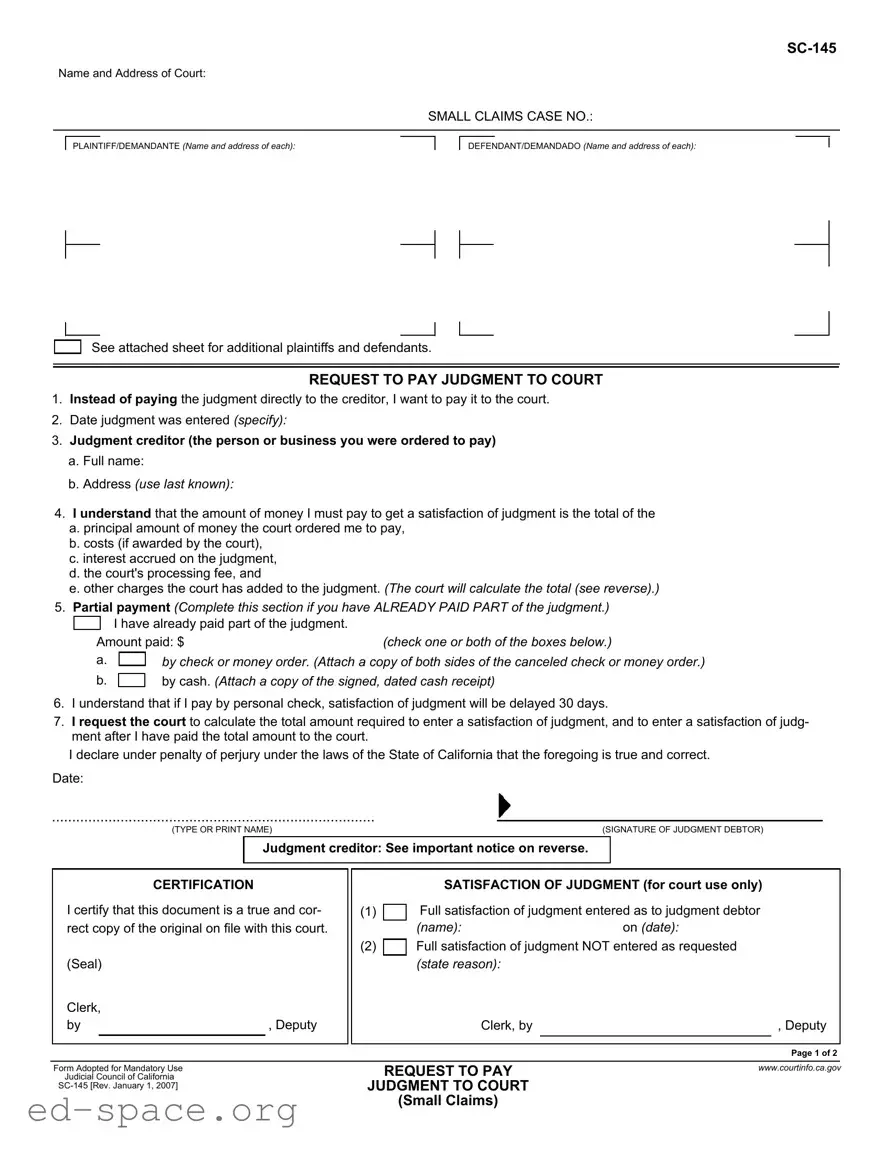
The California SC-145 form serves as a vital tool for individuals navigating the complexities of small claims judgments. Designed to facilitate the process of paying a judgment to the court rather than directly to the creditor, this form outlines several key components that must be addressed. First, it requires the identification of both the plaintiff and defendant, ensuring that all parties involved are clearly documented. Additionally, the form prompts the judgment debtor to specify the date the judgment was entered and to provide the name and last known address of the judgment creditor. Understanding the total amount required for satisfaction of the judgment is crucial; therefore, the form details the various components that contribute to this total, including the principal amount, any awarded costs, accrued interest, and applicable court processing fees. For those who have already made partial payments, the SC-145 allows for documentation of these amounts, emphasizing the importance of transparency in financial transactions. Furthermore, the form includes a certification section, where the judgment debtor affirms the accuracy of the information provided under penalty of perjury. This structured approach not only streamlines the payment process but also ensures that all legal requirements are met, ultimately leading to a clearer resolution for all parties involved.
Name and Address of Court:
SMALL CLAIMS CASE NO.:
PLAINTIFF/DEMANDANTE (Name and address of each):
DEFENDANT/DEMANDADO (Name and address of each):
See attached sheet for additional plaintiffs and defendants.
REQUEST TO PAY JUDGMENT TO COURT
1.Instead of paying the judgment directly to the creditor, I want to pay it to the court.
2.Date judgment was entered (specify):
3.Judgment creditor (the person or business you were ordered to pay)
a.Full name:
b.Address (use last known):
4.I understand that the amount of money I must pay to get a satisfaction of judgment is the total of the
a.principal amount of money the court ordered me to pay,
b.costs (if awarded by the court),
c.interest accrued on the judgment,
d.the court's processing fee, and
e.other charges the court has added to the judgment. (The court will calculate the total (see reverse).)
5.Partial payment (Complete this section if you have ALREADY PAID PART of the judgment.)
I have already paid part of the judgment. |
|
Amount paid: $ |
(check one or both of the boxes below.) |
a.
b.
by check or money order. (Attach a copy of both sides of the canceled check or money order.) by cash. (Attach a copy of the signed, dated cash receipt)
6.I understand that if I pay by personal check, satisfaction of judgment will be delayed 30 days.
7.I request the court to calculate the total amount required to enter a satisfaction of judgment, and to enter a satisfaction of judg- ment after I have paid the total amount to the court.
I declare under penalty of perjury under the laws of the State of California that the foregoing is true and correct.
Date:
................................................................................
(TYPE OR PRINT NAME) |
(SIGNATURE OF JUDGMENT DEBTOR) |
||
|
|
|
|
Judgment creditor: See important notice on reverse.
CERTIFICATION
I certify that this document is a true and cor- rect copy of the original on file with this court.
(Seal)
Clerk,
by, Deputy
(1)
(2)
SATISFACTION OF JUDGMENT (for court use only)
Full satisfaction of judgment entered as to judgment debtor
(name): |
on (date): |
Full satisfaction of judgment NOT entered as requested
(state reason):
Clerk, by |
|
, Deputy |
|
|
|
Form Adopted for Mandatory Use Judicial Council of California
REQUEST TO PAY
JUDGMENT TO COURT
(Small Claims)
Page 1 of 2
www.courtinfo.ca.gov
PLAINTIFF:
DEFENDANT:
CASE NUMBER:
FOR COURT USE ONLY
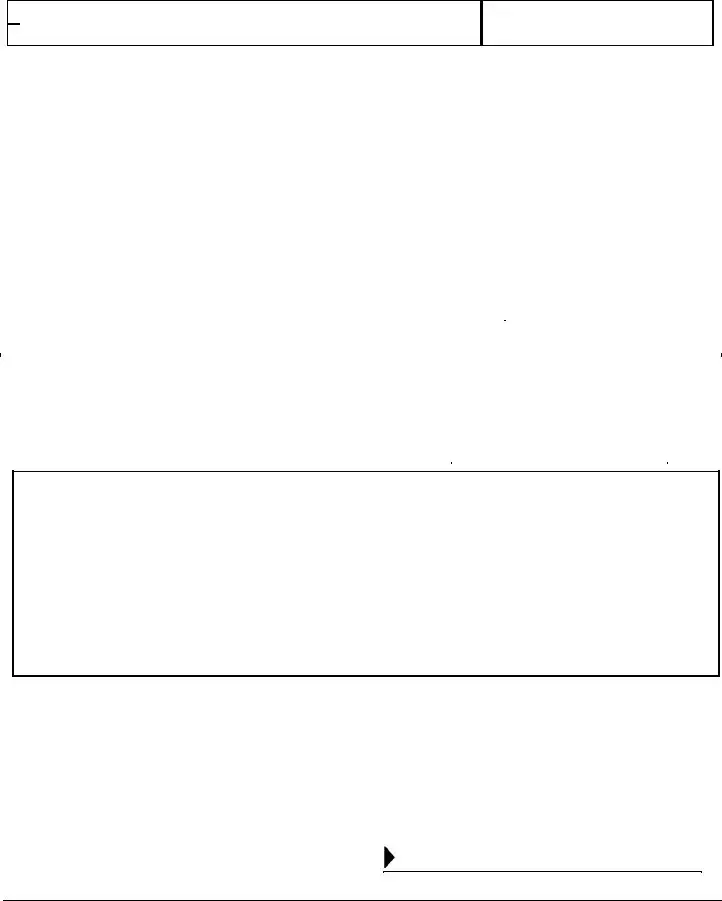
1.Judgment entered on (date):
2.Amount to be paid as of date of request (specify):
a. Unpaid principal |
$ |
|
|
b. Costs |
$ |
|
|
c. Post judgment costs |
$ |
|
|
d. Credits (see receipts) |
$ |
|
|
e. Interest accrued (to date in item 2, above) |
$ |
|
|
f. Processing fee |
$ |
|
|
g. Other (specify) |
$ |
|
|
|
SUBTOTAL |
$ |
|
Add interest at: $ |
per day (from date in item 2) |
$ |
|
|
|
|
|
|
TOTAL |
$ |
|
|
|
|
|
|
|
|
|
|
|
|
|
CLERK'S CERTIFICATE OF MAILING
I certify that I am not a party to this action. This Notice to Judgment Creditor was mailed first class, postage prepaid, in a sealed envelope to the address shown in item 3 on the reverse. The mailing and this certification occurred
at (place):California, on (date):
Clerk, by |
|
, Deputy |
|
|
|
NOTICE TO JUDGMENT CREDITOR
1.The judgment debtor has fully satisfied the judgment entered by making payment to the court in the amount shown above.
2.You may claim this money by
a. presenting this form in person to the court clerk during regular business hours,
b. mailing this form to the court.
3.Complete the Judgment Creditor's Request for Funds below.
4.Money not claimed within three years becomes the property of the court (see Government Code sections
JUDGMENT CREDITOR'S REQUEST FOR FUNDS
I request the court to pay the money to me by mail at my current address (specify):
(Mail or deliver this form to the court clerk Keep a photocopy for yourself.)
Date:
................................................................................
.... |
(TYPE OR PRINT NAME) |
(SIGNATURE OF JUDGMENT CREDITOR) |
REQUEST TO PAY
JUDGMENT TO COURT
(Small Claims)
Page 2 of 2
| Fact Name | Details |
|---|---|
| Form Purpose | The SC-145 form is used to request that a judgment payment be made to the court instead of directly to the creditor. |
| Judgment Calculation | It includes the total amount owed, which consists of the principal, costs, accrued interest, processing fees, and any other charges. |
| Partial Payments | If partial payments have been made, the form allows the debtor to indicate the amount already paid. |
| Payment Method | Payments can be made by check, money order, or cash, with specific documentation required for each method. |
| Governing Law | This form is governed by California Code of Civil Procedure, Section 116.230. |
Completing the California SC-145 form is a straightforward process that requires careful attention to detail. Once the form is filled out correctly, it will be submitted to the court for processing. Below are the steps to guide you through filling out the form.
After completing the form, make sure to keep a copy for your records. Submit the SC-145 form to the court, and await further instructions regarding the payment process and any additional steps you may need to take.
What is the purpose of the California SC-145 form?
The California SC-145 form is used to request that a judgment debtor pays a court-ordered judgment amount directly to the court instead of the creditor. This form helps to simplify the payment process and ensures that the court can properly track the payments made towards the judgment.
Who should fill out the SC-145 form?
The judgment debtor, or the person ordered by the court to pay a judgment, should fill out the SC-145 form. This includes providing necessary information about the judgment, the creditor, and any payments already made.
What information is required on the SC-145 form?
The form requires several pieces of information, including the date the judgment was entered, the name and address of the judgment creditor, and the total amount required to satisfy the judgment. Additionally, if any partial payments have been made, details about those payments must be included.
How is the total amount to be paid calculated?
The total amount required to satisfy the judgment includes the principal amount ordered by the court, any costs awarded, accrued interest, the court's processing fee, and any other charges added to the judgment. The court will calculate this total based on the information provided in the form.
What happens if I have already made partial payments?
If you have made partial payments towards the judgment, you must indicate this on the SC-145 form. You will need to specify the amount paid and provide proof of payment, such as a copy of a canceled check or a signed cash receipt.
What is the significance of paying by personal check?
When paying by personal check, it is important to note that the satisfaction of judgment may be delayed for 30 days. This delay is due to the time it takes for the check to clear the bank.
What should I do after submitting the SC-145 form?
After submitting the SC-145 form and making the payment to the court, you should keep a copy of the form and any payment receipts for your records. The court will then process the payment and update the status of the judgment accordingly.
What happens if the judgment is fully satisfied?
If the judgment is fully satisfied, the court will enter a satisfaction of judgment. This means that the debtor has met their obligation, and the creditor can no longer pursue the debt. The creditor will be notified of the payment, and they can claim the funds from the court if necessary.
What if the judgment is not satisfied?
If the judgment is not satisfied as requested, the court will provide a reason for the denial. It is crucial to address any issues raised by the court to ensure compliance with the judgment requirements.
Neglecting to Include Complete Names and Addresses: One common mistake is failing to provide full names and accurate addresses for both the plaintiff and defendant. It’s essential to ensure that all parties are correctly identified to avoid delays or complications.
Incorrect Judgment Amount: Some individuals make errors in calculating the total amount due. Be sure to include the principal amount, any awarded costs, accrued interest, and processing fees. Double-check these figures to ensure accuracy.
Missing Required Signatures: Failing to sign the form can lead to rejection. Always remember to sign and date the document before submission.
Not Providing Proof of Payment: If you have made partial payments, it’s crucial to attach the necessary documentation. This includes copies of canceled checks or receipts. Omitting this information can complicate the process.
Ignoring the 30-Day Delay for Personal Checks: Many people overlook the fact that payments made by personal check will delay the satisfaction of judgment for 30 days. This can lead to misunderstandings about when the judgment is considered satisfied.
Failing to Check for Additional Charges: Some individuals forget to account for other charges that may have been added by the court. Review the form carefully to ensure that all potential fees are included in your calculations.
Not Requesting the Court to Calculate the Total: It’s important to request the court to calculate the total amount required for satisfaction. Many people assume they know the total, but it’s best to let the court handle this calculation to avoid errors.
Overlooking the Certification Requirement: Lastly, individuals sometimes forget to certify that the document is a true and correct copy. This certification is necessary for the court to accept the form.
The California SC-145 form is an important document used in small claims cases, specifically for requesting to pay a judgment to the court rather than directly to the creditor. When dealing with such matters, there are several other forms and documents that may be necessary to ensure a smooth process. Below is a list of commonly used forms that often accompany the SC-145.
Understanding these forms can help streamline the small claims process. Each document plays a vital role in ensuring that all parties are informed and that the legal requirements are met. If you have any questions about these forms or the process, it is advisable to seek assistance to navigate through it effectively.
The California SC-145 form, which is used for requesting to pay a judgment to the court, has similarities with several other legal documents. Each of these documents serves a specific purpose within the legal system. Below is a list of documents that share characteristics with the SC-145 form:
When filling out the California SC-145 form, it is crucial to follow specific guidelines to ensure accuracy and compliance. Below is a list of things you should and shouldn't do.
Understanding the California SC-145 form is essential for anyone involved in a small claims case. However, there are several misconceptions that can lead to confusion. Here’s a list of ten common misunderstandings about this form:
Clearing up these misconceptions can help individuals navigate the small claims process more effectively. Always ensure you have the correct information and seek guidance if you’re unsure about any steps.
Filling out and using the California SC-145 form involves several important steps and considerations. Below are key takeaways that can help ensure the process is completed correctly.
These takeaways highlight the critical aspects of the SC-145 form, ensuring that both judgment debtors and creditors understand their responsibilities and the necessary steps to complete the process effectively.