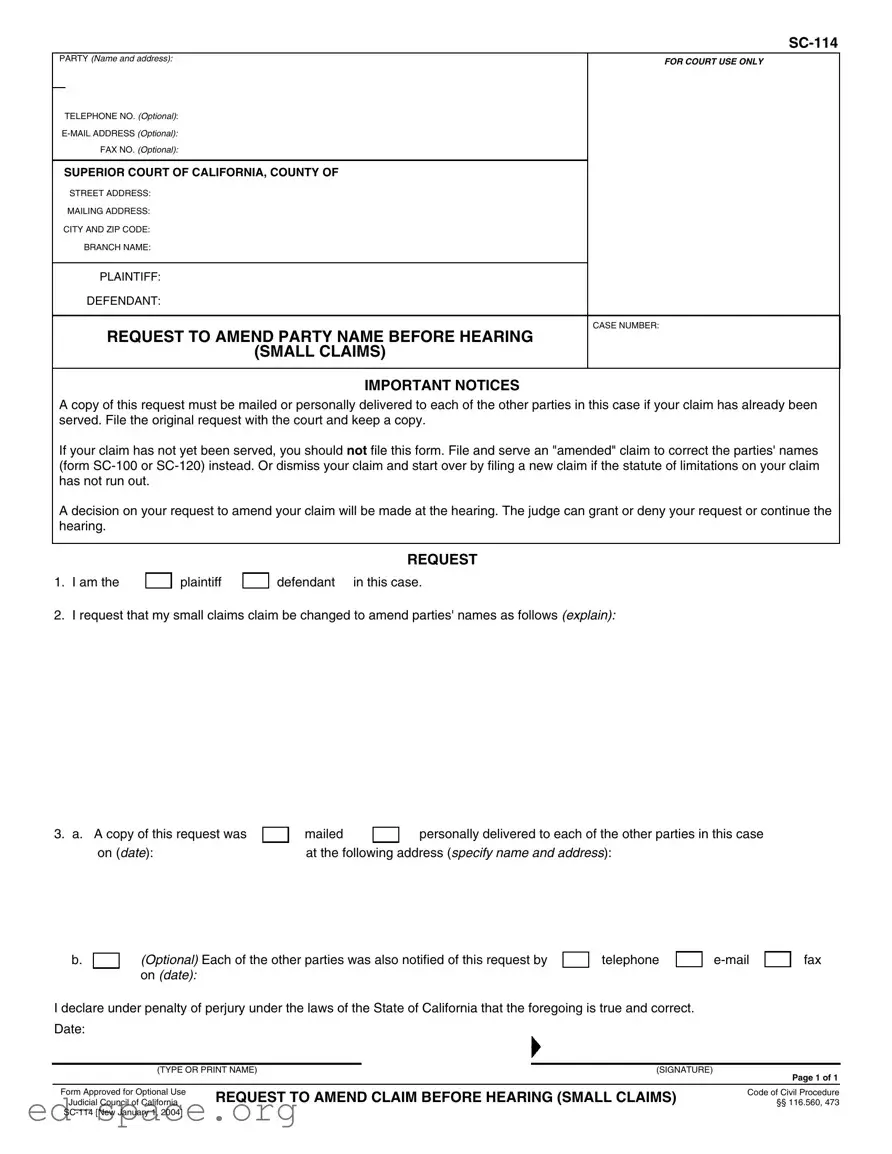
The California SC-114 form serves a vital role in the small claims process, allowing parties to request amendments to the names of those involved in a case before the hearing takes place. This form is essential for ensuring that the correct parties are recognized in court, which can significantly affect the outcome of a claim. The form requires the party seeking the amendment to provide their name, contact information, and details about the case, including the case number and the names of the plaintiff and defendant. It is important to note that a copy of the request must be delivered to all other parties involved in the case if the claim has already been served. If the claim has not yet been served, the SC-114 should not be filed; instead, an amended claim should be submitted using forms SC-100 or SC-120. The judge will review the request during the hearing and has the authority to approve or deny the amendment, or to postpone the decision. Completing this form accurately and following the proper procedures is crucial for maintaining the integrity of the small claims process in California.
PARTY (Name and address): |
FOR COURT USE ONLY |
TELEPHONE NO. (Optional):
FAX NO. (Optional):
SUPERIOR COURT OF CALIFORNIA, COUNTY OF
STREET ADDRESS:
MAILING ADDRESS:
CITY AND ZIP CODE:
BRANCH NAME:
PLAINTIFF:
DEFENDANT:
CASE NUMBER:
REQUEST TO AMEND PARTY NAME BEFORE HEARING
(SMALL CLAIMS)
IMPORTANT NOTICES
A copy of this request must be mailed or personally delivered to each of the other parties in this case if your claim has already been served. File the original request with the court and keep a copy.
If your claim has not yet been served, you should not file this form. File and serve an "amended" claim to correct the parties' names (form
A decision on your request to amend your claim will be made at the hearing. The judge can grant or deny your request or continue the hearing.
REQUEST
1. I am the
plaintiff
defendant in this case.
2. I request that my small claims claim be changed to amend parties' names as follows (explain):
3.a. A copy of this request was on (date):
mailed |
|
personally delivered to each of the other parties in this case |
at the following address (specify name and address):
b. |
|
(Optional) Each of the other parties was also notified of this request by |
|
telephone |
|
|
on (date): |
|
|
I declare under penalty of perjury under the laws of the State of California that the foregoing is true and correct.
Date:
fax
(TYPE OR PRINT NAME) |
(SIGNATURE) |
Page 1 of 1 |
|
|
|
|
|
Form Approved for Optional Use |
REQUEST TO AMEND CLAIM BEFORE HEARING (SMALL CLAIMS) |
Code of Civil Procedure |
|
Judicial Council of California |
§§ 116.560, 473 |
||
| Fact Name | Details |
|---|---|
| Form Purpose | The SC-114 form is used to request an amendment to the party name in a small claims case before a hearing. |
| Governing Law | This form is governed by the California Code of Civil Procedure, specifically sections 116.560 and 473. |
| Filing Requirement | The original SC-114 form must be filed with the court, and a copy should be kept for personal records. |
| Notification Requirement | A copy of the request must be mailed or personally delivered to all other parties involved in the case. |
| Claim Status | If the claim has not yet been served, the SC-114 form should not be filed. |
| Alternative Actions | If the claim is unserved, parties should file an amended claim using forms SC-100 or SC-120, or dismiss and refile a new claim. |
| Hearing Decision | The judge will decide whether to grant or deny the request during the hearing. |
| Perjury Declaration | The form includes a declaration stating that the information provided is true and correct under penalty of perjury. |
| Optional Information | Telephone numbers, email addresses, and fax numbers are optional fields on the form. |
| Form Approval | The SC-114 form is approved for optional use and was last updated on January 1, 2004. |
After gathering the necessary information, the next step involves accurately completing the California SC-114 form. This form is essential for requesting an amendment to party names in small claims cases. It is important to ensure all details are correct before submitting the form to the court.
What is the purpose of the California SC-114 form?
The SC-114 form is used to request an amendment to the names of the parties involved in a small claims case before a hearing takes place. If you realize that the names listed in your claim are incorrect, this form allows you to officially request a change.
Who can use the SC-114 form?
This form is intended for plaintiffs or defendants in small claims cases. If you are one of these parties and need to amend the names of the parties involved, this form is the right choice for you.
What information do I need to provide on the SC-114 form?
You will need to provide your name and address, as well as the name and address of the other parties involved in the case. Additionally, you must explain how you want to amend the party names. It's important to fill in all required fields accurately to avoid delays.
Do I need to notify the other parties about my request?
Yes, you must mail or personally deliver a copy of your request to each of the other parties involved in the case if your claim has already been served. This ensures that everyone is aware of the changes you are proposing.
What should I do if my claim has not been served yet?
If your claim has not been served, you should not file the SC-114 form. Instead, you should file and serve an amended claim using form SC-100 or SC-120 to correct the party names. Alternatively, you may choose to dismiss your claim and start over by filing a new claim, as long as the statute of limitations has not expired.
What happens after I submit the SC-114 form?
After you submit the SC-114 form, the judge will review your request during the hearing. The judge has the authority to grant or deny your request, or they may decide to continue the hearing for further consideration.
Is there a penalty for providing false information on the SC-114 form?
Yes, you must declare under penalty of perjury that the information you provided is true and correct. Providing false information can have serious legal consequences, so it’s crucial to be honest and accurate when filling out the form.
How do I file the SC-114 form?
You can file the SC-114 form by submitting the original request to the court. It's also wise to keep a copy for your records. Make sure to check the specific filing procedures for your local court, as they may vary.
Can I amend the party names after the hearing has taken place?
Incomplete Information: Failing to provide all required details, such as the names and addresses of all parties involved, can lead to delays. Ensure that every section of the form is filled out completely.
Incorrect Party Designation: Misidentifying yourself as the plaintiff or defendant can cause confusion. Double-check that you have selected the correct designation based on your role in the case.
Improper Notification: Not mailing or personally delivering a copy of the request to all other parties can result in rejection of the request. Remember, this step is crucial for compliance with court rules.
Missing Signatures: Forgetting to sign the form can invalidate your request. Always ensure that you sign and date the form before submission.
Filing Before Service: Submitting the form before serving your claim can complicate matters. If your claim has not been served, consider filing an amended claim instead.
The California SC-114 form is used to request amendments to party names in small claims cases. Several other forms and documents may accompany this request, depending on the specifics of the case. Below is a list of commonly used documents that may be relevant.
Understanding these documents can help ensure that the small claims process proceeds smoothly. Each form serves a specific purpose and contributes to the overall handling of the case in court.
The California SC-114 form is primarily used to request an amendment to the names of parties involved in a small claims case. It shares similarities with several other legal documents. Below are four documents that are comparable to the SC-114 form, along with explanations of how they are alike.
When filling out the California SC-114 form, there are important guidelines to follow. Here are five things you should do, and five things you should avoid:
Misconceptions about the California SC-114 form can lead to confusion and errors in the small claims process. Here are five common misunderstandings:
When dealing with the California SC-114 form, several key points are essential to understand for effective use. Below are the takeaways: