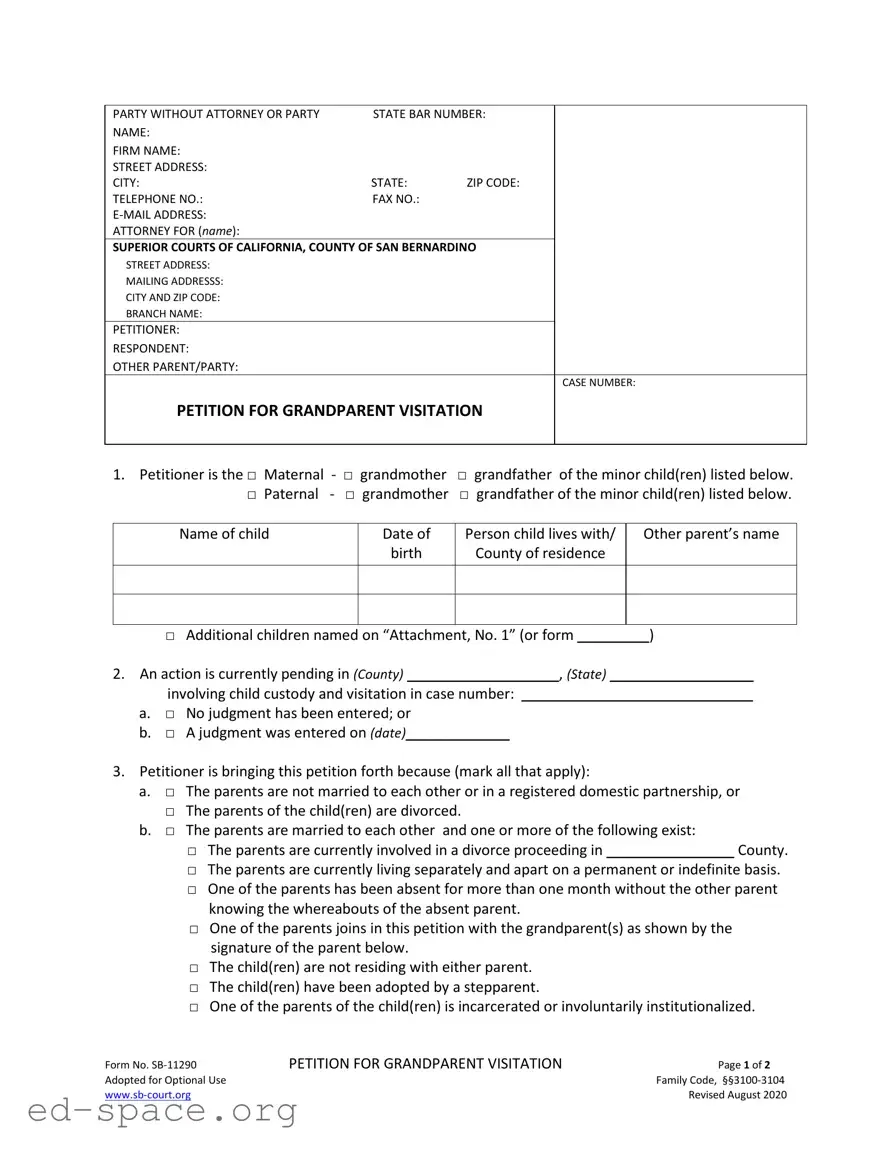
The California SB 11290 form serves as a vital tool for grandparents seeking visitation rights with their grandchildren. This form is specifically designed for situations where grandparents wish to petition the court for visitation privileges, particularly when the relationship with the child's parents may be complex or strained. It requires the petitioner to identify their relationship to the child, whether as a maternal or paternal grandparent, and to provide pertinent details about the child, such as their name and date of birth. Additionally, the form prompts the petitioner to disclose any ongoing legal actions related to child custody and visitation, ensuring that the court is aware of any existing family law cases. Essential to the process, the petitioner must articulate the reasons for seeking visitation, emphasizing the emotional bond between the grandparent and the child, and propose a visitation schedule that they believe serves the child's best interests. The form also includes a section for a parent’s consent, which can significantly influence the court's decision regarding visitation rights. Furthermore, it outlines the necessary steps for service of the petition, ensuring that all parties are properly notified. Overall, the SB 11290 form encapsulates the legal framework surrounding grandparent visitation in California, balancing the rights of grandparents with the best interests of the child.

PARTY WITHOUT ATTORNEY OR PARTY |
STATE BAR NUMBER: |
|
NAME: |
|
|
FIRM NAME: |
|
|
STREET ADDRESS: |
|
|
CITY: |
STATE: |
ZIP CODE: |
TELEPHONE NO.: |
FAX NO.: |
|
|
|
|
ATTORNEY FOR (name): |
|
|
SUPERIOR COURTS OF CALIFORNIA, COUNTY OF SAN BERNARDINO
STREET ADDRESS:
MAILING ADDRESSS:
CITY AND ZIP CODE:
BRANCH NAME:
PETITIONER:
RESPONDENT:
OTHER PARENT/PARTY:
CASE NUMBER:
PETITION FOR GRANDPARENT VISITATION
1. Petitioner is the □ |
Maternal - □ grandmother |
□ grandfather of the minor child(ren) listed below. |
□ |
Paternal - □ grandmother |
□ grandfather of the minor child(ren) listed below. |
Name of child
Date of
birth
Person child lives with/
County of residence
Other parent’s name
□Additional children named on “Attachment, No. 1” (or form _________)
2.An action is currently pending in (County) ___________________, (State) __________________
involving child custody and visitation in case number: _____________________________
a.□ No judgment has been entered; or
b.□ A judgment was entered on (date)_____________
3.Petitioner is bringing this petition forth because (mark all that apply):
a.□ The parents are not married to each other or in a registered domestic partnership, or
□The parents of the child(ren) are divorced.
b. □ The parents are married to each other and one or more of the following exist:
□The parents are currently involved in a divorce proceeding in ________________ County.
□The parents are currently living separately and apart on a permanent or indefinite basis.
□One of the parents has been absent for more than one month without the other parent knowing the whereabouts of the absent parent.
□One of the parents joins in this petition with the grandparent(s) as shown by the signature of the parent below.
□The child(ren) are not residing with either parent.
□The child(ren) have been adopted by a stepparent.
□One of the parents of the child(ren) is incarcerated or involuntarily institutionalized.
Form No.
PETITION FOR GRANDPARENT VISITATION
Page 1 of 2
Family Code,
Revised August 2020
4.There is a preexisting relationship and bond between the child(ren) and grandparent(s). Explain the reason why grandparent visitation is in the best interest of each child: _____________________
__________________________________________________________________________________
__________________________________________________________________________________
□See “Attachment, No. 4” (or form _________)
5.Describe the proposed visitation schedule:_____ _________________________________________
_________________________________________________________________________________
_________________________________________________________________________________
□See “Attachment, No. 5” (or form _________)
6.□ A completed Declaration Under the Uniform Child Custody Jurisdiction and Enforcement Act
7.Petitioner requests that the Court grant reasonable visitation with the
□A Request for Order
I declare under penalty of perjury under the laws of the State of California that the foregoing and all attachments are true and correct.
Date: |
|
________________________________ |
_________________________________________________ |
TYPE OR PRINT NAME |
SIGNATURE OF PETITIONER |
________________________________ |
_________________________________________________ |
TYPE OR PRINT NAME |
SIGNATURE OF PETITIONER |
________________________________ |
_________________________________________________ |
TYPE OR PRINT NAME |
SIGNATURE OF ATTORNEY FOR PETITIONER(S) |
PARENT’S CONSENT TO PETITION FOR GRANDPARENT VISITATION
I hereby consent to and join this Petition for Grandparent Visitation.
Date:
________________________________ |
_________________________________________________ |
TYPE OR PRINT NAME |
SIGNATURE OF □MOTHER □ FATHER OF CHILD(REN) |
NOTICE: The Court shall balance the interests of the child in having grandparent visits against the rights of the parents.
A rebuttable presumption against best interests/visitation is created:
1.If the parents agree that visitation is not in the best interests of the child(ren), or
2.If the parent awarded sole legal and physical custody (or with whom the child resides if no custody order) objects.
SERVICE: Personal service is required unless this petition is filed in an existing case. If filed in an existing case, service is completed by certified mail, return receipt to the last known address of parents, stepparent or person with physical custody of the child(ren). (See Family Code sections 3103(c) and 3104(c).)
Form No.
PETITION FOR GRANDPARENT VISITATION
Page 2 of 2
Family Code,
Revised August 2020
| Fact Name | Details |
|---|---|
| Form Title | Petition for Grandparent Visitation |
| Governing Law | California Family Code, §§3100-3104 |
| Form Number | SB-11290 |
| Purpose | This form allows grandparents to petition for visitation rights with their grandchildren. |
| Eligibility | The petitioner must be a grandparent of the minor child(ren) listed in the petition. |
| Pending Actions | The form requires disclosure of any ongoing child custody or visitation cases. |
| Preexisting Relationship | The petitioner must demonstrate a bond with the child(ren) to support the request for visitation. |
| Visitation Schedule | The petitioner must propose a visitation schedule as part of the petition. |
| Service Requirements | Personal service is required unless filed in an existing case, where certified mail may suffice. |
| Notice of Rights | The court balances the child's interests against parental rights, creating a rebuttable presumption against visitation. |
Filling out the California SB 11290 form requires careful attention to detail. This form is essential for petitioning for grandparent visitation rights. Ensure all information is accurate and complete to avoid delays in processing your request.
After completing the form, ensure that all necessary attachments are included and that you have made copies for your records. It is crucial to file the petition with the court and serve it to the relevant parties promptly. Following these steps will help facilitate the process of seeking grandparent visitation rights.
What is the California SB 11290 form used for?
The California SB 11290 form is a petition for grandparent visitation rights. It allows grandparents to seek legal visitation with their grandchildren when certain conditions are met. This form is particularly relevant in cases where the parents are separated, divorced, or otherwise unable to facilitate grandparent visits. The aim is to ensure that grandchildren maintain meaningful relationships with their grandparents, which can be beneficial for their emotional and psychological well-being.
Who can file the SB 11290 form?
The form can be filed by either a maternal or paternal grandparent of the minor child or children. The petitioner must demonstrate a significant relationship with the child and provide reasons why visitation is in the child's best interest. Additionally, the form allows for joint petitions, meaning that a parent can also sign alongside the grandparent to support the visitation request.
What information is required to complete the form?
To complete the SB 11290 form, you will need to provide personal information such as your name, address, and contact details. You must also include details about the child, including their name and date of birth, as well as information about the child's living arrangements and the other parent. Furthermore, you'll need to explain the reasons for seeking visitation and outline a proposed visitation schedule.
What are the grounds for filing a petition for grandparent visitation?
Grounds for filing the petition include situations where the parents are not married, are divorced, or are living separately. It may also apply if one parent is absent, incarcerated, or if the child has been adopted by a stepparent. The form requires the petitioner to mark all applicable reasons and provide supporting details for the request.
What happens after the form is submitted?
Once the SB 11290 form is submitted, the court will review the petition. If necessary, a hearing may be scheduled to discuss the visitation request. It is important to note that the court will consider the best interests of the child when making a decision. The petitioner may also need to serve the other parent with notice of the petition, following specific service requirements outlined in the law.
Is the consent of the parents required for grandparent visitation?
While parental consent is not strictly necessary to file the petition, it can significantly influence the court's decision. If both parents agree that visitation is in the best interests of the child, this may strengthen the case for the grandparent. Conversely, if one parent objects, the court may be less inclined to grant visitation rights.
What should I do if I need help with the form?
If you need assistance with the SB 11290 form, consider reaching out to legal aid organizations or family law attorneys who specialize in custody and visitation issues. They can provide guidance on how to complete the form accurately and advise you on the best steps to take based on your specific situation. Additionally, many courts have self-help centers that offer resources and support for individuals navigating the legal system.
Incomplete Information: Many individuals fail to fill out all required fields. Missing details such as the case number, names of the parties involved, or contact information can delay the process.
Incorrect Selection of Relationship: It's crucial to accurately indicate whether the petitioner is a maternal or paternal grandparent. Mislabeling this relationship can lead to confusion and potential rejection of the petition.
Failure to Explain Best Interests: The form asks for an explanation of why grandparent visitation is in the best interest of the child. Many forget to provide this critical information, which is essential for the court's consideration.
Not Including Attachments: If there are additional children or relevant documents, failing to attach them can result in an incomplete submission. It's important to reference and include all necessary attachments as indicated on the form.
Signature Errors: Signatures must be clear and complete. Some people neglect to sign the form or forget to have the necessary parties, like the parent, sign as well. This oversight can render the petition invalid.
When filing the California SB 11290 form, which is the petition for grandparent visitation, there are several other forms and documents that may be helpful or necessary to include. Each of these documents serves a specific purpose in the legal process, ensuring that all relevant information is presented to the court. Below is a list of commonly used forms that accompany the SB 11290.
Understanding these forms and their purposes can make the process smoother and more efficient. Each document plays a vital role in ensuring that the court has all the necessary information to make informed decisions regarding grandparent visitation rights. Always consider consulting with a legal professional if you have questions or need guidance on completing these forms.
The California SB 11290 form, which pertains to petitions for grandparent visitation, shares similarities with several other legal documents. Here’s a list of ten documents that are comparable, along with explanations of how they relate to the SB 11290 form:
Each of these documents plays a role in family law and shares common elements with the SB 11290 form, particularly in terms of initiating legal proceedings and addressing the rights and responsibilities of family members.
When filling out the California SB 11290 form, it is crucial to follow specific guidelines to ensure your petition is processed correctly. Here are nine things you should and shouldn't do:
There are several misconceptions surrounding the California SB 11290 form, which is used for petitions regarding grandparent visitation. Here’s a clear look at some of these misunderstandings:
This is not true. The form can be used by grandparents regardless of the marital status of the parents. It applies in cases where parents are married, divorced, or even when one parent is absent.
Filing the petition does not guarantee visitation. The court must determine whether visitation is in the best interest of the child, balancing it against the rights of the parents.
This form can initiate a new matter or be filed in conjunction with an existing case. If no existing case is present, a specific declaration must accompany the petition.
Both grandparents can join in the petition. The form allows for signatures from multiple petitioners, strengthening the case for visitation.
Providing a proposed visitation schedule is crucial. It helps the court understand the desired arrangement and assess its feasibility.
The court prioritizes the child's best interests. If the parents object to visitation, the court will weigh their rights heavily in its decision.
Even in existing cases, personal service is required unless specified otherwise. Proper service ensures all parties are informed and can respond accordingly.
Filling out the California SB 11290 form is an important step for grandparents seeking visitation rights. Here are some key takeaways to consider:
Completing this form accurately and thoroughly can help facilitate a smoother process in seeking visitation rights.