Homepage Free RV Bill of Sale Form for California
Content Overview

When purchasing or selling a recreational vehicle (RV) in California, having a well-prepared RV Bill of Sale form is essential. This document serves as a legal record of the transaction, providing both the buyer and seller with important details about the sale. Key aspects of the form include the names and addresses of both parties, the vehicle identification number (VIN), the make, model, and year of the RV, as well as the purchase price. Additionally, the form may outline any terms or conditions of the sale, such as whether the RV is sold "as-is" or if any warranties are included. Properly completing this form not only protects both parties in the transaction but also ensures that the transfer of ownership is documented for future reference. Understanding the significance of this document can help facilitate a smoother buying or selling experience.

Document Preview

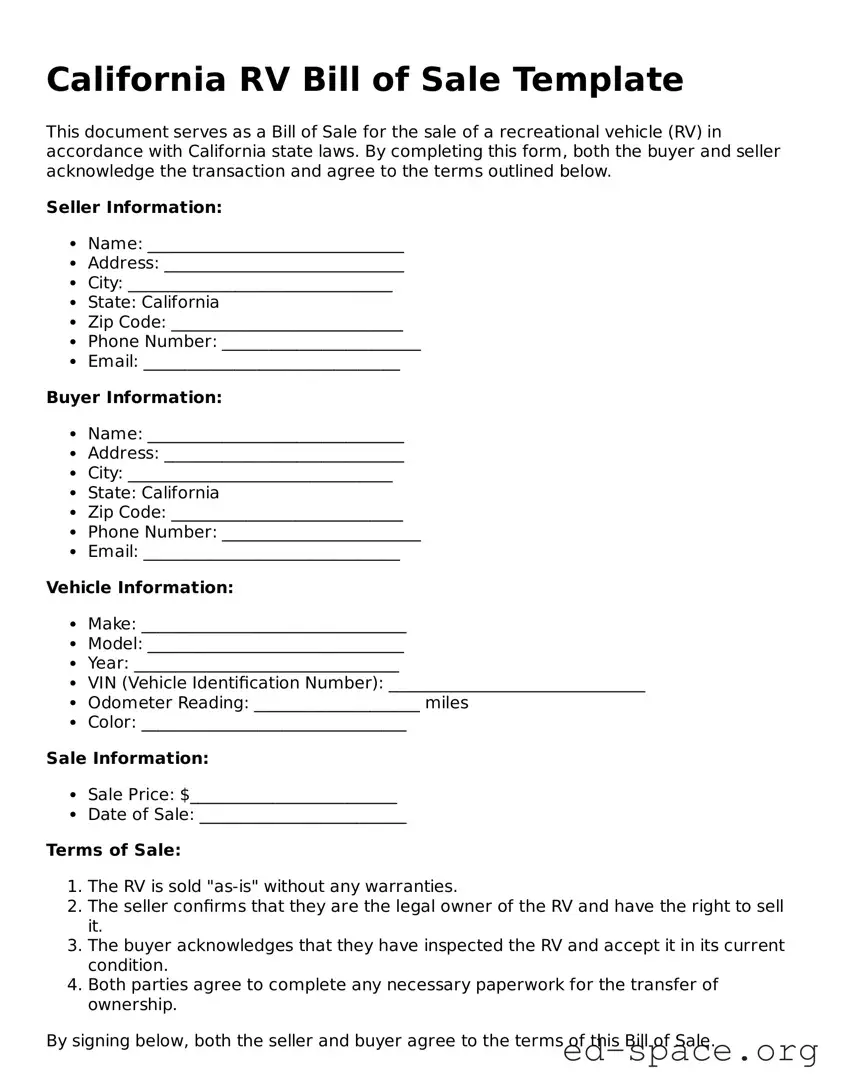
California RV Bill of Sale Template

This document serves as a Bill of Sale for the sale of a recreational vehicle (RV) in accordance with California state laws. By completing this form, both the buyer and seller acknowledge the transaction and agree to the terms outlined below.

Seller Information:

  • Name: _______________________________
  • Address: _____________________________
  • City: ________________________________
  • State: California
  • Zip Code: ____________________________
  • Phone Number: ________________________
  • Email: _______________________________

Buyer Information:

  • Name: _______________________________
  • Address: _____________________________
  • City: ________________________________
  • State: California
  • Zip Code: ____________________________
  • Phone Number: ________________________
  • Email: _______________________________

Vehicle Information:

  • Make: ________________________________
  • Model: _______________________________
  • Year: ________________________________
  • VIN (Vehicle Identification Number): _______________________________
  • Odometer Reading: ____________________ miles
  • Color: ________________________________

Sale Information:

  • Sale Price: $_________________________
  • Date of Sale: _________________________

Terms of Sale:

  1. The RV is sold "as-is" without any warranties.
  2. The seller confirms that they are the legal owner of the RV and have the right to sell it.
  3. The buyer acknowledges that they have inspected the RV and accept it in its current condition.
  4. Both parties agree to complete any necessary paperwork for the transfer of ownership.

By signing below, both the seller and buyer agree to the terms of this Bill of Sale.

Seller's Signature: _______________________ Date: _______________

Buyer's Signature: _______________________ Date: _______________

Keep a copy of this Bill of Sale for your records. It is advisable to register the RV with the California Department of Motor Vehicles (DMV) to ensure proper transfer of ownership.

PDF Form Details

Fact Name Description
Purpose The California RV Bill of Sale form is used to document the sale of a recreational vehicle (RV) between a buyer and a seller.
Legal Requirement While not mandatory, it is highly recommended to use this form to provide proof of ownership transfer.
Governing Law This form is governed by California Vehicle Code Section 5901, which outlines vehicle ownership transfer procedures.
Information Included The form typically includes details such as the vehicle identification number (VIN), make, model, year, and odometer reading.
Signatures Required Both the seller and the buyer must sign the form to validate the transaction.
Notarization Notarization is not required for the Bill of Sale in California, but it can add an extra layer of authenticity.
Record Keeping It is advisable for both parties to keep a copy of the completed Bill of Sale for their records.
Additional Documentation Other documents, such as the title and registration, may also need to be exchanged during the sale.

California RV Bill of Sale: Usage Guidelines

Once you have the California RV Bill of Sale form ready, you can start filling it out. Make sure to have all the necessary information at hand, such as details about the RV and the buyer. This will help ensure that the process goes smoothly.

  1. Begin by entering the date of the sale at the top of the form.
  2. Fill in the seller's full name and address. This identifies who is selling the RV.
  3. Next, provide the buyer's full name and address. This shows who is purchasing the RV.
  4. Write down the RV's make, model, year, and Vehicle Identification Number (VIN). This information uniquely identifies the RV.
  5. Include the sale price of the RV. This is the amount agreed upon by both the seller and the buyer.
  6. If applicable, note any trade-in details or additional terms of the sale.
  7. Both the seller and buyer should sign and date the form at the bottom. This confirms the transaction.
  8. Finally, make copies of the completed form for both parties. This serves as a record of the sale.

Your Questions, Answered

What is a California RV Bill of Sale form?

The California RV Bill of Sale form is a legal document that records the sale of a recreational vehicle (RV) between a seller and a buyer. It serves as proof of the transaction and includes essential details such as the vehicle's make, model, year, and identification number. This form is important for both parties, as it provides a clear record of the sale and can be used for registration purposes with the California Department of Motor Vehicles (DMV).

Do I need a Bill of Sale to sell my RV in California?

What information should be included in the California RV Bill of Sale?

A comprehensive California RV Bill of Sale should include the following information: the names and addresses of both the seller and buyer, the RV's make, model, year, and Vehicle Identification Number (VIN), the sale price, and the date of the transaction. It is also advisable to include any terms or conditions related to the sale, such as warranties or disclosures about the vehicle's condition. Both parties should sign the document to validate the transaction.

How do I obtain a California RV Bill of Sale form?

You can obtain a California RV Bill of Sale form through various means. Many websites offer free templates that you can download and fill out. Alternatively, you can create your own document by including all the necessary information mentioned earlier. If you prefer, the California DMV also provides resources and guidelines for creating a Bill of Sale. Regardless of how you obtain it, ensure that all required details are accurately captured to avoid any complications in the future.

Common mistakes

  1. Incomplete Information: Failing to provide all required details can lead to issues later. Ensure that all fields are filled out completely, including the names, addresses, and contact information of both the buyer and seller.

  2. Incorrect Vehicle Identification Number (VIN): Double-check the VIN for accuracy. An incorrect VIN can cause problems with registration and ownership verification.

  3. Missing Signatures: Both the buyer and seller must sign the document. Without signatures, the sale is not legally binding.

  4. Not Including the Sale Price: Clearly state the sale price of the RV. Omitting this information can complicate tax assessments and future registrations.

  5. Not Notarizing the Document: While notarization is not always required, it can provide an extra layer of authenticity. Consider having the document notarized, especially for high-value transactions.

  6. Using Incorrect Dates: Ensure that the date of the sale is accurate. An incorrect date can create confusion regarding ownership and responsibilities.

  7. Forgetting to Provide a Bill of Sale Copy: Both parties should keep a copy of the completed bill of sale for their records. This can be helpful for future reference or disputes.

  8. Not Disclosing Known Issues: Sellers should disclose any known defects or issues with the RV. Failure to do so can lead to legal disputes after the sale.

  9. Neglecting to Check Local Requirements: Different counties or cities may have specific requirements for RV sales. Be sure to check local regulations to ensure compliance.

Documents used along the form

When completing the sale of a recreational vehicle (RV) in California, several additional forms and documents may be necessary. These documents help ensure that the transaction is legal and that both parties are protected. Below is a list of commonly used documents alongside the California RV Bill of Sale form.

  • Title Transfer Form: This document is essential for transferring ownership of the RV from the seller to the buyer. It includes details about the vehicle and the parties involved.
  • Application for Title or Registration: Buyers must submit this form to the DMV to register the RV in their name. It provides the DMV with necessary information about the vehicle and its new owner.
  • Smog Certification: Depending on the age and type of RV, a smog check may be required to ensure the vehicle meets California's emissions standards. This certification must be provided at the time of sale.
  • Bill of Sale for Trade-In Vehicle: If the buyer is trading in a vehicle as part of the purchase, this document details the trade-in's value and condition, facilitating the transaction.
  • Odometer Disclosure Statement: This form is necessary to document the RV's mileage at the time of sale. It helps prevent fraud and ensures accurate reporting of the vehicle's condition.
  • Power of Attorney: If either party cannot be present during the transaction, a power of attorney may be needed. This document allows someone else to act on their behalf regarding the sale.
  • Release of Liability: This form protects the seller from future liability related to the RV after the sale. It confirms that the seller is no longer responsible for the vehicle once it changes hands.
  • Vehicle History Report: Buyers often request this report to check for any past accidents, title issues, or other important history related to the RV. It provides peace of mind before completing the purchase.

Having these documents ready can streamline the process of buying or selling an RV in California. Each form plays a vital role in ensuring that the transaction is smooth and legally sound.

Similar forms

  • Vehicle Bill of Sale: Similar to the RV Bill of Sale, this document transfers ownership of a motor vehicle. It includes details like the vehicle's make, model, and VIN, ensuring both parties have a clear record of the transaction.
  • Boat Bill of Sale: This document serves a similar purpose for boats. It outlines the buyer and seller information, along with the boat's specifications. Just like the RV Bill of Sale, it acts as proof of ownership transfer.
  • Motorcycle Bill of Sale: When buying or selling a motorcycle, this document is used. It captures essential details about the motorcycle and the parties involved, ensuring a smooth ownership transition.
  • Trailer Bill of Sale: This document is specifically for trailers. It includes information about the trailer's condition and identification, mirroring the structure and purpose of the RV Bill of Sale.
  • Aircraft Bill of Sale: For those dealing with aircraft, this document is necessary. It provides a detailed account of the aircraft being sold, similar to how the RV Bill of Sale outlines the RV details.

Dos and Don'ts

When filling out the California RV Bill of Sale form, it’s important to follow certain guidelines to ensure everything is completed correctly. Below are ten things you should and shouldn’t do.

  • Do provide accurate information about the RV, including the make, model, year, and VIN.
  • Don't leave any fields blank. Every section must be completed to avoid delays.
  • Do include the sale price clearly. This helps with future registration and tax purposes.
  • Don't use abbreviations or shorthand. Write everything out clearly to avoid confusion.
  • Do sign and date the form. Both the seller and buyer must provide their signatures.
  • Don't forget to provide a copy of the completed form to the buyer. They will need it for registration.
  • Do keep a copy for your records. This is important for your own documentation.
  • Don't alter the form after it has been signed. Any changes can lead to disputes.
  • Do check for any specific requirements in your county. Some areas may have additional rules.
  • Don't rush through the process. Take your time to ensure everything is filled out correctly.

Misconceptions

Understanding the California RV Bill of Sale form is essential for both buyers and sellers. However, several misconceptions can lead to confusion. Here are four common misunderstandings:

  1. It's not necessary for private sales. Many believe that a Bill of Sale is only required for dealership transactions. In reality, it is crucial for private sales as well. This document provides proof of the transaction and protects both parties.
  2. It must be notarized. Some think that notarization is mandatory for the Bill of Sale to be valid. In California, notarization is not required. However, having it notarized can add an extra layer of security and verification.
  3. Only the seller needs to sign it. This misconception suggests that only the seller's signature is necessary. Both the buyer and the seller should sign the Bill of Sale to ensure that the transaction is officially recognized by both parties.
  4. It can be a verbal agreement. Some believe that a verbal agreement suffices. A written Bill of Sale is essential to provide clear documentation of the sale. Verbal agreements can lead to disputes and misunderstandings.

Clarifying these misconceptions can help facilitate a smoother transaction when buying or selling an RV in California. Ensure that you have the proper documentation in place to protect your interests.

Key takeaways

When filling out and using the California RV Bill of Sale form, keep these key takeaways in mind:

  • Accurate Information is Crucial: Ensure all details about the RV, including make, model, year, and VIN, are correct. Mistakes can lead to complications in ownership transfer.
  • Signatures Matter: Both the seller and buyer must sign the form. This validates the transaction and protects both parties in case of disputes.
  • Keep Copies: After completing the form, make copies for both the seller and buyer. This serves as proof of the sale and can be useful for future reference.
  • Understand Additional Requirements: Depending on the situation, you may need to provide additional documents, such as a smog certificate or proof of payment, to complete the registration process.