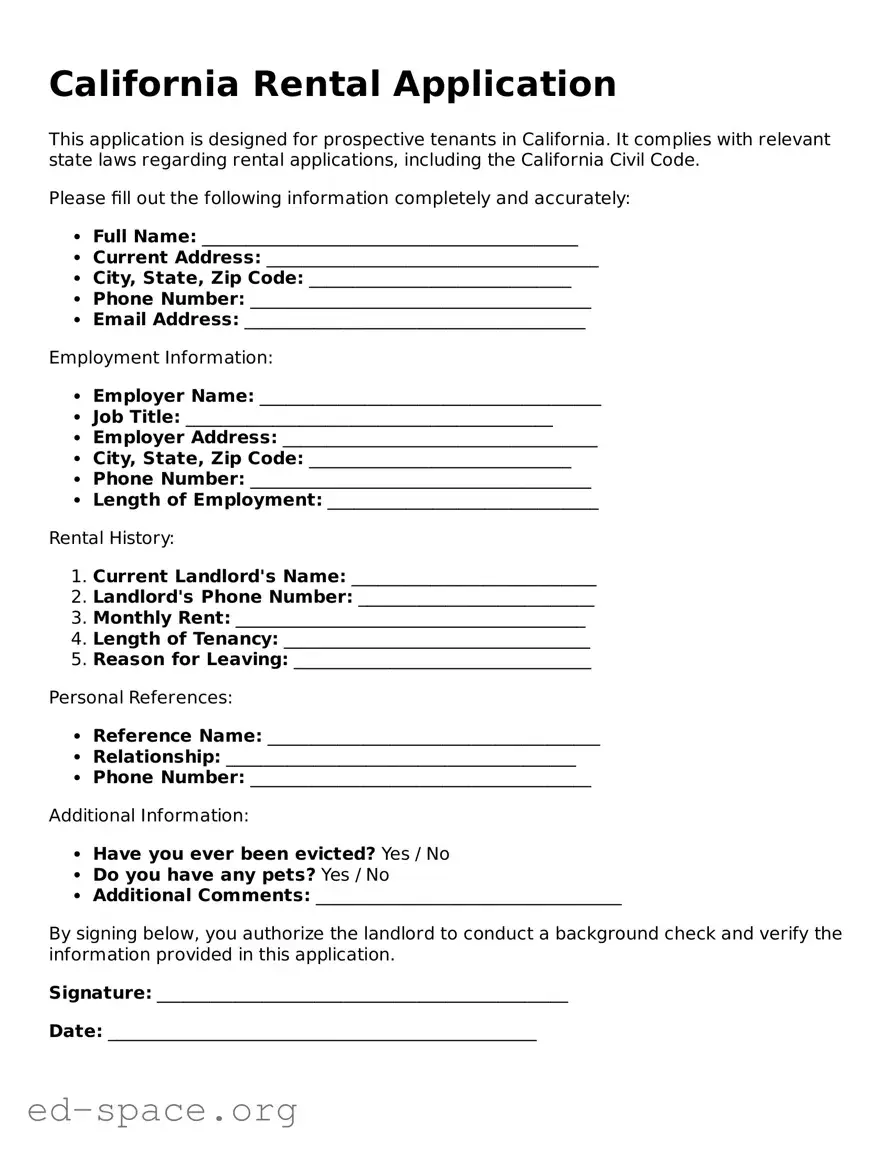
The California Rental Application form serves as a crucial tool for both landlords and prospective tenants in the rental process. This form collects essential information that helps landlords assess potential tenants' suitability for their properties. Typically, it includes sections for personal details, such as the applicant's name, contact information, and social security number. Additionally, the form often requests employment history and income verification to ensure that applicants can meet rental payment obligations. Landlords may also ask for references from previous landlords, which provide insight into the applicant's rental history and behavior. Importantly, the form often includes a consent section, allowing landlords to conduct background and credit checks. Understanding these components is vital for anyone navigating the rental market in California, as it lays the groundwork for a transparent and fair leasing process.
California Rental Application
This application is designed for prospective tenants in California. It complies with relevant state laws regarding rental applications, including the California Civil Code.
Please fill out the following information completely and accurately:
Employment Information:
Rental History:
Personal References:
Additional Information:
By signing below, you authorize the landlord to conduct a background check and verify the information provided in this application.
Signature: _______________________________________________
Date: _________________________________________________
| Fact Name | Description |
|---|---|
| Purpose | The California Rental Application form is used by landlords to collect information from prospective tenants. |
| Governing Law | The form is governed by California Civil Code Section 1950.6, which outlines the rules for rental applications. |
| Required Information | Applicants typically must provide personal details, rental history, and employment information. |
| Application Fee | Landlords can charge a non-refundable application fee, which is capped at a maximum amount set by state law. |
| Credit Check | Landlords often conduct a credit check as part of the application process to assess the applicant's financial responsibility. |
| Fair Housing Compliance | The application process must comply with the Fair Housing Act, prohibiting discrimination based on protected characteristics. |
| Disclosure Requirements | Landlords must disclose specific information, such as whether the property has lead-based paint, as part of the application. |
| Approval Timeline | California law does not specify a required timeline for processing rental applications, but prompt communication is encouraged. |
Once you have the California Rental Application form in hand, it is essential to complete it accurately to ensure a smooth application process. Following the steps below will help you provide all necessary information clearly and efficiently.
What is a California Rental Application form?
The California Rental Application form is a document used by landlords and property managers to collect information from prospective tenants. This form typically includes personal details, rental history, employment information, and references. It helps landlords assess the suitability of applicants for rental properties.
What information do I need to provide on the application?
When filling out the California Rental Application, you will need to provide various details. This usually includes your full name, contact information, Social Security number, employment history, income, and current address. Additionally, you may be asked to provide references from previous landlords or personal contacts who can vouch for your reliability as a tenant.
Is there a fee associated with the rental application?
Yes, many landlords charge an application fee to cover the costs of background checks and processing the application. The amount can vary by property and location, but it is typically non-refundable. Be sure to ask the landlord or property manager about the fee before submitting your application.
How long does the application process take?
The time it takes to process a rental application can vary. Generally, landlords may take anywhere from a few hours to several days to review applications. Factors that can influence this timeframe include the number of applications received, the thoroughness of background checks, and the responsiveness of references. It is advisable to follow up with the landlord if you have not received a response within a reasonable period.
Incomplete Information: Many applicants fail to provide all the required details. Missing sections can lead to delays or outright rejection.
Incorrect Contact Information: Entering wrong phone numbers or email addresses can make it hard for landlords to reach you. Double-check your contact details.
Not Disclosing Income: Some people underestimate the importance of showing proof of income. Landlords need this information to ensure you can pay rent.
Ignoring Background Check Consent: Forgetting to sign the consent for a background check is a common mistake. Without this, your application may not be processed.
Providing False Information: Lying on your application can lead to serious consequences. Always be honest about your rental history and credit status.
When renting a property in California, the rental application form is just one piece of the puzzle. Various other documents often accompany it to ensure a smooth and transparent leasing process. Here’s a list of common forms and documents that landlords and tenants may use together with the rental application:
Each of these documents plays a crucial role in the rental process. They help protect both the landlord's and tenant's interests, ensuring clarity and fairness throughout the leasing relationship. Understanding these forms can make the rental experience smoother and more successful for everyone involved.
Lease Agreement: Both documents outline the terms of occupancy. A lease agreement specifies the rights and responsibilities of both the landlord and the tenant, similar to how a rental application collects information to establish those terms.
Employment Verification Form: This document requires personal information about an applicant's job status. Like a rental application, it seeks to assess the reliability and stability of the individual applying for a rental property.
Credit Application: A credit application gathers financial information to evaluate a person's creditworthiness. This is akin to a rental application, which often includes questions about income and financial history to determine if the applicant can afford the rent.
Background Check Authorization: This document allows landlords to conduct background checks on potential tenants. Similar to a rental application, it aims to ensure that the applicant has a history that aligns with the expectations of the landlord.
Tenant Screening Report: A tenant screening report compiles various aspects of a potential tenant's background. Like the rental application, it provides crucial information that helps landlords make informed decisions about who to rent to.
When filling out a California Rental Application form, it's important to present yourself in the best light possible. Here are some key dos and don'ts to keep in mind:
Understanding the California Rental Application form is crucial for both landlords and tenants. However, several misconceptions can lead to confusion. Here are nine common misconceptions:
Many believe that all rental applications follow a standard format. In reality, each landlord may have their own specific requirements and questions.
Some think landlords can request any type of personal information. However, there are laws that limit the information landlords can collect to what is necessary for evaluating an applicant.
It is a misconception that rental applications are optional for landlords. Most landlords require a completed application to assess potential tenants.
Some applicants believe that paying the application fee ensures they will be approved. This is not true; the fee is for processing the application, not a guarantee of acceptance.
There is a belief that landlords cannot perform credit checks. In fact, landlords often conduct credit checks to evaluate an applicant's financial responsibility.
Some individuals think that providing inaccurate information on a rental application is minor. This can lead to disqualification or legal consequences.
It is a misconception that landlords are required to accept every applicant. They can deny applications based on valid criteria, as long as it complies with fair housing laws.
Some applicants assume that a signature is not necessary. However, most rental applications require a signature to confirm that the information provided is accurate.
Many believe that once an application is submitted, it cannot be retracted. In fact, applicants can withdraw their application at any time before a lease is signed.
Being aware of these misconceptions can help both landlords and tenants navigate the rental process more effectively.
When filling out and using the California Rental Application form, it’s important to keep a few key points in mind. Understanding these can help ensure a smoother rental process.
By keeping these takeaways in mind, you can navigate the rental application process more effectively and increase your chances of securing the rental you desire.