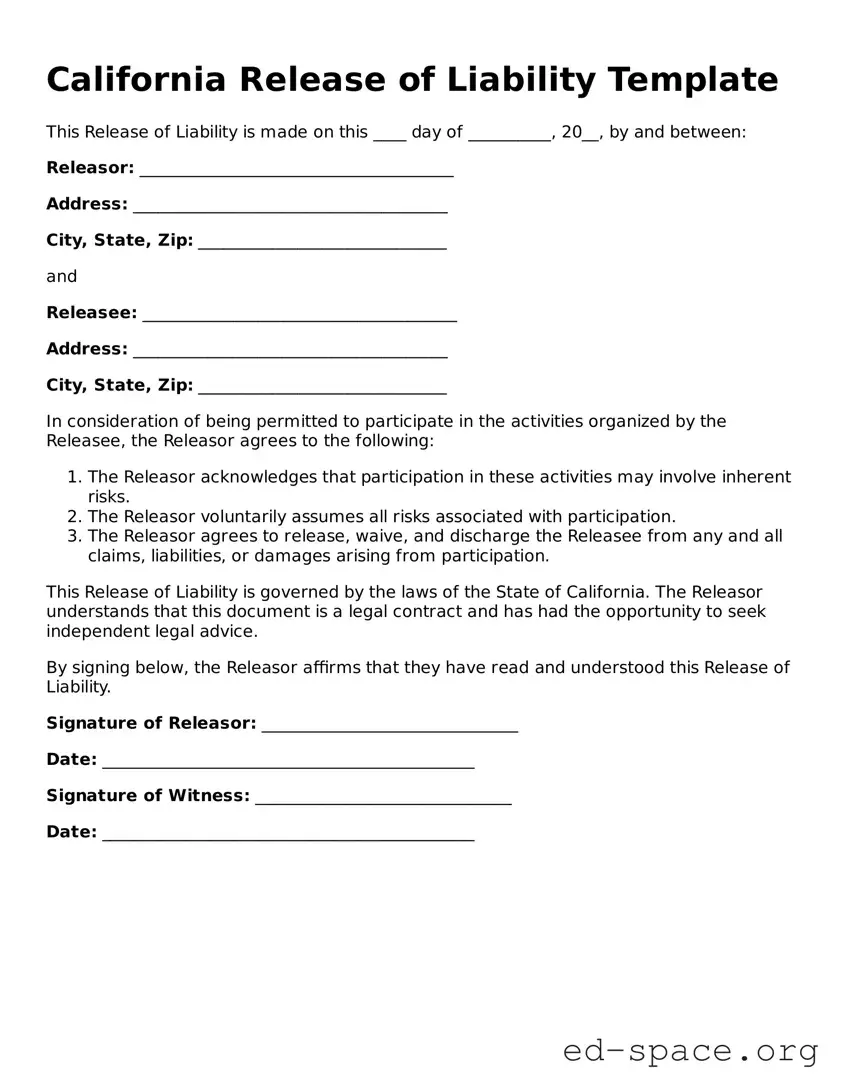
The California Release of Liability form serves as a crucial document for individuals and organizations seeking to mitigate risk associated with various activities. This form is often utilized in contexts such as recreational sports, events, and other activities where potential injuries may occur. By signing this form, participants acknowledge the inherent risks involved and agree to relinquish the right to hold the organizer or provider liable for any injuries or damages sustained during the activity. The document typically includes key elements such as a detailed description of the activity, a clear statement of the risks involved, and the participant's voluntary assumption of those risks. Additionally, it may outline any relevant legal rights being waived and specify the jurisdiction governing the agreement. Understanding the nuances of this form is essential for both organizers and participants to ensure that they are fully aware of their rights and responsibilities. Properly executed, the Release of Liability can provide a layer of protection for organizers while promoting informed consent among participants.
California Release of Liability Template
This Release of Liability is made on this ____ day of __________, 20__, by and between:
Releasor: ______________________________________
Address: ______________________________________
City, State, Zip: ______________________________
and
Releasee: ______________________________________
Address: ______________________________________
City, State, Zip: ______________________________
In consideration of being permitted to participate in the activities organized by the Releasee, the Releasor agrees to the following:
This Release of Liability is governed by the laws of the State of California. The Releasor understands that this document is a legal contract and has had the opportunity to seek independent legal advice.
By signing below, the Releasor affirms that they have read and understood this Release of Liability.
Signature of Releasor: _______________________________
Date: _____________________________________________
Signature of Witness: _______________________________
Date: _____________________________________________
| Fact Name | Description |
|---|---|
| Purpose | The California Release of Liability form is designed to protect an organization or individual from legal claims arising from injuries or damages that occur during an activity. |
| Governing Law | This form is governed by California Civil Code Section 1668, which allows for the enforcement of liability waivers as long as they are not deemed unconscionable. |
| Voluntary Participation | Participants must voluntarily sign the form, indicating their understanding of the risks involved and their agreement to release liability. |
| Scope of Release | The form typically includes a broad release, covering all potential claims related to the specified activity, including negligence. |
| Minors | If a participant is a minor, a parent or legal guardian must sign the form on their behalf to make it legally binding. |
| Legal Enforceability | For the release to be enforceable, it must be clear, specific, and not violate public policy. Courts may scrutinize the language used in the form. |
Once you have the California Release of Liability form in hand, you can proceed to fill it out. Ensure that you have all necessary information readily available to make the process smooth and efficient. Follow these steps to complete the form accurately.
After completing the form, review it for accuracy. Ensure all sections are filled out correctly before submitting it to the relevant party.
What is a California Release of Liability form?
A California Release of Liability form is a legal document that protects an individual or organization from being held liable for injuries or damages that may occur during an activity. By signing this form, participants acknowledge the risks involved and agree not to hold the organizer responsible for any accidents or injuries that may happen.
When should I use a Release of Liability form?
This form is commonly used for activities that involve a risk of injury, such as sports events, recreational activities, or community events. If you are organizing an event where participants may face risks, it is wise to have them sign this form to limit your liability.
Who should sign the Release of Liability form?
All participants in the activity should sign the form. If the participant is a minor, a parent or legal guardian must sign on their behalf. This ensures that the responsible adult acknowledges the risks and agrees to the terms of the release.
What are the key components of a Release of Liability form?
A typical form includes a clear statement of the risks involved, an acknowledgment of those risks by the participant, and a waiver of the right to sue the organizer for injuries. It may also contain sections on indemnification, which protects the organizer from claims made by third parties.
Is a Release of Liability form enforceable in California?
Yes, a Release of Liability form can be enforceable in California, provided it is properly drafted and executed. The form must be clear, unambiguous, and should not violate public policy. Courts generally uphold these agreements as long as they meet legal standards.
Can a Release of Liability form protect against gross negligence?
Generally, a Release of Liability form does not protect against gross negligence or willful misconduct. If the organizer acts with extreme carelessness or intentional harm, the release may not hold up in court. It is important to ensure that safety standards are maintained during the activity.
How can I ensure my Release of Liability form is valid?
To ensure the validity of the form, it should be written in clear language, signed voluntarily by participants, and include all necessary information about the risks involved. It is advisable to consult with a legal professional to tailor the document to your specific needs and circumstances.
What should I do if someone gets injured despite signing the form?
If an injury occurs, document the incident thoroughly. Take notes, gather witness statements, and report the injury to appropriate authorities. While the Release of Liability may limit your liability, it is crucial to handle the situation with care and consider legal advice to navigate any potential claims.
Not Reading the Entire Form: Many individuals rush through the form without fully understanding its implications. This can lead to unintended consequences.
Failing to Provide Accurate Information: It's crucial to fill in all personal details correctly. Errors can invalidate the form.
Omitting Necessary Signatures: Forgetting to sign the form, or having it signed by someone other than the intended party, can render it unenforceable.
Not Including Date: A common oversight is neglecting to date the form. Without a date, it may be difficult to establish when the release was executed.
Ignoring Witness Requirements: Some situations may require a witness to sign the form. Failing to do so can lead to complications later.
Using Ambiguous Language: Clear and precise language is essential. Vague terms can create confusion about the scope of the release.
Not Understanding the Risks: It's important to fully comprehend the risks being waived. Ignoring this can lead to disputes down the line.
Assuming All Releases Are the Same: Each release of liability is unique. Using a generic form without tailoring it to specific circumstances can be problematic.
Not Keeping a Copy: After submitting the form, individuals often forget to keep a copy for their records. This can be crucial if disputes arise later.
The California Release of Liability form is a crucial document that helps protect individuals and organizations from legal claims resulting from injuries or damages. However, it is often used in conjunction with several other forms and documents that further clarify responsibilities and expectations. Below is a list of some commonly used forms alongside the Release of Liability form.
These documents work together to create a comprehensive framework for safety and accountability. By using them alongside the California Release of Liability form, individuals and organizations can better protect themselves and ensure that participants are well-informed about their responsibilities and risks.
A Release of Liability form is a legal document that protects one party from legal claims made by another party. Several other documents serve similar purposes. Below are six documents that share similarities with the Release of Liability form:
When filling out the California Release of Liability form, it's important to follow certain guidelines to ensure the document is valid and effective. Here are seven things you should and shouldn't do:
Many people have misunderstandings about the California Release of Liability form. Here are four common misconceptions:
Understanding the California Release of Liability form is crucial for anyone engaging in activities that carry inherent risks. Here are some key takeaways to consider:
Using the California Release of Liability form effectively can provide peace of mind while participating in various activities. However, understanding its limitations and legal implications is equally important.