The California Quitclaim Deed form serves as a vital instrument in real estate transactions, particularly for individuals seeking to transfer property ownership without the complexities often associated with traditional deeds. This form allows a property owner, known as the grantor, to convey their interest in a property to another party, referred to as the grantee. Importantly, the quitclaim deed does not guarantee that the grantor holds clear title to the property; instead, it transfers whatever interest the grantor may have, if any. This aspect makes it particularly useful in situations such as divorces, family transfers, or settling estates, where the parties involved may already have a mutual understanding of the property’s status. The form must be completed with specific details, including the names of both the grantor and grantee, a legal description of the property, and the signature of the grantor. Once executed, the quitclaim deed should be recorded with the appropriate county office to ensure public notice of the transfer. Understanding the nuances of this form can help individuals navigate property transactions more effectively, ensuring that their rights and interests are adequately addressed.
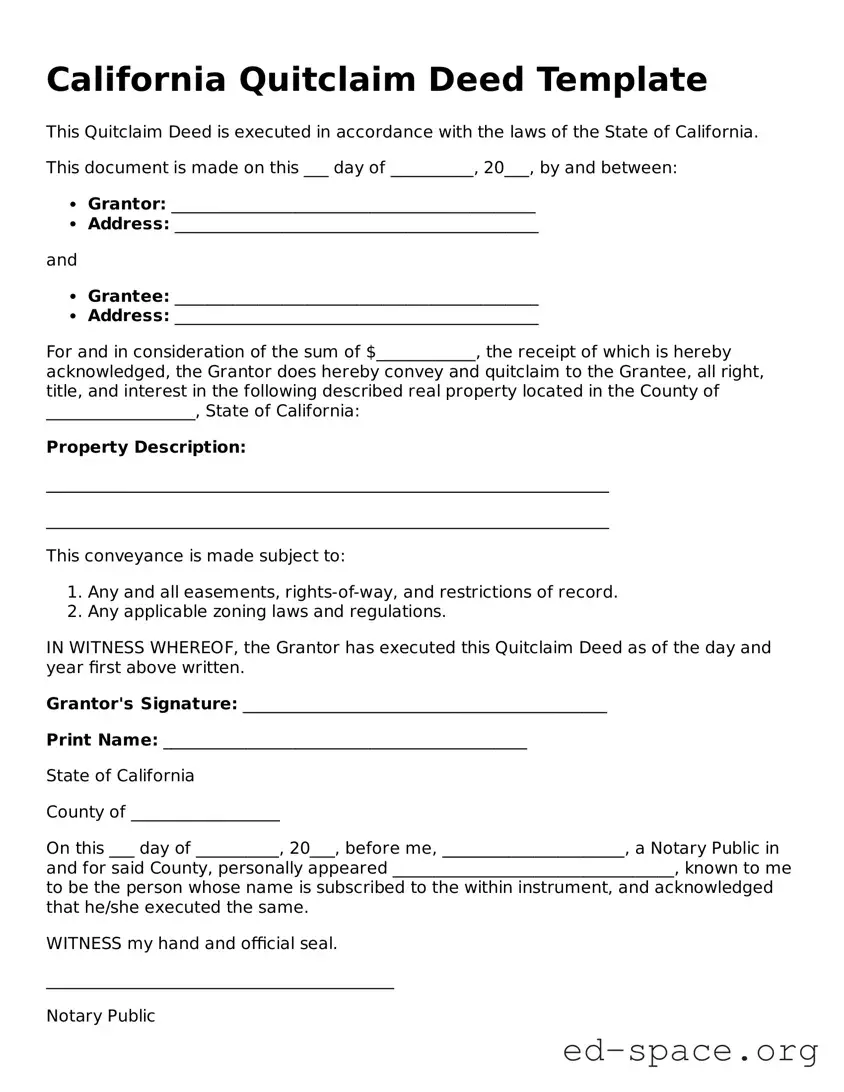
California Quitclaim Deed Template
This Quitclaim Deed is executed in accordance with the laws of the State of California.
This document is made on this ___ day of __________, 20___, by and between:
and
For and in consideration of the sum of $____________, the receipt of which is hereby acknowledged, the Grantor does hereby convey and quitclaim to the Grantee, all right, title, and interest in the following described real property located in the County of __________________, State of California:
Property Description:
____________________________________________________________________
____________________________________________________________________
This conveyance is made subject to:
IN WITNESS WHEREOF, the Grantor has executed this Quitclaim Deed as of the day and year first above written.
Grantor's Signature: ____________________________________________
Print Name: ____________________________________________
State of California
County of __________________
On this ___ day of __________, 20___, before me, ______________________, a Notary Public in and for said County, personally appeared __________________________________, known to me to be the person whose name is subscribed to the within instrument, and acknowledged that he/she executed the same.
WITNESS my hand and official seal.
__________________________________________
Notary Public
My Commission Expires: __________________
| Fact Name | Details |
|---|---|
| Definition | A quitclaim deed is a legal document used to transfer ownership of real property without any warranties or guarantees. |
| Governing Law | The California Quitclaim Deed is governed by California Civil Code Section 1092. |
| Use Cases | Commonly used in transactions between family members, divorce settlements, or to clear up title issues. |
| Warranties | Unlike other types of deeds, a quitclaim deed does not provide any warranties regarding the property title. |
| Filing Requirements | After execution, the deed must be filed with the county recorder’s office to be effective. |
| Signature Requirement | The deed must be signed by the grantor (the person transferring the property). |
| Consideration | While consideration (payment) is not required, it is often included for tax purposes. |
| Effect on Ownership | The quitclaim deed immediately transfers whatever interest the grantor has in the property to the grantee. |
After obtaining the California Quitclaim Deed form, you will need to complete it accurately to ensure it meets the necessary requirements. Follow these steps carefully to fill out the form correctly.
Once the Quitclaim Deed is recorded, it becomes part of the public record. This process officially updates the ownership of the property as specified in the deed.
What is a Quitclaim Deed in California?
A Quitclaim Deed is a legal document used to transfer ownership of real estate from one party to another without making any guarantees about the property title. In California, this form is often used between family members, in divorce settlements, or to clear up title issues. The grantor, or person transferring the property, relinquishes any claim they may have to the property, but does not guarantee that the title is free of defects or liens.
How do I complete a Quitclaim Deed in California?
To complete a Quitclaim Deed, you need to fill out the form with specific information. This includes the names of the grantor and grantee, a legal description of the property, and the date of the transfer. It is essential to ensure that the information is accurate and clear. Once completed, the deed must be signed by the grantor in the presence of a notary public. This notarization adds an extra layer of authenticity to the document.
Do I need to file the Quitclaim Deed with the county?
Yes, after the Quitclaim Deed is signed and notarized, it must be filed with the county recorder’s office where the property is located. Filing the deed is important because it provides public notice of the transfer and updates the official property records. There may be a small fee associated with the filing, so it's advisable to check with the local county recorder for specific requirements and costs.
Are there any tax implications when using a Quitclaim Deed?
Generally, transferring property using a Quitclaim Deed may not trigger immediate tax consequences, especially if the transfer is between family members or as part of a divorce. However, it’s essential to consult with a tax professional or attorney to understand any potential implications, such as property tax reassessment or capital gains tax in the future. Each situation can vary based on individual circumstances.
Can a Quitclaim Deed be revoked?
Once a Quitclaim Deed is executed and recorded, it cannot be revoked simply by the grantor. The transfer is considered final. If the grantor wishes to regain ownership, they would need to execute a new deed transferring the property back to themselves or to a third party. It is crucial to understand that a Quitclaim Deed does not provide any warranties, so if there are issues with the title, the grantee may face challenges.
What are the benefits of using a Quitclaim Deed?
One of the primary benefits of a Quitclaim Deed is its simplicity. It allows for a quick and straightforward transfer of property without the need for extensive legal processes. This can be particularly useful in situations such as family transfers, where the parties involved trust each other. Additionally, a Quitclaim Deed can help clear up title issues by removing claims from individuals who may no longer have an interest in the property.
Incorrect Property Description: One common mistake is failing to provide a precise description of the property. The deed must include not only the address but also the legal description, which can often be found on the previous deed or property tax statement. Without this information, the deed may not be valid.
Not Including the Grantor's and Grantee's Names: It is essential to clearly state the names of both the person transferring the property (the grantor) and the person receiving it (the grantee). Omitting either name can lead to confusion and potential legal issues down the line.
Failure to Sign the Document: A Quitclaim Deed is not valid unless it is signed by the grantor. Some individuals mistakenly believe that the form is complete without a signature, but this is not the case. A signature is a critical component of the document's validity.
Not Having the Document Notarized: In California, a Quitclaim Deed must be notarized to be recorded. Failing to have the deed notarized can prevent the transfer of property from being recognized by the county recorder’s office.
Ignoring Local Recording Requirements: Each county may have specific requirements for recording a Quitclaim Deed. Some individuals overlook these local regulations, which can result in delays or rejection of the deed when submitted for recording.
Not Keeping Copies: After the Quitclaim Deed is completed and submitted, it is crucial to keep copies of the signed and notarized document. Some individuals neglect this step, which can lead to complications in the future if proof of the transfer is needed.
The California Quitclaim Deed is a legal document used to transfer property ownership without any warranties. When completing this process, several other forms and documents may be necessary to ensure a smooth transaction. Below is a list of commonly used documents that often accompany the Quitclaim Deed.
Understanding these additional documents can help facilitate a successful property transfer process in California. It is important to ensure that all necessary forms are completed accurately to avoid complications in the future.
A Quitclaim Deed is a legal document used to transfer ownership of property. It is important to understand its similarities with other documents that serve related purposes. Below are four documents that share characteristics with a Quitclaim Deed:
When completing a California Quitclaim Deed form, it’s essential to follow specific guidelines to ensure the process goes smoothly. Here’s a list of what to do and what to avoid:
By following these guidelines, you can help ensure that your Quitclaim Deed is processed without issues. Always consider seeking professional assistance if you have questions or concerns about the form.
Many people have misunderstandings about the California Quitclaim Deed form. Here are nine common misconceptions and the truths behind them:
Understanding these misconceptions can help ensure that you make informed decisions when dealing with property transfers in California.
When filling out and using the California Quitclaim Deed form, consider the following key takeaways: